
Functional Threshold Power
The essential guide
How to train with power, find your number, set your zones, and watch it go up.
Training with power, explained so it makes sense
Power is the most honest number in cycling. It tells you exactly how hard you are working, and it does not care about the wind, the hill, or how you feel. But the language around it can sound like a secret code. FTP. Zones. Level. Critical power.
This guide takes the code apart. It is what we tell our own athletes, in plain language, in the order that makes sense. If you are brand new to power, start at chapter 1 and read straight through. If you already know your FTP, look for the "For the data nerds" boxes. That is where the deeper science lives.
Chapters
- What FTP is, in plain EnglishOne number that sets how hard every workout should be.3 min
- How to find your FTPThe 20 minute test, why tests go wrong, and how to skip the test.5 min
- How to set your training zonesTurn one number into every effort level.3 min
- Four ways to raise your FTPSweet spot, threshold climbing, flat land work, and VO2 max intervals.5 min
- Level and FTPWhy riding more works, and what to do when it stops working.3 min
- FTP versus critical powerTwo ways to measure the same engine.3 min
- How to keep your number currentWhen to retest, and when you do not have to.3 min
- Your FTP checklistTick it off. Your progress is saved in this browser.2 min
The guide opens with chapter 1 below. Enter your email on that first screen to read all eight chapters, right here on this page. It stays unlocked on this device.
What FTP is, in plain English
One number that tells you how hard to train, and how fast you are getting.
FTP is the hardest steady pace you can hold for about an hour.
FTP stands for Functional Threshold Power. Power is measured in watts, and your bike computer shows it live from your powermeter. Your FTP is the most watts you can keep up, at a steady effort, for roughly an hour.
That one number matters because every workout is built from it. "Ride at 90 percent of your FTP" only works if you know your FTP. Once you do, you stop guessing whether a ride was too easy or too hard.
- It is a number in watts. A rider with a 200 watt FTP and a rider with a 300 watt FTP both have a number. It is not good or bad on its own.
- It is about one hour. Not a sprint, not a short climb. Your steady, can't-quite-keep-going pace.
- It changes. It goes up when you train well and drifts down when you do not.
Unlock the FTP Guide
Enter your email and the whole guide opens right here on this page. No download, no inbox hunt.
- What FTP is and why it matters
- How to find yours, even without a test
- Your training zones, set in minutes
- Four workouts that raise your number
- A checklist that saves your progress
You will also get our free Tuesday training tips. One email a week, unsubscribe any time. We never share your address.


The higher your FTP, the bigger your sponge.
Dr. Andrew Coggan, the scientist who helped make FTP famous, called it "the single greatest determinant of cycling performance." Long climbs, solo breakaways, and time trials all lean on it directly.
Think of FTP as a sponge. The bigger it is, the more hard efforts you can soak up. Every time the group surges, it costs the rider with the higher FTP less. That rider still has energy left for the big move or the sprint at the end.
- For climbing: your FTP sets how fast you can go up a long hill.
- For racing and group rides: it decides how many surges you can answer.
- For sprinting: a bigger sponge means you arrive at the finish with more left.
For the data nerdsWhere the definition comes from
Coggan defines FTP as the highest power a rider can maintain in a quasi steady state without fatiguing. In practice it is the best you can do for roughly an hour, and it sits near the boundary between a sustainable effort and an unsustainable one. The classic paper behind the "greatest determinant" line is Coyle, Coggan, Hopper and Walters, "Determinants of endurance in well-trained cyclists," Journal of Applied Physiology, 1988.
One number sets all your zones.
Once you know your FTP, a handful of simple percentages turn it into training zones. Easy rides, sweet spot, threshold, and hard intervals each get a watt range. You will set yours in chapter 3.
- Know the number, and every workout has a target.
- Retest or re-measure, and you can see your fitness in black and white.
- Skip the guessing about whether a ride counted.
The words you will see in this guide
Six terms. Once you know these, the rest is easy.
| Term | What it means | Where it shows up |
|---|---|---|
| FTP | The most power you can hold, steadily, for about an hour | Chapter 1 |
| Watts | The unit power is measured in | Throughout |
| Training zones | Power ranges, set from your FTP, for easy through hard riding | Chapter 3 |
| Sweet spot | Medium hard riding at 84 to 97 percent of your FTP | Chapter 4 |
| Level | CoachCat's daily measure of how much you have been training | Chapter 5 |
| Critical power | Your best power at every length of effort, drawn as a curve | Chapter 6 |
How to find your FTP
Test it, track it, or let CoachCat find it from the rides you already did.
The 20 minute test is simple, and it works.
Ride as hard as you can for exactly 20 minutes. Write down your average power. Then take about 5 percent off. That is your FTP.
For example, if you average 224 watts, your FTP is about 213 watts.
- Warm up for 20 to 30 minutes. Start easy and build to a steady endurance effort.
- Pick uninterrupted road. A steady 2 to 3 percent climb with no stops is ideal. A flat stretch you can ride again works too.
- Go as hard as you can for 20 minutes. Pace it. Starting too hard and fading is the most common mistake.
For the data nerdsWhy "about 5 percent"?
The 5 percent rule is a convention, and it is not perfect for everyone. Our full 20 minute test post uses 5 percent for slow twitch, aerobic riders, 10 percent for riders with a big anaerobic engine such as sprinters and criterium racers, and 7.5 percent if you do not know which you are. Studies that compare 95 percent of 20 minutes against a true 60 minute effort find small differences on average and large ones between individual riders. Exhibit 2 shows why.
Every test needs the one thing that is hard to do.
An FTP test asks you to go as hard as you possibly can, on purpose, and it hurts. So riders put it off. It is cold, it is windy, they will do it next week. And when they do test, pacing mistakes, a bad night of sleep, or a tough day can make the number wrong by enough to set every zone too high or too low for the next eight weeks.
- Test rarely and your FTP is months out of date.
- Test badly and your zones are off.
- Skip it entirely and you ride on a guess.
Find your FTP without a test.
The CoachCat FTP Tracker finds your FTP from rides you have already done. No test needed. It analyzes your power, your heart rate, and your Level, then tells you how confident it is in the number. Hard efforts still make it more accurate, but you do not have to manufacture one on a Tuesday to know where you stand.
- It uses every ride, not one test on one day.
- It uses your heart rate to tell a maximal effort from one that just felt hard.
- It shows a confidence score, and tells you when one hard effort would raise it.
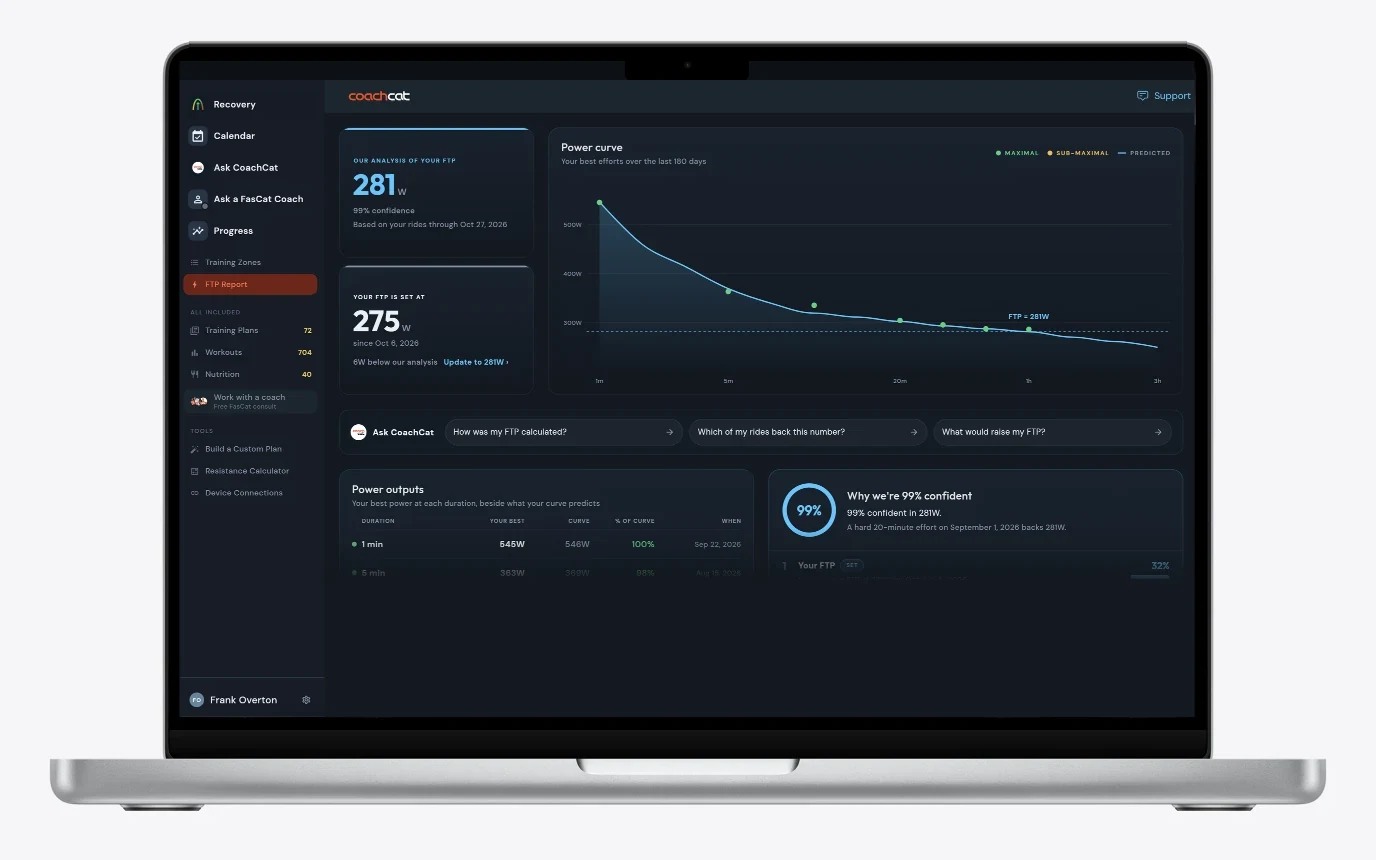
Every way to find your FTP, side by side
Pick the one that fits your life. They all lead to the same place: a number you can train with.
| Method | What it takes | What can go wrong | Best for |
|---|---|---|---|
| 20 minute test | One all out 20 minutes, then subtract about 5 percent | Poor pacing, or a multiplier that is off for your body type | Riders who like a clear benchmark |
| Ramp test | Ride to failure on a rising ladder | Notorious for overestimating FTP | Quick checks on the trainer |
| 8 minute test | Two maximal 8 minute efforts | Easy to leave something in the tank on the second one | Riders short on time |
| Full hour | One maximal 60 minutes | Almost nobody does one outside a race | Time trial specialists |
| CoachCat FTP Tracker | A few weeks of rides, ideally with a heart rate strap | Incomplete data set | Everyone, especially riders who dread testing |
For the data nerdsFrank's three testing rules
Frank's testing philosophy comes down to three things: testing must be repeatable, it should be simple to do, and it should match the demands of the racing you are training for. That is why we still like the 20 minute test, and why we built the Tracker to use real world efforts instead of a lab.
When testing, if you give the test your best effort from start to finish, you did it right.Jake Rytlewski FasCat coach, former pro road racer, 6th at US Pro criterium championships
How to set your training zones
One number turns into every effort level you need.
Zones are just percentages of your FTP.
Each zone is a range of watts. Zone 1 is very easy. Higher zones get harder and shorter. Your FTP number tells your bike computer, or your CoachCat plan, exactly which watts belong in which zone.
- Enter your FTP once and every zone is calculated.
- Ride by the zone, not by feel alone.
- Update when your FTP changes, and every zone moves with it.
An FTP of 213 watts gives a sweet spot of about 179 to 207 watts.
Sweet spot is 84 to 97 percent of your FTP. It is the zone where you get the most fitness for the least strain. For a 213 watt FTP, that is about 179 to 207 watts. You will use that zone a lot in chapter 4.
- Multiply your FTP by 0.84 for the bottom of sweet spot.
- Multiply it by 0.97 for the top.
- Or let CoachCat do it. Go to Profile, then Training Zones, enter your FTP, and every zone fills in.
The zone ladder
From easiest to hardest, and what each one feels like.
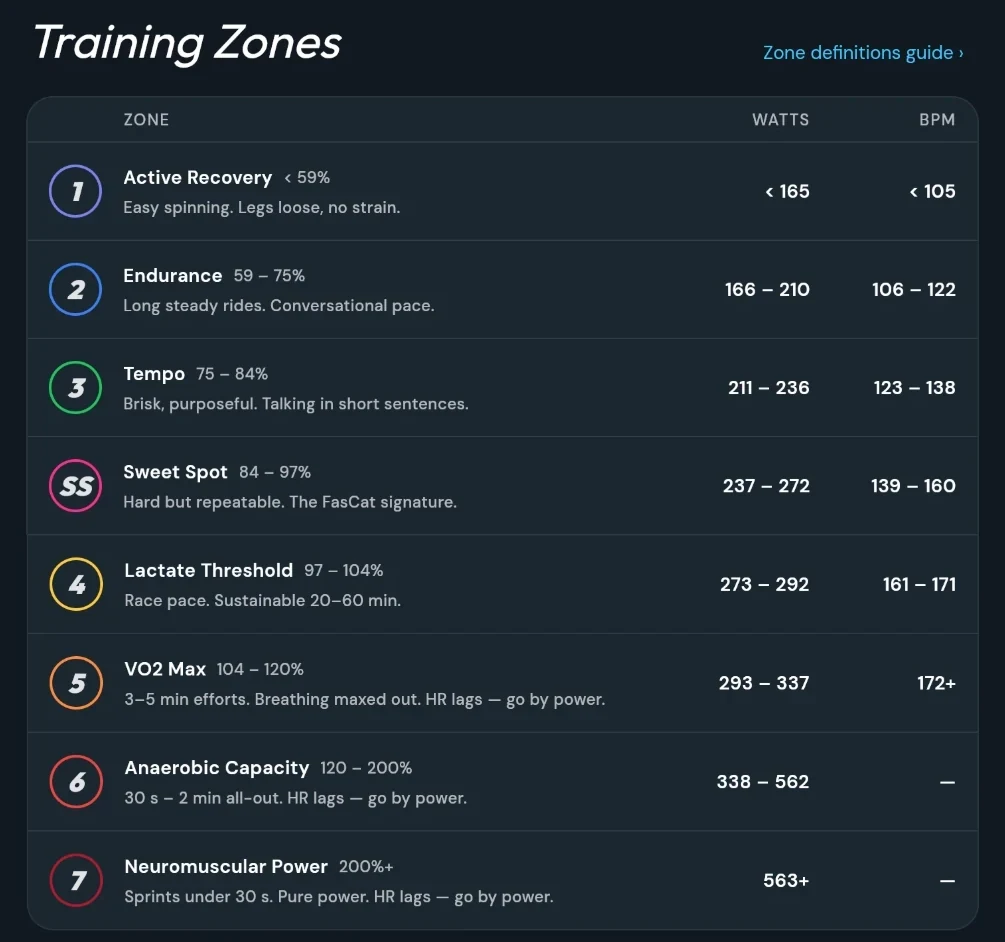
Most riders go too hard on their easy days and not hard enough on their hard days. Your zones fix that. Ride the zone the workout asks for, and every ride does its job.Ricky Arnopol FasCat coach, former pro, yellow jersey at Redlands and the Tour of the Gila
Four ways to raise your FTP
Sweet spot, threshold climbing, flat land work, and VO2 max intervals. All four, in the right amounts.
Sweet spot builds your aerobic engine.
Riding at 84 to 97 percent of your FTP improves the steady, aerobic effort that defines FTP. You get a lot of benefit without the toll of riding right at threshold. That is why it is called the sweet spot: a balance of intensity and volume.
- Find uninterrupted road. A steady 3 to 5 percent hill works very well, or use the trainer.
- Hold steady power. Do not start hard and fade.
- It is repeatable. It takes less out of you, so you can do it more often.
- Track time in your sweet spot zone. The minutes add up, and that total is what moves your FTP.
Threshold climbing is the hard work.
To get better on long climbs, ride at 98 to 104 percent of your FTP, zone 4, on a sustained climb. For efforts under 12 minutes, go a little harder, 100 to 108 percent. Do these on days when you are fresh. Keep the total time at threshold under 60 minutes in a session.
- Start with 3 × 10 minutes at 100 to 108 percent, with 10 minutes of easy spinning between.
- Build to 3 × 15 minutes at 98 to 104 percent, with 8 minutes easy between.
- The gold standard is 2 × 20 minutes at 98 to 104 percent, with 10 minutes easy between.
For the data nerdsThe durability workout
Instead of doing threshold efforts as a set, spread them through a long ride. For example, do 3 × 15 minute efforts during a 5 hour ride, at 1 hour, 2.5 hours, and 4 hours in. The goal is to hit the third effort at the same power as the first.
Do not only train on climbs.
It is easy to get very good at hitting your numbers on a steep hill and then struggle on the flats. To fix this, do the same threshold work on flat roads at 95 or more rpm. If the terrain allows, do one of your three efforts on a flat road and two on a climb. Flat work is also good time on the time trial bike.
- Same workouts, different terrain.
- Keep cadence at 95 rpm or higher on the flats.
- Mix it: one flat effort, two climbing efforts.
VO2 max intervals raise the ceiling.
Your FTP lives under your VO2 max, the most oxygen your body can use in a minute. Raise that ceiling and your FTP has room to follow. These are 3 to 5 minute efforts at 105 to 120 percent of your FTP, zone 5. They are the hardest work in this guide, so do them fresh.
- Start with an age and ability appropriate number of VO2s, per this training tip.
- Build to 5 × 5 minutes, with 5 minutes easy between.
- Pace for the set. The last interval should be as strong as the first.
- Keep the block short. Three to four weeks of VO2 work.
For the data nerdsWhere VO2 max fits
Power at VO2 max is roughly the best you can hold for about 5 minutes, and FTP sits at about 75 to 85 percent of it. Once sweet spot and threshold work have pushed your FTP close to that ceiling, the ceiling itself has to move. That is why chapter 5 switches from base to intervals for the last 10 to 25 percent.
Four ways, on one page
| Way | Effort | Starting workout | What it builds |
|---|---|---|---|
| Sweet spot | 84 to 97% of FTP | Steady efforts on a 3 to 5% hill or the trainer | Aerobic engine, repeatable work |
| Threshold climbing | 98 to 104% of FTP, 100 to 108% under 12 min | 3 × 10 min, 10 min easy between | Strength on long climbs |
| Flat land FTP work | 98 to 104% of FTP at 95+ rpm | One of your three efforts on the flat | FTP that holds up off the climbs |
| VO2 max intervals | 105 to 120% of FTP | 5 × 3 min, 3 min easy between | The ceiling your FTP sits under |
Once you have trained for a while, review your files. Look at your best 20 minute power from hard rides and races, and retest or re-measure your FTP a few months after your first number. Update your zones when it goes up.
Want a plan that puts these together? See 16 Weeks of Sweet Spot.
For the data nerdsWhy sweet spot works
Training effect peaks just above sweet spot. Strain climbs steeply as you go harder, and the time you can hold the effort falls. Sweet spot, 84 to 97 percent of FTP, is where you get the most training effect for the strain it costs. That is why it is the backbone of a base.
Redrawn from the original sweet spot chart, 2005. More in chapter 3 of the Winter Training Guide.
Level and FTP
Why riding more works, and what to do when it stops working.
The more you ride, the faster you get. Up to a point.
Level is CoachCat's daily measure of how much you have been training. It is also called training load. It rises when you ride more and falls when you ride less. There is a clear link between your Level and your FTP.
- Here is a real example. One athlete raised his Level from 33 to 64 over about three months.
- His FTP went from 260 to 284 watts, on CoachCat's 16 weeks of sweet spot plan.
- Riding more worked. Until it did not, which is the next idea.
Base gets you most of the way. Intervals get you the rest.
A full base of sweet spot training can take your FTP to about 75 to 90 percent of its true potential. The last 10 to 25 percent comes from switching to higher intensity, lower volume work. That is where the link between Level and FTP "breaks." Your Level may hold steady, but your power keeps going up.
- Build base first, and let your Level climb.
- Then switch from base to race: lower volume, higher intensity.
- Power still rises because you are fresher for hard sessions and your body has adapted.
Read how to switch from base to race.
For the data nerdsWhy power keeps rising when Level does not
Two things happen. First, the athlete is fresher and more recovered, so they can produce more power in hard sessions. Second, the athlete has built combined aerobic adaptations, mainly higher mitochondrial density and greater cardiac output. A combined pyramidal then polarized structure has been shown to work better than pyramidal or polarized training alone.
References: Filipas L, Bonato M, Gallo G, Codella R. Effects of 16 weeks of pyramidal and polarized training intensity distributions in well-trained endurance runners. Scand J Med Sci Sports. 2022;32(3):498-511. Bishop DJ, Granata C, Eynon N. Can we optimise the exercise training prescription to maximise improvements in mitochondria function and content? Biochim Biophys Acta. 2014;1840(4):1266-75.
Your season at a glance
Focus on raising your Level during base. Then switch to high intensity intervals to raise your FTP the last 10 to 25 percent.
- Sweet spot base, 8 to 16 weeks, pyramidal: Level and FTP climb together. A recovery week dips Level without costing fitness.
- Intervals, race and recover, polarized: Level holds and FTP keeps rising.
Read the full post: Level and FTP.
FTP versus critical power
Two ways to measure the same engine. You do not need this to train, but it helps you understand your number.
FTP is one number. Critical power is a curve.
FTP is the most power you can hold for about an hour. Critical power is a curve built from your best efforts at many lengths, such as 1 minute, 5 minutes, 12 minutes, 20 minutes and 60 minutes. From that curve you can predict what you can hold for any length of time, including an hour.
- FTP is simple and great for setting training zones.
- Critical power is more precise for specific efforts, like an 18 minute hill climb or a Strava segment.
- We use both.

When you have good data, CP and FTP are aligned and they are the same.Allie Legg FasCat coach, six years as a World Tour pro, raced two World Championships
The curve is only as good as the efforts behind it.
The curve only works if the efforts you feed it are truly maximal. A "pretty hard" effort makes the curve too low. That is the big caveat, and it is where most of the debate comes from.
- Use maximal efforts only. A race, a hill climb, or an all out Strava segment all count.
- Use recent efforts. Do not mix last year's best minute with last week's 20 minute test.
- Cover short and long: at least one effort from 30 seconds to 5 minutes, and one from 8 to 30 minutes.
Most riders' power files are full of hard efforts and nearly empty of truly maximal ones. The curve cannot tell the difference on its own. That is the whole problem in one sentence.Frank Overton FasCat founder, former Cat 1 racer, invented sweet spot training in 2005
For the data nerdsFrank's rolling 6 week window
Frank avoids full critical power testing because it takes rest and time away from training. Instead, he pulls maximal efforts from an athlete's existing files. A rolling 6 week window is his rule of thumb for fitness that is current enough to trust. The gold standard test for FTP is a 40k time trial.
FTP and critical power, side by side
| FTP | Critical power | |
|---|---|---|
| What it is | The most power you can hold for about an hour | A curve of your best power at every duration |
| How you get it | A 20 minute test, a 40k time trial, or the CoachCat FTP Tracker | Maximal efforts from rides, races, and tests |
| Best for | Setting training zones and measuring improvement | Predicting a specific effort |
| Main risk | A multiplier that is off for your body type | Missing or sub maximal data points |
Read the full post: FTP versus Critical Power.
How to keep your number current
When to retest, and when you do not have to.
Test at the start of a block, and monitor FTP with our new FTP Tracker.
One test at the start of a training block sets your zones. After that you do not have to test again to know whether the training worked. Every hard group ride, race, and workout you upload to CoachCat is data, and the FTP Tracker analyzes those efforts to update your FTP as you go. If your number went up, keep going. If not, something needs to change.
- Same road, same conditions. Use the same power meter, the same warm up, and the same kit.
- Compare like with like. Indoor power runs a little lower than outdoor. Never mix the two.
- Log it. Write down the conditions and how you felt.
- Let your hard rides do the testing. A full gas group ride, a race, or a maximal workout updates your FTP in the Tracker. No formal retest needed.
For the data nerdsA 9 month testing calendar
Frank's classic season: a 20 minute field test in November to set zones, group ride season through the winter (a hard group ride can count as a test if you go full gas), another field test in February or March to measure improvement, then race data from April to August. Group ride and race data can confirm three things: your FTP is set right, it has gone up, or it has gone down.
Let the FTP Tracker keep watch.
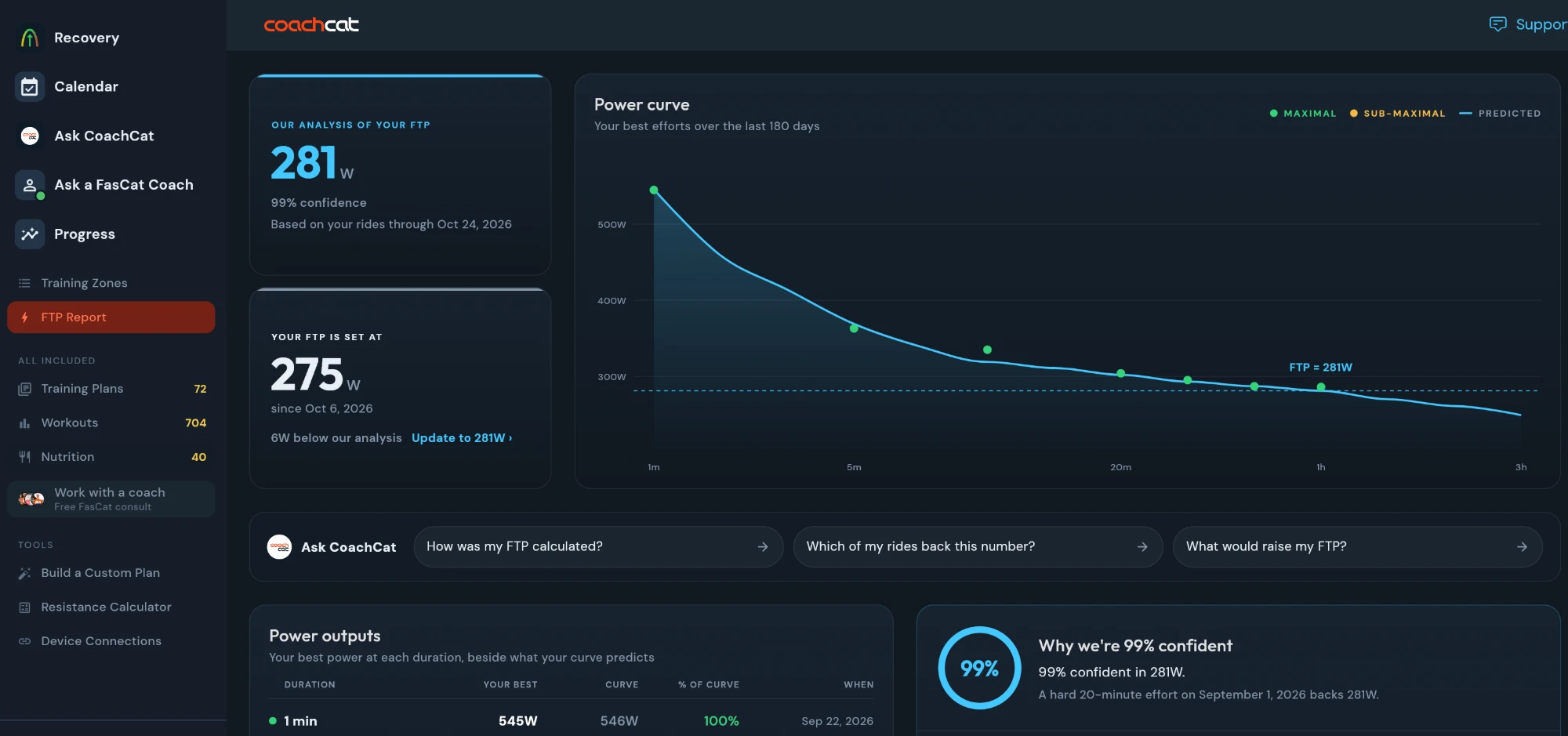
Open the FTP Tracker in CoachCat and you see two numbers side by side: the FTP our analysis found from your rides, and the FTP currently set in your profile. If they match, your zones are right. If they do not, update from the Tracker in one tap and every workout on your calendar recalculates.
- Every number has a confidence score. For example, "83 percent confident in 260 watts."
- It tells you what would help. Usually one hard 20 minute effort would raise it.
- A new maximal effort always wins. Your next hard effort resets the number to what you actually did.
A true maximal effort still raises your degree of confidence, and the Tracker will tell you when one is overdue. The difference is that you no longer have to manufacture one on a Tuesday in order to know where you stand.Frank Overton FasCat founder, former Cat 1 racer, invented sweet spot training in 2005
For the data nerdsHow the Tracker thinks
Four things, each with a job.
- Every duration counts, from 1 to 60 minutes and the whole power curve, so no single test carries the number.
- Heart rate decides how much each effort is trusted: near threshold means maximal and builds the curve, well below threshold means sub maximal and sets a floor.
- Power at a given heart rate catches a faulty power meter, which would otherwise look like a breakthrough.
- Level compares your training now with when your best efforts were set, so the number reflects today and not July.
Level moves the number slowly on purpose, so a rest week or a taper does not cause a cliff.
When to test, and when not to
| Situation | What to do |
|---|---|
| New power meter or starting a program | Do a baseline test, or let the Tracker learn from a few weeks of rides |
| On a CoachCat training plan | Test when the plan says to. 16 Weeks of Sweet Spot schedules its own tests, and the Tracker keeps watch in between |
| In season with races on the calendar | Use race and hard group ride data. Skip formal tests |
| Number in your profile and number in the Tracker disagree | Update from the Tracker |
| Power meter reads oddly high at the same heart rate | Check the meter. The Tracker will flag it |
Your FTP checklist
Everything in this guide, as things you can tick off. Saved on this device.
Your FTP checklist
Tick the box when it is done. Your progress is saved in this browser.
Know your number
Set your zones
Raise your number
Build the base, then sharpen
Keep it current
Go deeper
Now go find your number.
That is the whole guide. Know your FTP, set your zones, train the right way, and keep your number current. Do that and every ride starts to mean something.
The easiest way to follow this guide Start your free week of CoachCat CoachCat finds your FTP from your rides, sets your zones, and builds your plan. 7 days free, no credit card. Start freeKnow a rider who needs to understand FTP?
© 2026 FasCat Coaching. All rights reserved.