

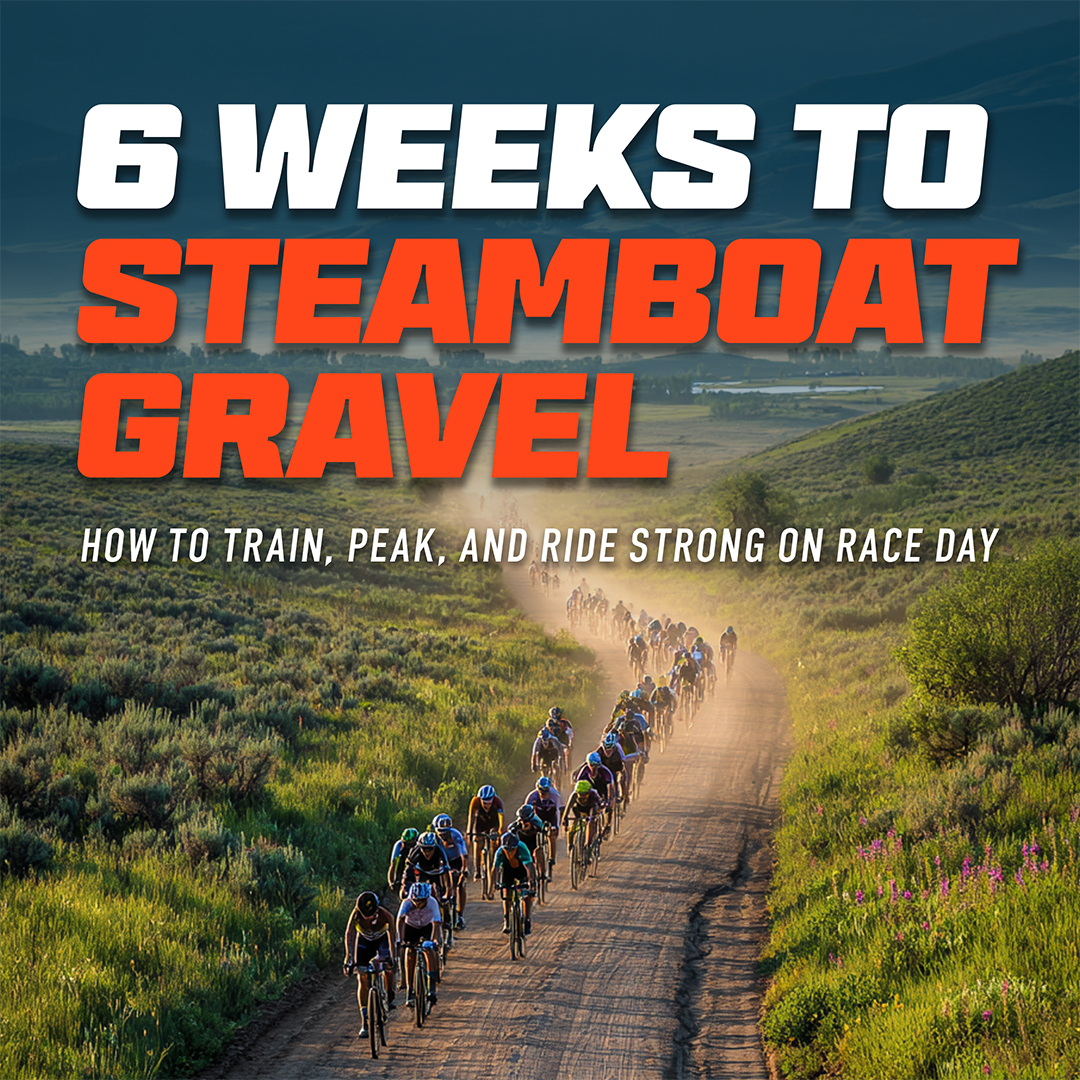
Welcome to FasCat's complete Steamboat Gravel guide — every piece of coaching, course intel, power data, and race-day strategy we've developed for Steamboat Gravel in one place. Below you'll find the course breakdown, winners' power files, fueling math, gear list, race-day tactics, and our six-week Steamboat Gravel Training Plan — included with the CoachCat App.
What is Steamboat Gravel?
Steamboat Gravel launched in 2019 as the first professional-distance gravel race on the U.S. calendar, with a 144-mile course out of Steamboat Springs, Colorado. It runs four distances (Black at ~144 miles, Blue at ~100, plus shorter Red and Green options) across roughly 3,000 slots that sell out in under ten minutes. It's a long day of dirt roads, the occasional stretch of singletrack, fast pack dynamics on the rolling sections, and a temperature swing that catches almost everyone off guard.
Bottom line: Steamboat Gravel is endurance-first, intensity-second. If you can't ride for 6–10 hours and still pedal at threshold on a climb, you can't race Steamboat Gravel well — no matter how good your 20-minute power is.
Watch: Race-Day Coaching Advice for Steamboat Gravel
Before we go deep on the training, watch our coaching breakdown of the right and wrong way to ride Steamboat Gravel — pacing, positioning, and the mistakes we see athletes make every single year. This video already ranks at the top of Google results for "Steamboat Gravel training":
The Steamboat Gravel Course: Where the Race is Won & Lost
The course changes year to year, but the selection points are remarkably consistent. Here are the four sections that decide your day.
Cow Creek & Fly Gulch Early Selector
The first major punch comes within the first 30–40 miles. Riders go too hard here every single year — the fast initial pace feels comfortable because everyone's fresh and adrenaline is high. The riders who win Steamboat Gravel hold back here and let the over-pacers come back to them.
Steamboat Lake Climb Decisive Moment
This is where the front group gets cut in half. In Ben Delaney's winning Blue Course ride, the Lake climb required 356 W normalized for 11.5 minutes (4.4 W/kg), with a 5-min peak of 375 W (4.7 W/kg). If you can't hold an effort like that on a climb three hours into a hot day, you're racing for second.
Trout Creek & The Long Grinder The Mental Test
After the Lake climb comes a long, gradual, deceptive grinder where you're already cooked but still have hours to ride. Pack dynamics matter enormously. Riding solo is sometimes faster than a slow group, but it's brutal mentally — our six-week plan rehearses this exact feeling.
Corkscrew & The Heat Wall Where Most Time Is Lost
The final 25–30 miles into the Corkscrew climb is where most finishers actually lose time — not on the climbs themselves, but to the heat. By mile 128 it can be 100°F. Most people don't lose Steamboat Gravel on watts. They lose it on calories, salt, and core temperature.
How to Train for Steamboat Gravel
Good Steamboat Gravel training is built in two phases.
Phase 1 — Build Your Aerobic Base (Ideally Starting Earlier in the Season)
The best Steamboat Gravel performances are built on a strong aerobic foundation. Ideally, that process starts earlier in the year with consistent Sweet Spot, Tempo, endurance, and long ride work that gradually builds durability for a long day in the saddle.
FasCat's 16 Weeks of Sweet Spot plan is our preferred way to build that foundation because it develops the aerobic engine, durability, and repeatability needed for Steamboat Gravel without burying you in excessive intensity.
But here's the important part:
If you did not start training in January, that does not mean you cannot have a great Steamboat Gravel.
Many athletes arrive at Steamboat with limited preparation time, and that is exactly why our six-week Steamboat Gravel Training Plan exists. The race-specific block is designed to help you maximize the fitness you already have and prepare specifically for the demands of Steamboat Gravel.
Consistency still matters more than perfection.
Phase 2 — The 6-Week Steamboat Gravel Training Plan
About six weeks before race day, transition to our race-specific block. Built specifically for Steamboat Gravel, it focuses on the things that matter most late in your preparation:
- Weekend simulation rides on varied terrain that match the demands of the course — long, hot, dirt, with intentional pacing practice.
- Mid-week Advanced Endurance Tuesday through Thursday — shorter sharpening intervals including the SBTG Ramps workout: 2 × 10 minutes at progressively rising intensity.
- A taper week in the final seven days that drops volume while keeping your legs sharp.
- Equipment, fueling, and pacing rehearsals baked into every long ride so there are no surprises on race day.
Whether you have been building since winter or are dialing things in during the final six weeks, the goal stays the same: arrive in Steamboat fit, fresh, fueled, and ready to ride strong.


The plan in the CoachCat App: weekly calendar, workout detail, and the SBTG Ramps interval session.
Steamboat Gravel Power & Pacing: What the Winners' Files Show
FasCat has analyzed power files from multiple Steamboat Gravel finishers, including Ben Delaney's winning ride on the Blue (100-mile) course. Here's what a top-tier Steamboat Gravel ride looks like by the numbers:
| Metric | Winning Blue (Delaney) |
|---|---|
| Total time | 4:48:03 |
| Average speed | 20.8 mph |
| Normalized power | 272 W |
| Power-to-weight | 3.33 W/kg |
| Intensity Factor | 0.83 |
| TSS | 326 |
| Steamboat Lake climb (11.5 min) | 356 W (4.4 W/kg) |
| 5-minute peak | 375 W (4.7 W/kg) |
| Final sprint (9 sec) | 1,138 W (peak 1,203 W) |
| Total feed-zone time | ~4 minutes |
For most age-group athletes targeting a strong sub-9-hour Black Course finish, our coaches see normalized power in the 3.0–3.5 W/kg range with similar 0.78–0.82 Intensity Factors. The pattern holds: most of the watts are spent on a few key climbs; the rest of the day is endurance and survival.
Watch: Full Power-File Breakdown
Coach Frank walks through a winner's power file from start to finish — pacing pattern, fade prevention, and how the decisive efforts stack up against everyday FTP work:
Steamboat Gravel Fueling Strategy
Nutrition wins or loses Steamboat Gravel for more athletes than fitness does. Here's the FasCat playbook:
- Carbs: 75–100g per hour for most riders. Many female athletes do better at 50–75g/hour. Race-pace days are not the time to be in a calorie deficit — your body needs fuel and your gut needs to be trained to absorb it.
- What that looks like: Ben Delaney took 8–10 gels and several packs of energy chews across his 4:48 winning ride, with feed-zone stops totaling about four minutes for the entire race.
- Hydration: Pre-hydrate the day before. Sodium matters — bring salt pills if you're a heavy or salty sweater. The midday heat will dehydrate you faster than you think possible.
- Heat strategy: Ice in your jersey at the long aid stations. Pour water on your arm warmers, jersey, and helmet. Cooling is calories saved.
- Practice it: Every fueling and hydration choice on race day must have been tested in a long simulation ride first. New gel flavor on race morning is how you DNF.
Gear & Equipment for Steamboat Gravel
- Tires: 35–45mm semi-slick gravel tires. Don't run sticky XC compounds — the dirt roads are fast.
- Bottles vs. hydration pack: Either works for the Blue. Most Black Course finishers use a hydration pack plus 2 bottles. Your pack should be reachable from the saddle without slowing down.
- Layers: Arm warmers and a light vest at the start; ditch them at the first aid station. Sunscreen and sunglasses are non-negotiable above 7,000 feet.
- Bike fit and shorts: Whatever your most comfortable pair of bibs is — wear that. Fresh chamois cream. Test it on a 6+ hour ride first.
Race-Day Strategy: Let the Race Come to You
The single most useful piece of pacing advice for Steamboat Gravel is to let the race come to you. Don't chase early surges. Don't bury yourself on Fly Gulch trying to stay with riders you have no business riding with. Sag-climb if you need to. The riders who win Steamboat Gravel are the ones who are still strong at mile 100 — not the ones who looked great at mile 30.
The Bottom Line
Steamboat Gravel rewards athletes who train the right things in the right order: a big aerobic base first, then a focused six-week race-specific block, then disciplined pacing and fueling on race day. Get those three things right and a strong Steamboat Gravel finish is well within reach.


