

Now that the weather is warmer and the days are longer, it's time to break the habit of doing structured intervals day after day indoors. That said, here are 8 ways to help you make better training decisions about when to ride indoors versus outdoors this Spring and Summer.
1. By spring, you're cooked. Get outside.
Most riders we coach have done their indoor time by April. They've ground through winter intervals, watched enough Zwift loops to know every turn, and they're mentally fried. That fatigue is real, and it shows up in the data: power that should feel routine starts feeling like a slog.
Part of that is mental. Part of it is physical. Indoor riding genuinely does feel harder than outdoor riding at the same watts, and a big reason is low rolling inertia. On the road, your bike, your body, and your momentum are all working with you. The flywheel on your trainer doesn't replicate that. Every pedal stroke does a little more work than it would outside, which is why indoor watts can feel worse.
So when the days get longer and the roads dry out, don't manufacture reasons to stay inside. Get out, get the sun and wind in your face, and remember why you ride.
2. You have one FTP. Period.
There's no such thing as an indoor FTP and an outdoor FTP. Your physiology has one FTP: one threshold, one engine.
What riders are actually compensating for when they "lower their indoor FTP" is the difficulty of producing power on a trainer: the cooling, the static bike, the rolling inertia issue above, the head game of staring at a screen. None of that means your threshold dropped. It means the environment is harder.
Don't lower your FTP to make the trainer feel friendlier. The better answer is to fix what you can fix indoors (cooling, setup, mental engagement) and get outside more, where you can actually express the fitness you have.
3. Outdoor power is stochastic — and that's a feature, not a bug
ERG mode produces clean lines on a graph. Real-world riding doesn't, and shouldn't.
Outdoor power is stochastic — it bounces. Terrain changes, wind shifts, you stand to roll over a kicker, you soft-pedal through a corner. That's how you learn to ride fast over undulating terrain.
This is why we prescribe intervals in ranges, not single target wattages. If your sweet spot range is 250–270 watts and your power blips up to 285 for a couple of seconds rolling over a small rise, that's fine. If it dips to 240 on a downhill, that's fine too. What you want to avoid is prolonged periods above or below the prescribed range, that's when the session stops doing what it was designed to do.
Stop chasing the perfect power file. Chase the right physiological stress.
4. Adapt your training style to the road
Some workouts were designed for the trainer and only really work there. Criss-cross intervals, over-unders, and any session that demands you snap precisely between two power targets every 30 or 60 seconds — those rely on ERG mode and a controlled environment. Try executing a clean over-under on a rolling road with stoplights and traffic, and you'll either get frustrated or get flattened.
The fix isn't to stay inside to keep doing them. The fix is to adapt your workout style to outdoor riding. Lean into longer, more sustained intervals — efforts that don't require constant power-snapping and that actually benefit from real terrain underneath you.
A favorite of ours is the AmEx workout — a session built specifically for outside, where real climbs and real terrain do work that no trainer can replicate. Watch the video for the full breakdown.
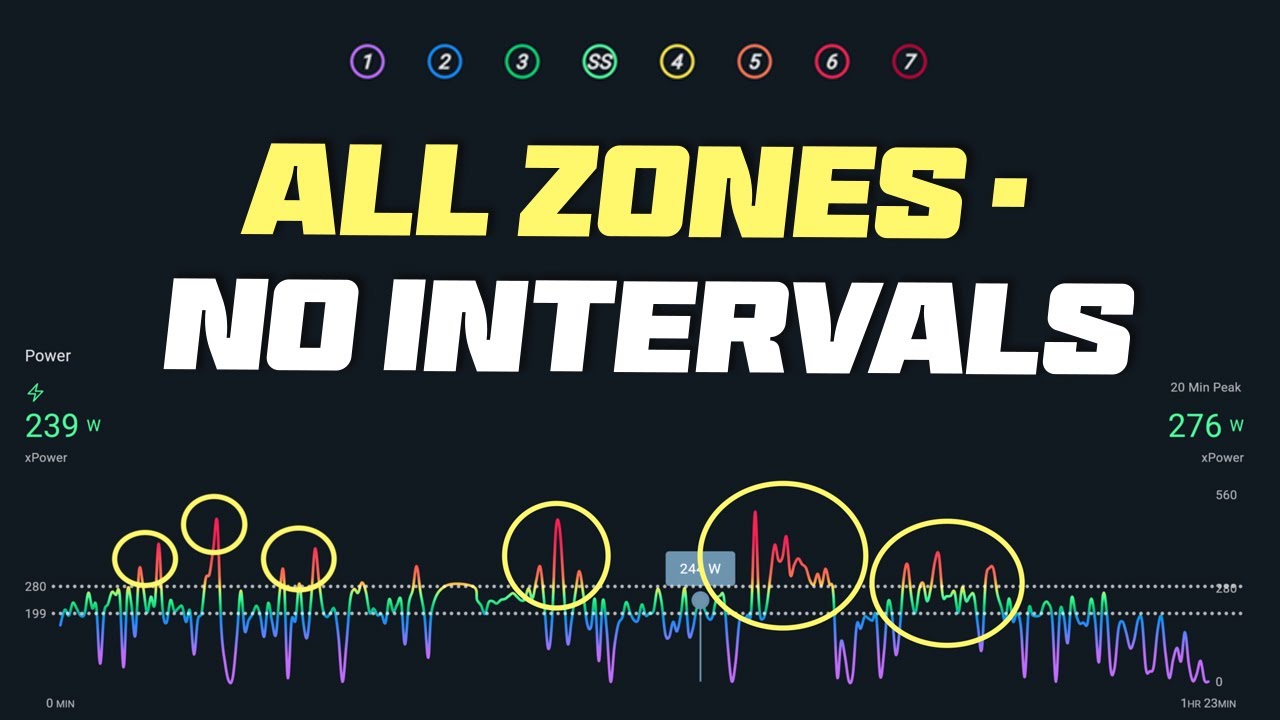
Spring training should look different than winter training. Trade trainer precision for road sustained, and you'll get more out of both.
5. When indoor does win: time, terrain, weather
We're not anti-trainer. There are times indoors is the right call, and they come down to three things: how much time you have, what your terrain looks like, and what the weather's doing.
If it takes you 50 minutes to ride to a good road for VO2 intervals and you've only got an hour, do some mack daddy VO2 intervals indoors and call it a win. The same goes for a Tuesday when you have a long day at work plus kids soccer practice. Indoors is a precision tool: use it when precision is what the day requires.
But here's the habit we want you to break: the default to indoors because it's easy to knock out an hour after work. That convenience is exactly what's capping your training. Outside, you're good for 10–20 more watts on intervals. That's not a small thing — that's more physiological adaptation, more training stress, more progression. The "easy" indoor hour is often the less productive hour.
6. Group rides and skills — get outside or stay slow
If you're a bike racer, or you just want to hang on the Saturday group ride, you have to be outside.
No skills are being learned indoors. ;-)
Drafting, positioning, holding a wheel, picking lines through corners, knowing when to go hard and when to go harder, when to hide and conserve, when to attack — none of that is happening on Zwift. You can have a 4 W/kg engine and still get spit out the back of a B-group ride if you can't sit in. Fitness is half the job. The other half is craft, and craft only gets built in traffic with other riders, on real roads.
7. Two ways athletes do this well
We have two flavors of athletes who get this right.
The first group doesn't ride indoors at all from April through October. They take the long days and use them — endurance on weekends, intervals after work in daylight, recovery spins on the bike paths. The trainer goes back in the basement and stays there until the clocks change.
The second group lives in a city, has a demanding work week, and uses the trainer surgically — two or three focused indoor workouts during the work week (intervals, sweet spot, VO2), then long outdoor rides solo or with the group on the weekend. They're not fighting traffic on a Tuesday at 6pm. They're getting their quality work done and saving the volume and skills for when they have time.
Both work. The common thread is that outdoors is doing the heavy lifting on volume, endurance, and skills, and indoors is being used with intent — not as a default.
8. The big one: time on the bike is your biggest lever — so do it outside
Here's the point we most want you to take away.
The single biggest driver of cycling fitness isn't your interval prescription, your threshold work, or your VO2 max sessions. It's time on the bike. Riding longer is the most powerful lever you have, and most riders aren't pulling it hard enough.
Outside is where you actually pull it. The trainer rewards short, dense sessions. The road rewards time. Three hours outside can pass before you've thought about checking your watch — the terrain, the scenery, and the rhythm of moving through real space all make long aerobic work sustainable, which is the whole point. You can't compress that into a 90-minute trainer session no matter how badly you want to.
If you're stuck in an indoor habit, you're almost certainly riding less than you could be. Run the math on your own week:
- Bump your normal 1-hour indoor weekday ride to a 1.5-hour outdoor ride when you can.
- Stretch your 2–3-hour indoor "long" ride into a 3–5-hour outdoor long ride on the weekend.
Do that, and an 8-hour indoor week becomes a 10–12-hour outdoor week without you ever feeling like you're forcing it. That's a 25–50% increase in training volume, made possible just by changing where you ride.
The physiological returns on that are massive — better aerobic base, better fat utilization, more durability late in races, and yeah, eventually a higher FTP. At a higher level, you're building mitochondrial density, expanding capillary networks in your working muscle, improving stroke volume, and training your body to oxidize fat at higher intensities so you spare precious glycogen for when it actually matters. These are the slow, durable adaptations that make a rider hard to drop in hour four of a gravel race, or on the third KOM of a Saturday hammerfest. None of them happen meaningfully in 60-minute indoor blocks. They happen in long, repeated, real-world hours on the bike.
Long rides outside. Always, when you can.
Bottom line
If you want to race well, hang on the group ride, finish a gravel epic, or increase your FTP — those all point outside.
Use the indoor trainer for precision strikes, not as your default when your time and the weather are favorable for riding longer outside.
Ride longer than you think you should. Ride with people. Learn the skills. Achieve the watts. Have more fun.
Work hard to ride fast. As always — FtFP 💪
We give you two ways to ride faster — the CoachCat app or 1:1 Coaching — and the first week is free with either. See what it's like having a coach accelerate your improvement! Start Your Free Week today
