Build a Custom Cycling Training Plan in 5 Questions
How to Build a Custom Cycling Training Plan That Actually Fits Your Life
Most cycling training plans fail for one reason: they aren’t built around the athlete. They’re generic templates with generic weeks, and they don’t account for your fitness, your schedule, your goal event, or the days you actually have to ride.
CoachCat’s custom training plan builder is different. It’s built on the same training plan design methodology the FasCat Coaches have used for over 20 years — from new cyclists to national champions.
In this video and training tip, the FasCat Coaches walk through the five questions behind every personalized cycling training plan we build, and how each answer changes the phases, the workouts, and the periodization in your plan.
The Philosophy Behind FasCat’s Cycling Training Plans
Behind the plan builder are over 100 specialty cycling training plans that act as phases of your year:
- Sweet Spot base phases
- Build phases
- Interval phases (VO2, threshold, anaerobic)
- Weight lifting phases
- Specialty phases for gravel, fondo, and marathon mountain biking
- Dozens of event-specific cycling training plans
The job of the plan builder is to ask the right questions, then stitch together the right phase at the right time so you arrive at your goal event in great shape.
That’s real training plan design — not a copy-paste template, but a periodized plan that progresses from base to build to peak.
The 5 Questions Behind Every Custom Cycling Training Plan
These are the same five questions FasCat coaches have asked athletes for two decades. Each one shapes a different part of your plan.
Question 1 — Tell Us About Yourself and How Many Hours per Week You Can Train
This sets the tone for fitness level, then gets granular on weekly training volume. The hours-per-week answer is what calibrates the volume in every phase of your training plan.
The FasCat Coaches’ age-appropriate guidance:
- Over 60: 4–8 hours per week
- Over 40: 8–12 hours per week
You can always adjust later — ride more outside when the weather improves, or scale back during a busy stretch at work. CoachCat will also adjust on a per-day basis when you tell it “I only have 45 minutes today” or “I can ride 4 hours Saturday.”
Question 2 — What Are You Training For?
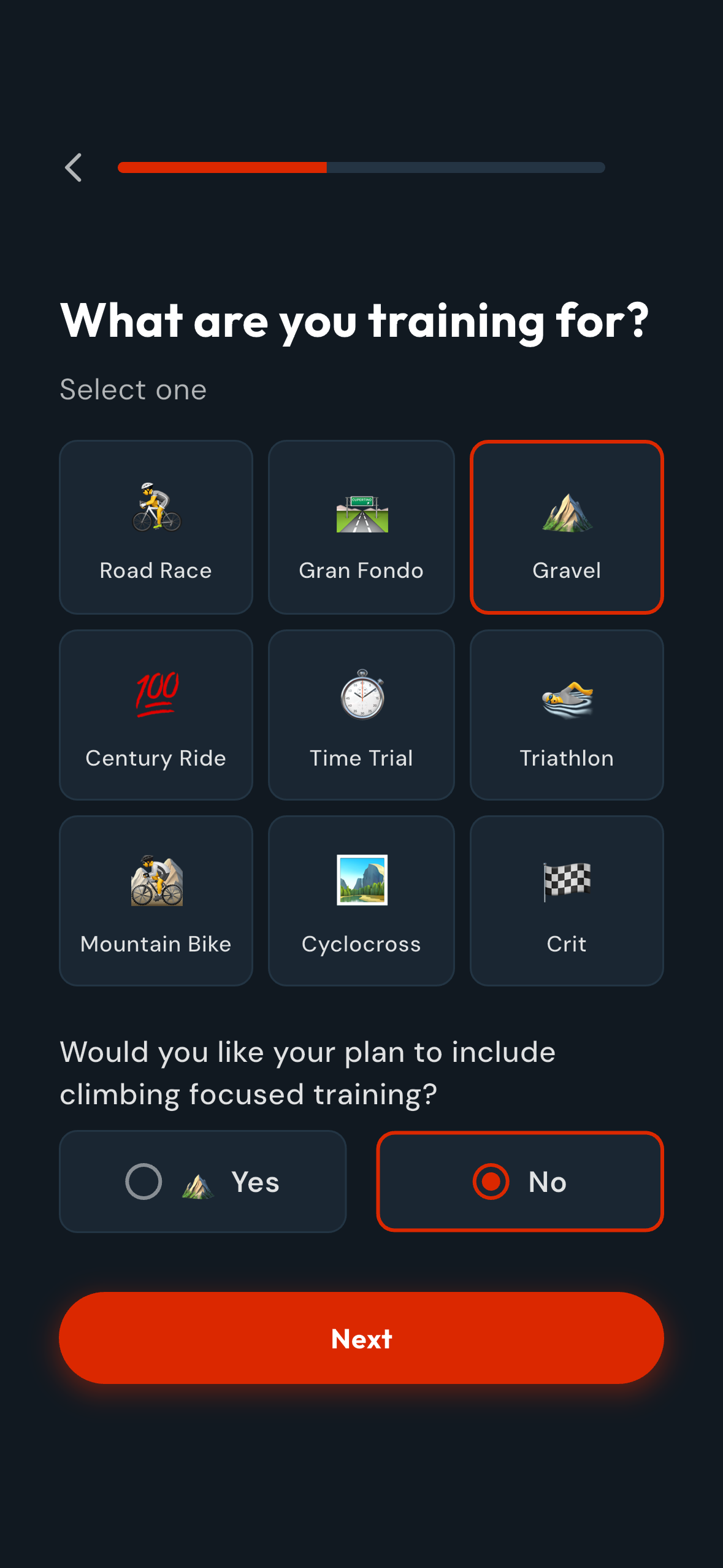
Five options, each one drives a different training plan design:
- A specific race
- A year-round plan
- Building fitness
- Beating your friends on the group ride
- A cycling trip
A single A-event peaks differently than a year-round plan. A trip’s phases are different than a race. Improving for a group ride is a different yet similar style of training. Your answer here determines which event-specific plans we pull in and how the phases line up.
If you’re training for a race, the plan picker builds you a plan to peak for your A event. Once that framework is built, you can layer in B and C races by telling CoachCat in chat.
Question 3 — When Is Your Race?
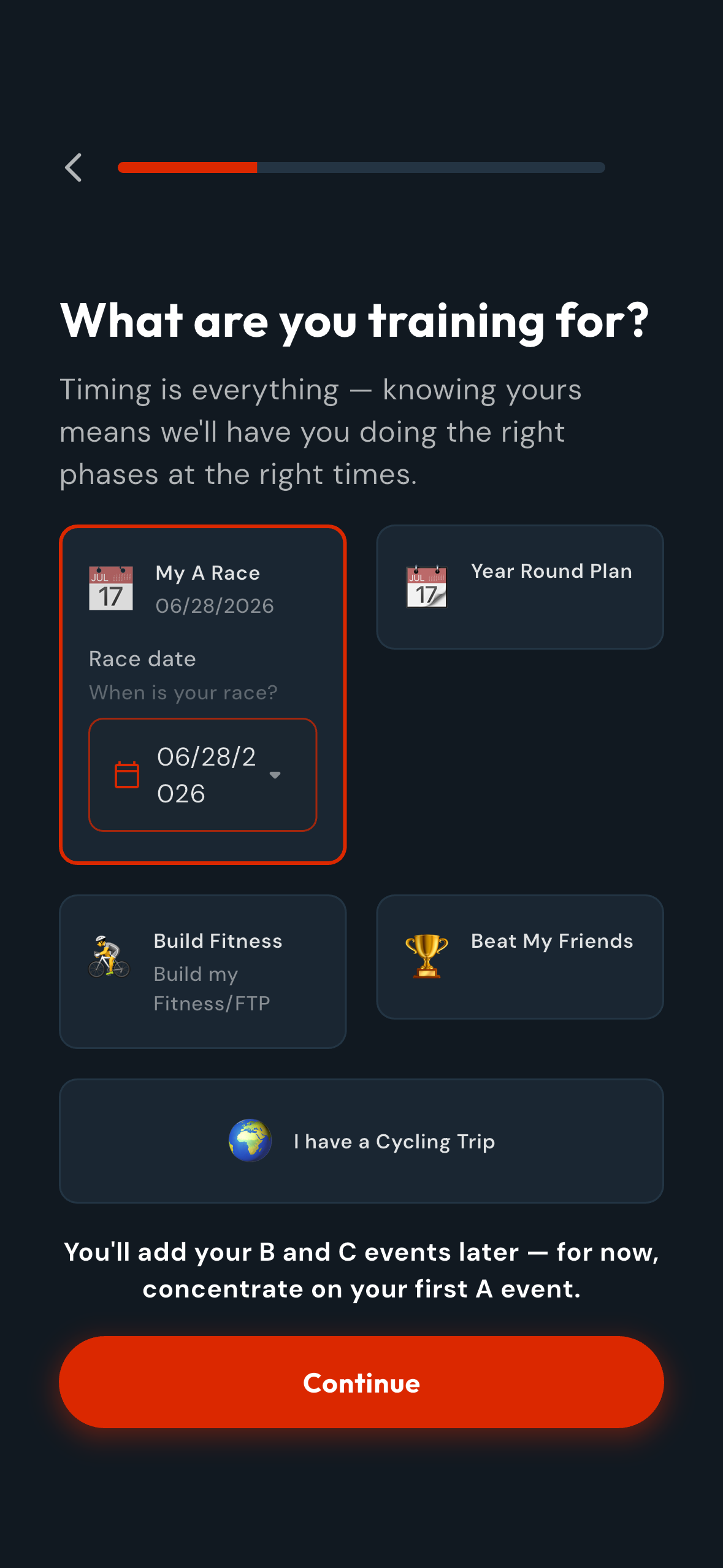
Timing drives the entire periodization of your cycling training plan: base or intervals, long rides versus short, event-specific prep or weight lifting.
Once we know your event date, your trip date, or your group ride day, we work backward from it. Base before build, build before intervals, taper into the event. The “when” is what makes the periodization real — and it’s how you make the most wattage and PEAK.
Question 4 — Strength Training
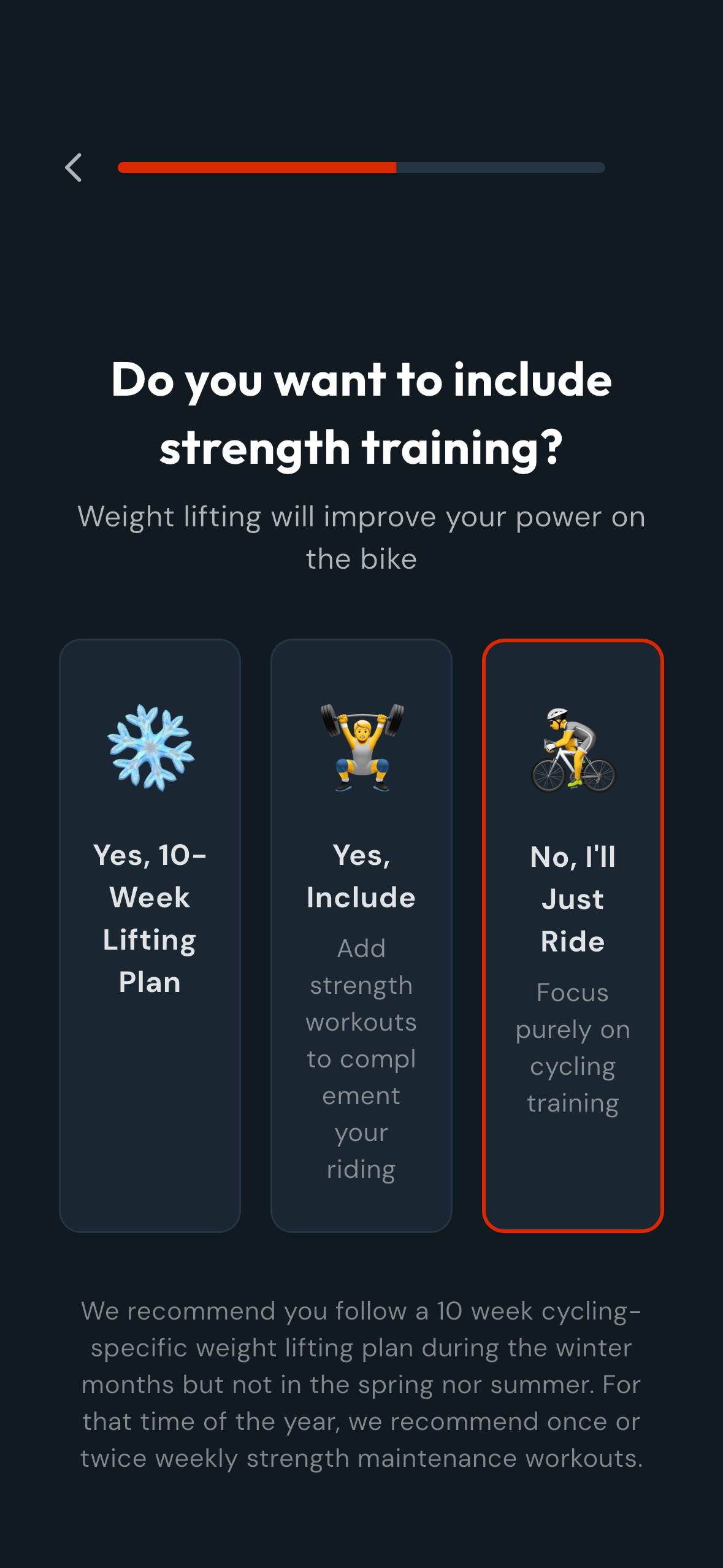
Three choices:
- A full 10-week lifting plan (recommended Fall and Winter)
- Strength Maintenance workouts during the season
- “No, I’ll just ride”
Strength training is one of the most important decisions in your cycling training plan design. We’ll come back to the nuance below.
Our year-round recommendation: 10-week phase in the off-season, maintenance during the race season, and cut out lifting before your peak events. The plan builder knows the season and your event, and pulls the right strength phase at the right time of year.
Question 5 — Your Availability
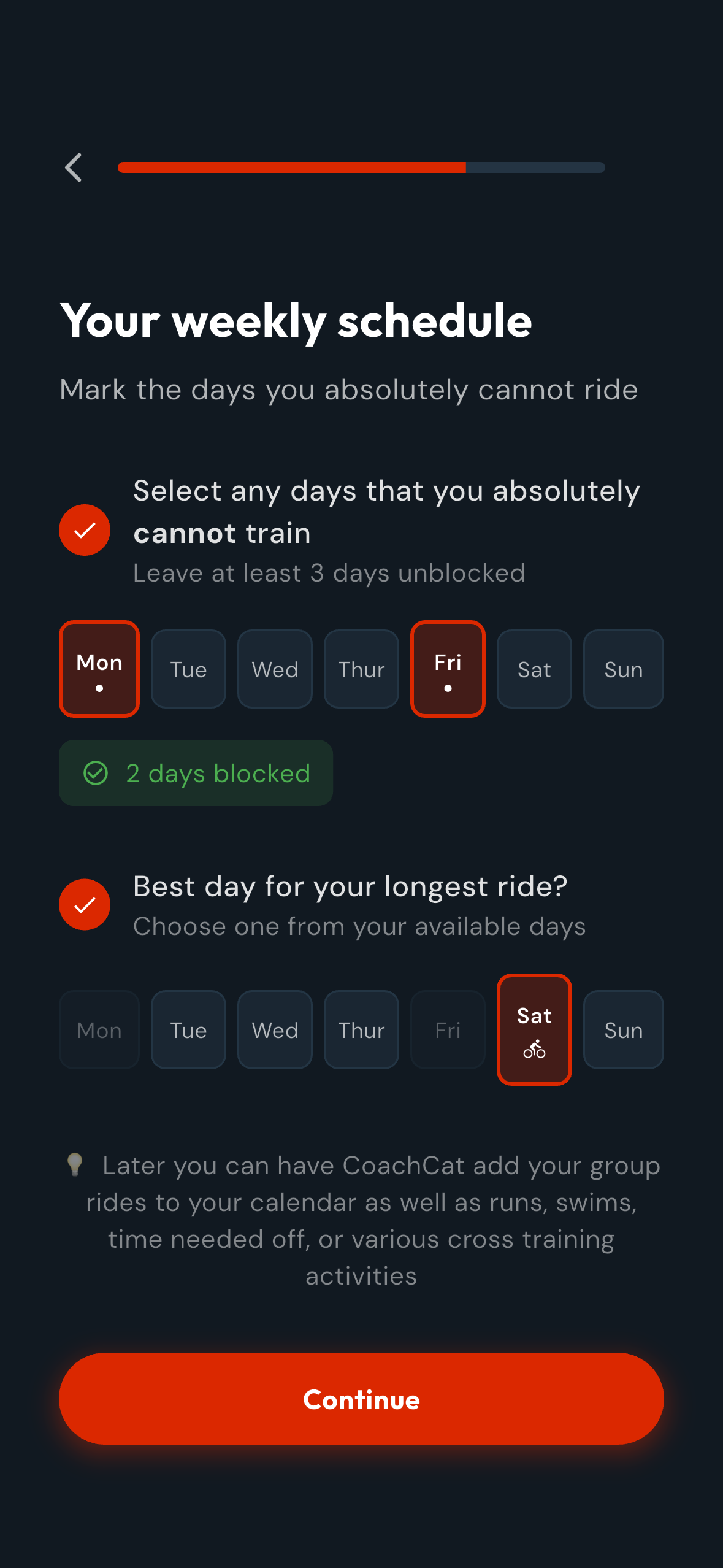
This is the brand-new question, and the one athletes have asked us about for years.
What if you can’t train on Wednesdays? What if your weekends are Mondays and Tuesdays because you’re a first responder with a non-traditional schedule? This part of the plan builder finally fixes that.
Two parts:
- Days you can’t train. Block them out. The builder turns those into rest days instead of trying to schedule a workout you can’t actually do. If you can only train 3 or 4 days a week, that’s a real plan now — not a compromise.
- Best day for your long ride. Saturday is the default, but if Sunday is your big day, choose Sunday. The whole week revolves around your long ride day and your key workout days — because you need to be fresh to get the most out of them.
What does “fresh” mean? A rest day before. You want to be doing your hardest workouts following rest days — this is where I see most static training plans fall apart. No one is benefiting from VO2 Max intervals randomly scheduled the day after a long ride.
The most common reason a cycling training plan fails isn’t the workouts — it’s that the plan doesn’t fit around your life. This question fixes that.
Event-Specific Cycling Training Plan Design
Once we know what you’re training for, the workouts in each phase get specific to that event. Each discipline has its own demands, its own interval style, and its own volume requirements.
Road Race
Race-specific intervals that train the surges, attacks, breakaways, and sprints — VO2s, anaerobic work, and sprints — plus long rides and Sweet Spot breakaway training.
Gran Fondo
A big aerobic foundation, sustained tempo and Sweet Spot work, then fondo-specific endurance — long rides that match the duration and pacing of your event.
Gravel
Sweet Spot base, 5-hour power, gravel simulation rides, durability, and the legendary Gravel Power Workout. Gravel is essentially a long time trial, so we train your diesel watts. We also have dozens of event-specific gravel plans designed for the power demands of specific courses.
Century
Aerobic base, lots of Sweet Spot training, and century-specific long rides — the kind that get you riding 100 miles strong, not just surviving them.
Time Trial
Threshold, supra-threshold, and time-trial-specific threshold work. TTs live and die at FTP. Then race-specific intervals at your TT duration — whether that’s a 20-minute effort or a 40K.
Triathlon
A bike-specific progression: Sweet Spot base, threshold work for sustained power, race-pace efforts at your target wattage off the swim.
Mountain Bike
Three flavors:
- XC — anaerobic capacity for clearing technical terrain at speed
- Marathon — lots and lots of Sweet Spot base
- Ultra — long, long endurance for 100-mile events. Plus our Leadville-specific plan to be completed six weeks prior to Leadville, and our Breck-Epic Stage Race plans.
Cyclocross
Short anaerobic efforts are the name of the game: anaerobic capacity work, race starts, hot laps, Wednesday Worlds simulation, sprints, plyometrics, running, and strength conditioning.
Criterium
Sprint work, anaerobic capacity training, one-minuters, breakaway practice, plus race-specific corners-and-jump-out-of-corner intervals.
The Climbing Question
Right after you pick your event, we ask: does your event have climbing on the course?
The rule of thumb is climbs longer than 8 minutes. Generally:
- East of the Mississippi: do not choose climbing
- West of the Mississippi (Rocky Mountains, California): choose climbing
- European trips: climbing for Majorca and Tour de France style trips, no climbing for Belgian Classics trips like Roubaix and Flanders
If yes, we include a climbing threshold phase — sustained power that’s different from intervals on a flat course or on the trainer. If no, that time goes into more event-specific power phases — whatever makes you faster on the course you’re actually riding.
That one question can shift the whole back half of your build.
Strength Training in Your Cycling Training Plan: When and How
This is the question athletes get wrong more than any other. The science is clear: weight lifting increases your power output on the bike. For Masters cyclists especially — anyone over 35 — lifting isn’t optional if you want to keep getting faster.
The 10-Week Lifting Plan — Fall and Winter
This is the foundational phase. Heavy, structured, cycling-specific lifting in the off-season, when your bike intensity is naturally lower and your body has the time to recover. The strength you build here translates directly to on-bike power when you ramp cycling intensity in the spring.
If you only do one block in the gym all year, this is it. Just don’t try to do this kind of lifting in spring and summer when you’re trying to ride fast — the stress will leave your legs feeling like concrete blocks.
Strength Maintenance — Spring and Summer
Once race season starts, the goal shifts. You’re no longer building new strength — you’re preserving what you built. One or two short sessions a week, lighter loads, less volume.
Add Strength Maintenance workouts the day before your rest days. If your rest day is Monday, lift Sunday after your ride. Start with once per week. These are the minimum effective dose — no burn, no failure, no soreness.
No, I’ll Just Ride
A real choice when you’re within 6–12 weeks of an A event and need to recover from riding as much as possible. Cutting out lifting before a peak event prioritizes recovery, freshness, and watts.
It’s also the right call if lifting genuinely isn’t part of your plan right now — an old shoulder, knee, or back injury, for example.
Our year-round recommendation: 10-week phase in the off-season, maintenance during the race season, and cut out lifting before your peak events. The plan builder knows the season and your event, and pulls the right strength phase at the right time of year.
Why This Approach to Cycling Training Plan Design Works
Most generic cycling training plans hand you the same week-over-week structure regardless of who you are or what you’re training for. That’s not training plan design — that’s a template.
FasCat’s plan builder asks five questions because each answer changes the plan:
- Hours per week sets your volume
- What you’re training for sets your phases
- When it is sets your periodization
- Strength training sets your off-bike work
- Availability sets the shape of your week
Then the climbing question and event specificity adjust the back half of your build. The result is a periodized cycling training plan that fits your goal, your fitness, your calendar, and your life.
Build Your Custom Cycling Training Plan
CoachCat’s custom training plan builder is available to both new and existing CoachCat athletes, and every plan comes with a complimentary coaching consultation — we verify you built the right plan and offer suggestions to make it even better.
The first week is free. Build your custom cycling training plan, follow the F’ing plan, and improve more than you ever thought possible.