

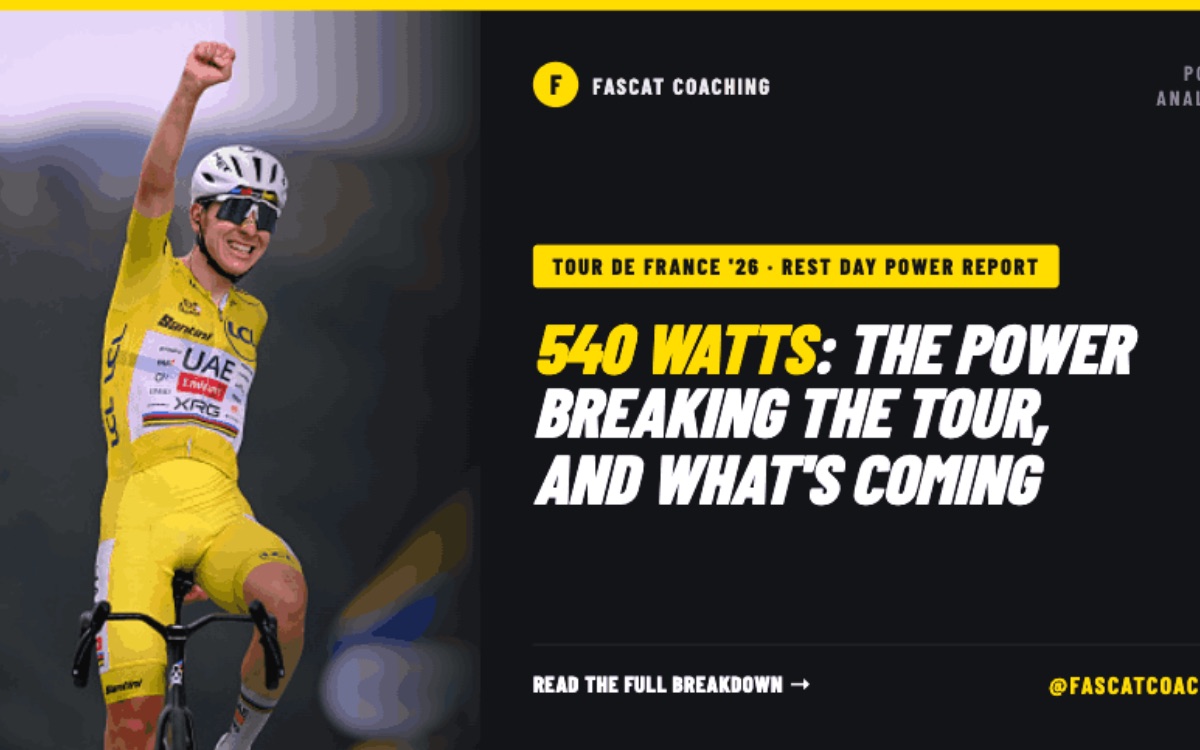
After two weeks of racing, there's a pattern so clear you can set your power meter to it. Pogačar rides the big climbs at sweet spot with the GC group, then detonates the race with a three to four minute effort north of 8 W/kg. We have been putting physics-based power estimates on every stage of the 2026 Tour de France, and before the final week begins, here are the most sensational numbers so far, plus our predictions for the time trial, Orcieres-Merlette, back-to-back Alpe d'Huez summits, and the Montmartre finale in Paris. Tap any stage below for the full story.
The Numbers, All in One Place
| Stage | Climb / Effort | Duration | W/kg | Watts | Winner / Our Pick |
|---|---|---|---|---|---|
| What Happened | |||||
| 6 | Gavarnie-Gedre finale (final 17 km) | ~28:10 | ~6.8 | ~450 | Pogačar 🏆 |
| 10 | Col de Pertus attack (final 1.4 km at 9.6%) | 3:25 | 8.2 | ~540 | Pogačar 🏆 |
| 14 | Col du Haag attack (final 1.4 km) | 4:13 | ~7.5 | ~500 | Pogačar 🏆 |
| What's Coming, Our Predictions | |||||
| 16 | 26 km ITT, Thonon-les-Bains (~2,250 W/m² of CdA) | ~29:00 | 6.5 | ~430 | Evenepoel |
| 18 | Orcieres-Merlette (7.1 km at 6.7%), from the break* | ~19:00 | 6.2 | ~460 | Jorgenson |
| 19 | Alpe d'Huez (13.9 km at 8.0%) | ~41:00 | 6.4 | ~409 | Pogačar |
| 20 | Col de Sarenne (12.9 km at 7.3%) | ~36:00 | 6.5 | ~416 | Seixas |
| 21 | Butte Montmartre punch | ~2:30 | 9.2Updated | ~690 | van der Poel |
Stage 6: The Tourmalet Record Falls at 6.35 W/kg
The Tourmalet is 17.1 km at 7.3%, one of the most storied climbs in the sport, and Pogačar took its record apart. He summited in 43:02, more than two minutes faster than the previous best, and the physics work out to roughly 6.35 W/kg and about 420 watts for 43 minutes. Vingegaard crossed 30 seconds later at 6.3 W/kg and 380 watts.
Then came the part nobody's legs were ready for. On the final 17 km to Gavarnie-Gedre, Pogačar dropped the hammer at 6.8 W/kg and 450 watts, putting two minutes into a fading Vingegaard while the Evenepoel and Seixas group climbed at 5.9 W/kg. A record ride up the Tourmalet, and it was the warm-up.
Stage 10: 540 Watts for 3:25
This is the number of the Tour so far. On the Col de Pertus, Pogačar sat in the GC group at about 6.2 W/kg for the first 3 km, then attacked the final 1.4 km at 9.6% gradient with 8.2 W/kg and roughly 540 watts for 3:25. He averaged 6.8 W/kg and 450 watts for the full climb, rode the Font de Cere at another 6.8 W/kg, and won solo in Le Lioran.
We had predicted 7.9 W/kg for the winning effort. The measured attack came in at 8.2.
He confirmed the playbook on Stage 14, climbing the Col du Haag with the favorites at 6.1 W/kg before uncorking 500 watts at 7.5 W/kg for 4:13, touching 8.3 W/kg through the steepest 1.1 km. Same script, new mountain range.
Stage 16 Time Trial: Forget W/kg, This Is About W/CdA
The 26 km test from Evian-les-Bains to Thonon-les-Bains is flat and fast, so the physics flip. On a climb, gravity is the enemy and watts per kilogram decide the race. Against the air, the currency is watts per square meter of drag area, your power divided by your CdA.
Our prediction: the winner needs about 2,250 W/m² of CdA. That is roughly 430 watts at a CdA of 0.19 m², good for about 54 km/h and a winning time near 29 minutes. The beauty of this metric is the tradeoff it exposes. Evenepoel, the most aerodynamic rider in the sport at a CdA near 0.175, can win this on about 400 watts. Pogačar at a bigger 0.20 position needs closer to 450. Aero is a skill, and it is worth watts you never have to produce.
Stage 18: Orcieres-Merlette Goes to the Breakaway
The Tour returns to Orcieres-Merlette, 7.1 km at 6.7%, and this is the day the race finally lets a breakaway breathe. With the GC all but decided and two Alpe d'Huez summits looming, Pogačar's team has zero reason to chase and every reason to save matches. Expect a huge fight to make the morning move, a gap that stretches past five minutes, and a stage decided up the road while the yellow jersey group rides sweet spot behind.
Our pick is Matteo Jorgenson. He has the engine for a long-range move, the climbing legs to finish it on a 19 minute summit, and a team that will happily take a stage win now that the GC battle has slipped away. The winning move takes about 6.2 W/kg and 460 watts for roughly 19 minutes up the final climb, while the GC group rides tempo behind. That is a hard but very repeatable number for a fit WorldTour rouleur, and with a four minute cushion at the bottom of the climb, the math is comfortable: a GC group riding tempo closes maybe 45 to 60 seconds over 19 minutes.
Stages 19 and 20: Alpe d'Huez, Twice
Stage 19 finishes atop the 21 hairpins, 13.9 km at 8.0%. You already know this climb. Alpe du Zwift is a bend-for-bend replica of it, so if you have ever buried yourself past Bend 7 with the summit banner refusing to get closer, you have ridden Stage 19's finale. Which makes the prediction personal: if you hold 4.0 W/kg up Alpe du Zwift, you top out in roughly 50 minutes, and that is a seriously strong ride. Our model says the Stage 19 winner climbs the real thing at 6.4 W/kg and about 409 watts for 41 minutes. Nine minutes faster than your best day, at half again your watts per kilo.
And here is the twist: with Pogačar defending yellow, that 41 minutes is the controlled part. The stage is won with a kick of 8.3 W/kg and roughly 530 watts over the final kilometer, about 2.5 minutes on legs already 40 minutes deep. Next time you finish an Alpe du Zwift PR, try sprinting for the last kilometer. That is what we are asking of the winner.
Stage 20 is the savage one: Croix de Fer, Telegraphe, Galibier, then the brutal, narrow Col de Sarenne, 12.9 km at 7.3%, before dropping to climb the final ramp to Alpe d'Huez again. Second straight summit day, three climbs already banked, so fatigue caps the fireworks: 6.5 W/kg and about 416 watts for 36 minutes up the Sarenne, with the win coming from a 7.9 W/kg kick at roughly 505 watts over the last kilometer.
Stage 21: MvdP and the Montmartre Punch, Updated to 9.2 W/kg
Paris is no longer a parade. The finale climbs the cobbled Butte Montmartre three times, and in 2025 the final ascent shattered the bunch. We originally called 9.0 W/kg for the winning 2.5 minute punch. We are updating that to 9.2 W/kg.
Why the bump? This Tour keeps out-running our attack predictions. We called 7.9 on Stage 10 and got 8.2. Pogačar has held 8.3 W/kg for a full four minutes deep into a mountain stage. A fresh, fully rested Mathieu van der Poel unloading everything on cobbles for 2.5 minutes clears 9. At van der Poel's roughly 75 kg, 9.2 W/kg is about 690 watts, with spikes over 1,000 watts on the steep cobbled ramps. That is the winning move we expect on the Butte.
Want to train these watts, scaled to your FTP instead of Pogačar's? Every stage page has a Copy This Into CoachCat workout built from the day's demands. Watts/kg are physics-based estimates, not measured power.