


The fuel target on every workout card, and the Fuel Your Ride panel that turns it into bottles, gels, and when to start eating.
Every bonk, fade, and reduced power output you have ever had was preventable with more carbohydrate, eaten earlier. Most cyclists plan their workouts to the minute, then fuel them by feel: a gel in the pocket, a bottle of mix. The result shows up in your ride file as power fading through the final hour, and it gets blamed on fitness when it was a fueling error the whole time.
Eat the right amount of carbohydrate, at the right times, and your legs produce more watts and recover faster; under-eat and you pay for it twice. Proper sports nutrition fuels both halves of getting faster: the performance you put out today and the recovery that turns it into fitness tomorrow.
Now, CoachCat's new FuelTrix™ feature tells you how much to eat during your ride, race, or workout based on its duration and intensity, alongside CoachCat's proprietary algorithm backed by scientific research.
Look Up Your Fuel
What is actually in your bottle or your pocket? Type a brand, or tap one, and see which sugars you are buying and how many grams per hour they can carry.
Racing with a bottle and gels? Your gut sees the total. Add up the grams from every source for your per-hour number, and above 60 g/hr make sure every source is a dual-sugar product, drinks and gels alike.
How to Read the Matrix
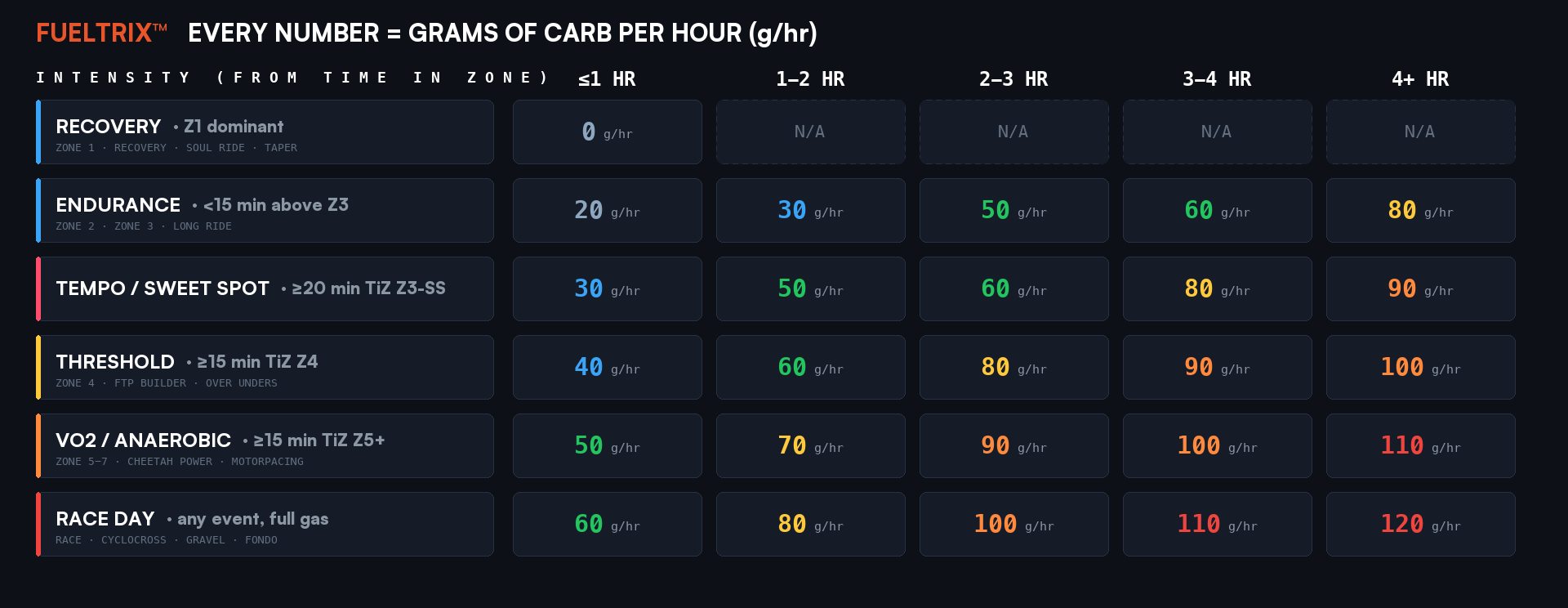
FuelTrix reduces to one table. Rows are how hard the ride is, columns are how long it lasts. Harder moves you down, longer moves you across, and the number, grams of carbohydrate per hour, only goes up.
You never pick your own row. CoachCat assigns it from planned time in zone, summed across every interval. Less than 15 minutes above Zone 3 is Endurance. Twenty minutes of tempo or sweet spot work moves you to the Tempo / Sweet Spot row, 15 minutes at threshold to the Threshold row, 15 minutes at Zone 5 or above to the VO2 row. The summing matters: 2 sets of 3 x 5 minutes at Zone 5 is 30 minutes of Zone 5 work, so that workout is a VO2 ride no matter what its title says. And a race flag overrides everything, because races burn more than any plan suggests.
So a 90 minute endurance spin reads 30 grams per hour. A 2.5 hour ride with threshold intervals reads 80. A gravel race longer than 4 hours reads 120. Recovery rides read 0, your gut gets a rest day too.
The Colors Tell You Which Sugars to Use
The three colors represent which sugars to fuel your ride. Read your number, match the color to the right kind of product, done.
| The color | The sugars | The ratio | Products that work |
|---|---|---|---|
| Blue / Green0 to 60 g/hr | Anything works.Below 60 g/hr one doorway is enough: glucose or maltodextrin alone absorbs fine, and dual-sugar drinks do too. | Any | SiS GO IsotonicHammer GelHEEDGatorade (bottle)Skratch Sport HydrationSkratch Super High-CarbYes, Skratch Super High-Carb goes here despite the name: it is 92 g glucose polymer to 8 g fructose per serving, about 11:1, so the glucose doorway still sets your absorption ceiling. |
| Yellow70 to 80 g/hr | Glucose + fructose.Two sugars, two doorways into the blood. One sugar alone cannot get here. | 2:1glucose to fructose | TorqHigh5 Energy DrinkPrecision Fuel & HydrationNeversecondGatorade PowderGatorade powder counts only mixed double strength: its sugar + dextrose blend lands near 2:1. |
| Orange / Red90 to 120 g/hr | Glucose + fructose, plus a trained gut.The race day mix. Practice it in training first. | 1:0.8glucose to fructose | MaurtenSiS Beta FuelNduranzAmacx TurboFlow FormulasStyrkrTable SugarThe budget path: table sugar is a 1:1 glucose to fructose blend, right next to 1:0.8 on the fructose-heavy side. 90 g in a 750 ml bottle is the cheapest race-day mix there is; train your gut with it first, like everything in this row. |
Why different sugars and ratios? Your gut absorbs glucose through one transporter called SGLT1, and that pathway is full at roughly 60 grams per hour.1 Fructose enters through a second pathway called GLUT5, which is why a 2:1 glucose to fructose mix carries absorption to about 90.1 The 1:0.8 mixes load that second doorway closer to its full capacity for the highest numbers,2 and the highest numbers also demand a trained gut, because the gut adapts to absorption the way muscles adapt to intervals.3 Eating more of one sugar past its absorption limit just sits in your gut, which is where GI distress comes from.
Real Products on Real Shelves
Choose your brands per the type of riding and racing you will be doing. These are verified against current manufacturer information in August 2026. Formulations change, so check your own labels.
Single source: good to 60
- SiS GO Isotonic gels are maltodextrin only, 22 grams each.
- Hammer Gel and HEED are also maltodextrin with no added fructose: perfect for blue and green cells, a bottleneck beyond them.
- Bottled Gatorade and Skratch Sport Hydration live here too, not because of their sugars but because of their strength. Both are sucrose and dextrose blends, but at about 36 grams per 20 ounce bottle and 21 grams per serving, they cannot reach the yellow numbers at drinkable volumes.
- Skratch Super High-Carb gets a fair verdict, not a takedown. Its 100 grams per serving is 92 grams of Cluster Dextrin (a glucose polymer) to 8 grams of fructose, about 11:1, so nearly everything arrives through the glucose doorway. What it is genuinely good at is 60 to 80 grams per hour in comfort: Cluster Dextrin's very low osmolality clears the stomach fast and sits light, and at those rates you are at or near the doorway's capacity with excellent tolerance. What it cannot do is 120, because emptying the stomach faster does not raise the doorway's ceiling; it just delivers the traffic jam sooner. Skratch's own guidance tops out at 100 grams per hour, and most of their athletes ride at 80. If your card shows orange or red, reach for a 1:0.8 product rather than trying to blend your way there. Grams in the bottle are not grams through the gut wall; the ratio decides that.
2:1 glucose to fructose: the 90 gram generation
- Torq drinks and gels are built at 2:1 maltodextrin to fructose.
- High5's Energy Drink is 2:1 as well, though its standard gel is not.
- Precision Fuel & Hydration runs 2:1 across its range, and its PF 90 gel packs 90 grams into a single serving.
- Neversecond's whole C-Series is 2:1, with the C90 mix delivering 90 grams a scoop.
- Gatorade powder mixed double strength lands near 2:1, because sugar is half fructose and dextrose is pure glucose.
1:0.8 glucose to fructose: the 100 to 120 generation
This is what the WorldTour races on.
- Maurten's gels are 1:0.8 glucose to fructose, with its Drink Mix 320 right beside them at 1:0.7.
- SiS Beta Fuel was reformulated from its original 2:1 to 1:0.8, and the 2:1 original is no longer sold.
- Nduranz builds its whole Nrgy line at 1:0.8.
- The newer wave is 1:0.8 too: Amacx's Turbo line, Flow Formulas, and Styrkr's MIX90 and GEL50.
If your race plan calls for an orange or red number, these are the products engineered for it.
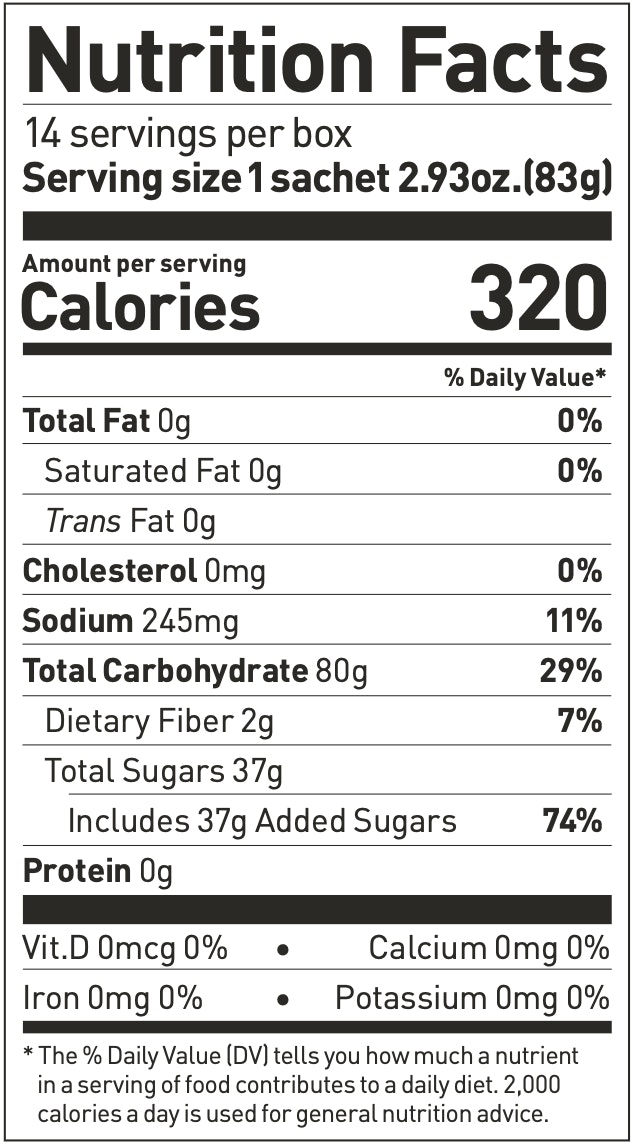
How to read a label: Maurten's Drink Mix 320 delivers 80 g of carbohydrate per 83 g sachet, and the first two ingredients are the sugars. The proportions of maltodextrin (glucose) and fructose are the ratio. Label and ingredients from maurten.com.
The budget path
Table sugar is not a single sugar. Sucrose is one glucose bonded to one fructose, a built-in 1:1 dual mix, which puts it right next to the 1:0.8 race products, just a touch more fructose-heavy.
That makes 90 grams of plain table sugar in a 750 ml bottle the cheapest race-day mix there is. It is concentrated, so treat it like the rest of the orange and red tier: practice with it in training before you race with it.
Why the Numbers Are What They Are
None of the cells are opinions. The short version:
- Under 45 minutes, eating does nothing for performance.4 That is why recovery spins read 0. The fuel already stored in your muscles and liver covers the work.
- 30 grams per hour covers 1 to 2 hours of endurance riding,1,5 with position stands allowing up to 60 as the riding gets harder.4
- 60 grams per hour is the classic target past 2 hours, rising to 90 beyond about 2.5 to 3 hours, if and only if the mix contains both glucose and fructose.1,4 Intensity shifts you up the range because glycogen burns faster the harder you go: a 2 hour race eats more fuel than a 4 hour Zone 2 ride.
- 120 grams per hour is real, not marketing. At that intake, fluid, gels, and chews all get burned at comparable rates with minimal gut distress,6 riders taking 120 burn more of what they eat than riders taking 90,7 and gut-trained elite runners fueling at 120 through a mountain marathon finished with less muscle damage in their bloodwork.8 Field reports relayed by a 2026 review put a 2025 Tour de France stage winner at about 116 grams per hour.9 The matrix caps at 120 because beyond that the evidence runs out, and the review's own authors say so.
Why FuelTrix does not ask your weight
Notice what FuelTrix does not do: scale with body size. Absorption happens in the gut, and gut capacity does not track your weight, so the classic guidance is to prescribe fuel in absolute grams for everyone.1 That is why the same workout gets the same number whether you weigh 52 kg or 92 kg. The newest isotope research adds a wrinkle, finding that bigger riders do burn somewhat more of what they ingest, likely because they push more absolute watts,10 but the effect is small next to the gut's ceiling, and it never justifies scaling carbs per kilogram the way you scale watts.
One piece of coaching judgment to layer on top: very light riders should treat about 1.5 grams per kilogram per hour as a sensible personal ceiling. For a 52 kg rider that is roughly 70 to 80 grams per hour, so grow into the highest cells with your gut, not just your calendar. Everyone else can take the card at face value.
No gender switch, no age switch
The matrix also has no adjustment for gender or age, and that is a feature, not an oversight. The transporters in your gut do the same job whether you are a 28 year old man or a 62 year old woman. Even the broader differences in fuel use that show up between sedentary men and women largely disappear in trained athletes.11 Same workout, same target, same benefit from hitting it. If the number on your card feels high, that is an under-fueling habit talking, not your physiology.
The red cells are earned
What does change from rider to rider is absorption, and absorption is trainable. Feed your gut more and it upregulates the very transporters that limit absorption,3 which is exactly why the orange and red tiers say trained gut. Take your race-day number into long training rides starting weeks out and build up. If 100 grams per hour sounds impossible, that is because you have not trained it yet.
How to Use It
There is nothing to configure. Update CoachCat and every workout on your calendar shows its FuelTrix target, plus the translation: a bottle counts as 40 grams of mix in 750 ml, a gel as 25 grams. The worked example: 80 g/hr × 2.5 hr = 200 g = 3 bottles + 3 gels. Pack that, eat on schedule, done.
Two habits make the number work. First, consume what the card says even when it feels like too much, especially in the first hour when you are not hungry yet. The final hour of every ride is fueled by what you ate in the first. Second, treat your race-day number as a skill: rehearse it in training (especially your simulation rides) so your gut shows up as prepared as your legs.
Your plan already tells you what to do. Now it tells you what to eat. Open CoachCat and check tomorrow's workout.
References
- Jeukendrup A. A step towards personalized sports nutrition: carbohydrate intake during exercise. Sports Medicine. 2014;44(Suppl 1):S25-S33. doi:10.1007/s40279-014-0148-z
- Podlogar T, Wallis GA. New horizons in carbohydrate research and application for endurance athletes. Sports Medicine. 2022;52(Suppl 1):5-23. doi:10.1007/s40279-022-01757-1
- Jeukendrup AE. Training the gut for athletes. Sports Medicine. 2017;47(Suppl 1):101-110. doi:10.1007/s40279-017-0690-6
- Thomas DT, Erdman KA, Burke LM. American College of Sports Medicine joint position statement: nutrition and athletic performance. Medicine & Science in Sports & Exercise. 2016;48(3):543-568. doi:10.1249/MSS.0000000000000852
- Burke LM, Hawley JA, Wong SHS, Jeukendrup AE. Carbohydrates for training and competition. Journal of Sports Sciences. 2011;29(Suppl 1):S17-S27. doi:10.1080/02640414.2011.585473
- Hearris MA, Pugh JN, Langan-Evans C, et al. 13C-glucose-fructose labeling reveals comparable exogenous CHO oxidation during exercise when consuming 120 g/h in fluid, gel, jelly chew, or coingestion. Journal of Applied Physiology. 2022;132(6):1394-1406. doi:10.1152/japplphysiol.00091.2022
- Podlogar T, Bokal S, Cirnski S, Wallis GA. Increased exogenous but unaltered endogenous carbohydrate oxidation with combined fructose-maltodextrin ingested at 120 g/h versus 90 g/h at different ratios. European Journal of Applied Physiology. 2022;122(11):2393-2401. doi:10.1007/s00421-022-05019-w
- Viribay A, Arribalzaga S, Mielgo-Ayuso J, Castaneda-Babarro A, Seco-Calvo J, Urdampilleta A. Effects of 120 g/h of carbohydrates intake during a mountain marathon on exercise-induced muscle damage in elite runners. Nutrients. 2020;12(5):1367. doi:10.3390/nu12051367
- Morton JP, Fell JM, Gonzalez JT, et al. From metabolism to medals: contemporary perspectives and revisiting carbohydrate guidelines for fueling endurance athletes during exercise. The Journal of Nutrition. 2026;156(5):101442. doi:10.1016/j.tjnut.2026.101442
- Ijaz A, Collins AJ, Moreno-Cabanas A, et al. Exogenous glucose oxidation during exercise is positively related to body size. International Journal of Sport Nutrition and Exercise Metabolism. 2025;35(1):12-23. doi:10.1123/ijsnem.2024-0097
- Cano A, Ventura L, Martinez G, et al. Analysis of sex-based differences in energy substrate utilization during moderate-intensity aerobic exercise. European Journal of Applied Physiology. 2022;122(1):29-70. doi:10.1007/s00421-021-04802-5
