

You can absolutely still get faster after 40. And 50. And yes, after 60, too. But here's the catch every successful masters cyclist eventually learns: you can't train the way you did in your 30s and expect it to work anymore.
Father time comes for your watts. Recovery slows down. And between a career, a family, and everything else life piles on, you don't have all day to ride. The good news? None of that means you're done improving. It just means the approach has to change.
At FasCat we've coached masters athletes to national championships, world titles, and plenty of hard-earned personal bests for over 20 years. This is the playbook we've built CoachCat's masters knowledge on, so whether you're chatting with CoachCat in the app or just reading this on a Tuesday, you're getting the same coaching philosophy.
Let's get into it.
What you'll learn in this guide
- Who counts as a masters cyclist, and why 50 is the real turning point
- What actually changes after 40 (VO2 max, muscle, bone) and the lever that offsets each
- How to pick the right volume level for your age and schedule
- Why recovery, not the hard training, is the real limiter after 40
- How to age-adjust your VO2 max and Sweet Spot intervals without losing intensity
- The three pillars of masters recovery that beat any gadget
- The 5 masters training rules Bicycling Magazine featured, with the full coaching context
- How CoachCat's Optimize Recovery Analysis tells you when to push and when to back off
Who Counts as a Masters Cyclist?
In competition, "masters" starts at 40. But in our coaching experience, the real turning point is closer to 50. That's when age-related decline starts to show up in your power file, and in the mirror.
So think of it this way: 40+ makes you a master, but the older you get, the more you lean into the "train less, recover more" adjustments below. A sharp 42-year-old and a wise 62-year-old are both masters. They just need different dials turned.
What Actually Changes With Age (and What You Can Do About It)
Aging is real, but most of what people blame on age is really the result of training less, recovering worse, and skipping the gym. Here's what the science says actually changes, and the lever you pull for each one.
- VO2 max drifts down. Your aerobic ceiling declines roughly 5 to 10% per decade, and the slide steepens after about 50 (1). The good news: most of that decline tracks with training volume and intensity dropping off, not age alone. Your lever: keep doing real intensity. Masters who hold onto their VO2 max intervals hold onto far more of their ceiling than those who quietly let the hard days disappear.
- You lose fast-twitch muscle first (sarcopenia). Muscle mass declines with age, and it's the Type II, fast-twitch fibers, the ones behind your sprint and top-end power, that atrophy first (2). Your lever: lift weights and do short, sharp anaerobic efforts. Both directly recruit and preserve the fibers age is trying to take.
- Bone density falls, and cycling doesn't help. Bones thin with age, and because cycling is non-impact, masters cyclists often have lower bone density than the general population (3). Your lever: heavy strength work and, if you can, some impact (hiking, running strides, plyometrics). Your femurs will thank you if you ever hit the deck.
- Hormones taper. Testosterone and estrogen decline from your prime onward, which slows tissue repair (4). Your lever: the recovery trifecta below, sleep, nutrition, and a plan that respects your recovery, is how you make the most of the repair capacity you have.
Notice the pattern: aging takes away your top end and your muscle, and the antidote in every case is intensity plus strength plus recovery. That's not a coincidence. It's the whole masters playbook in one paragraph.
Where to Start: Masters-Friendly Plans
We build our training around volume levels, and two of our structured training plans are purpose-built for masters athletes:
- Basic level is 4 to 8 hours per week. Fewer workouts, shorter durations. Perfect if you're newer to structured training or working a full-time job.
- Intermediate level is 8 to 12 hours per week. More volume for masters who have the time and the ability to recover from it.
One important rule: advanced-level plans are off the table for most athletes over 50. We mean it. More is not better once your recovery can't keep up.
Here's how to pick your level:
- Over 60? Go Basic if you're still holding down a job or newer to the sport. Only choose Intermediate if you've been training consistently for 2+ years, have 8 to 12 hours a week, and have the time to actually recover.
- In your 50s? If you've got the hours (8 to 12 per week), Intermediate will serve you better than Basic. Choose Basic if you're newer to training or only have 4 to 8 hours to work with.
- Over 40? Either works. Let your consistently-available weekly hours make the call, not your ego.
On the fence? That's exactly what CoachCat is for. Tell it your age, your schedule, and your goals, and it'll point you to the right starting point. Want a human in your corner? You can also hire a FasCat coach to build and manage the plan for you.
Why Masters Training Is Different
Recovery is the real limiter
Here's the mindset shift: the gains don't come from the hard training. They come from the recovery from the hard training, the adaptation. And as you age, that recovery takes longer.
Why? Hormones. From your physiological prime onward, your body makes a little less testosterone and estrogen every single year, on the order of 1.6% a year for men. Less of those hormones means slower muscle repair, which means a workout that used to take one night's sleep to bounce back from now takes two. That's not an excuse. It's just the new math you build your training around.
Your endurance holds, your top end fades
Now the good news. Peak power and FTP decline with age, but your aerobic endurance and efficiency are remarkably well preserved when you keep training. The tortoise really does beat the hare here.
That's exactly why so many masters gravitate toward gravel races and fondos over crits and time trials. You can still crush a 5-hour ride. What you can't do as easily anymore is back it up with another hard ride the very next day. Embrace that, and plan around it. (For more on this, read Riding Faster After 50.)
Train less, recover more
This is the heart of masters training:
- Those 2-hour weekday rides from your 30s? They become 60 to 75 minutes. Manageable, repeatable, and sustainable three days in a row.
- Those 12 to 16 hour weeks? They become 8 to 10 hours most of the time. A bigger overload week is fine occasionally to peak, but not as your regular diet.
Consistent 8 to 10 hours a week, year-round, will beat sporadic big weeks every time.
Consistency beats cramming
The number-one mistake we see masters make isn't training too little in a given week, it's inconsistency. Taking the whole fall or winter off, then trying to cram fitness back in come spring.
The best masters cyclists ride year-round. It's actually the biggest of our five rules for masters cyclists, which we cover in full below. And here's the patience part: what took you 6 weeks to adapt to at 30 might take 8, 10, even 12 weeks now. Stay consistent, be patient, and you may surprise yourself with numbers you haven't seen in years.
The 5 Rules for Masters Cyclists (Featured in Bicycling Magazine)
Bicycling Magazine interviewed Coach Frank Overton and published these principles in an article titled "I Coach Older Cyclists for a Living." Here they are with the full coaching context that didn't fit on the magazine page. Want the expanded walk-through? Watch 5 Training Rules for Masters Cyclists: What Bicycling Magazine Left Out.
Rule 1: Balance your training against your recovery
Bicycling called this "don't overdo the miles," and the principle is simple: the training you do has to match the recovery you can actually achieve. You can't ride 20 hours a week and benefit if you can only recover from 10, especially if you're newly retired with time on your hands. And take a hard look at those hours, because a big chunk are often junk miles: intensity so low it piles on fatigue without stimulating any real adaptation. You get more tired, not more fit. Eight to 12 hours a week works well for 50+ riders, an hour or two less for 60+, even when you have unlimited time. Pour the extra time into sleep and the kitchen instead.
Rule 2: Don't skip the truly hard efforts
Older riders tend to shy away from Zone 6, the anaerobic, all-out stuff, and leave watts on the table. You can still improve a lot from high-intensity work; it is not just for the young bucks. We're talking short, sharp 30 to 60 second efforts above 120% of your FTP, genuinely all out (don't patsy-cake it). Do an age-appropriate number: 40+ two sets of 4x1 minute, 50+ two sets of 3x1 minute, 60+ just four 1-minute efforts. Quality over quantity, with a rest day on either side.
Rule 3: Strength train year-round, the right way
There are two kinds of lifting, and mixing them up sabotages your riding. In the fall and winter, do the real work: a 10-week heavy phase, three to four gym sessions a week, squats and leg press and leg curls, building strength from the ground up. Then in spring and summer, switch to maintenance: once a week, light, just enough to preserve what you built without adding fatigue. The classic mistake is lifting heavy all year, then wondering why your legs feel like concrete on the bike. If you only do one exercise, make it squats, three reps at 70% of your one-rep max.
Rule 4: You don't need an event to have a goal
"I'm not really training for anything" is the phrase we hear most, and it's never true. Hanging with the Saturday group ride is a goal. That cycling trip is a goal. Riding a favorite climb faster, keeping up with friends, feeling good on the bike, those are all legitimate goals worth training for. Dig a little deeper and there's often something bigger underneath: your health, your community, proving to yourself you can still do hard things. Find it, and the motivation takes care of itself.
Rule 5: Never take an extended break
This is the big one. The older you get, the harder and longer it takes to come back from time off. What once took a month to rebuild can take dramatically longer, and sometimes you don't fully get it back. The fix isn't white-knuckling a structured plan 52 weeks a year. It's never fully stopping. Ride a lower volume for a few weeks when you need a mental break: no plan, no intervals, just two or three easy rides a week, three to five hours, turning the wheels. A month or two completely off over the winter is the thing that quietly crushes masters. And vacations? Plan them around the riding, not away from it.
The Three Pillars of Masters Recovery
Before you spend a dime on massage guns or recovery boots, nail these three. They're 80 to 90% of the equation:
- Sleep & HRV. Sleep is the number-one recovery tool, full stop. Aim for 8+ hours. Everything downstream depends on it.
- Nutrition. Win in the kitchen. Older athletes need proportionally more protein to fight sarcopenia, roughly 1.6 to 2.2 grams per kilogram of bodyweight per day, spread across your meals, with a serving after hard rides and lifting. Because you're riding a bit less, you can carry relatively fewer carbs on easy days, but still fuel your hard days on the bike. And it starts at the grocery store: if the cookies come home, the cookies get eaten. (More in our cycling nutrition strategies.)
- A well-designed, masters-specific plan. The right structure builds in the rest you need instead of leaving it to chance.
Want the deep dive? Read The Three Vital Components of Masters Recovery.
How to Adjust Your Intervals by Age
Here's a myth worth busting: masters don't need "easier" intervals. You train the same zones and intensities as the pros. What changes is the volume and frequency, how much you do and how often.
A few real examples:
- VO2 max: Where a younger racer might do 2 sets of 3x5 minutes (on/off), a 50+ athlete does 2 sets of 2x5 minutes, about 20 minutes total. New to training at 50+? Start with a single set of 3x5.
- Sweet Spot: Where a 30-something grinds out 2 to 3 hours of Sweet Spot work, a 50+ athlete does 45 to 90 minutes total. Do less in a single session, but do the workout more often to reach the same result over time.
The golden rule: cut sets before you cut intensity, and pull up before you're fully cooked. Leave a little in the tank for your family, your job, and tomorrow's ride. Fewer high-quality intervals will always beat grinding yourself into the ground. For a full walk-through, watch Intervals for Masters Cyclists: Train Like the Pros, Recover Like a Master.
Don't Skip the Off-the-Bike Work
Cycling alone doesn't build a balanced athlete. Lift weights, do your mobility, take care of your hips and back. The repetitive, restricted motion of riding creates problems over the years. A little maintenance every day keeps the garden healthy.
And if life has gotten a little simpler in this chapter, kids grown, career settled, pour that freed-up time into recovery, not just more riding. Less stress means less cortisol, which means better recovery. It all compounds.
Let CoachCat Do the Heavy Lifting
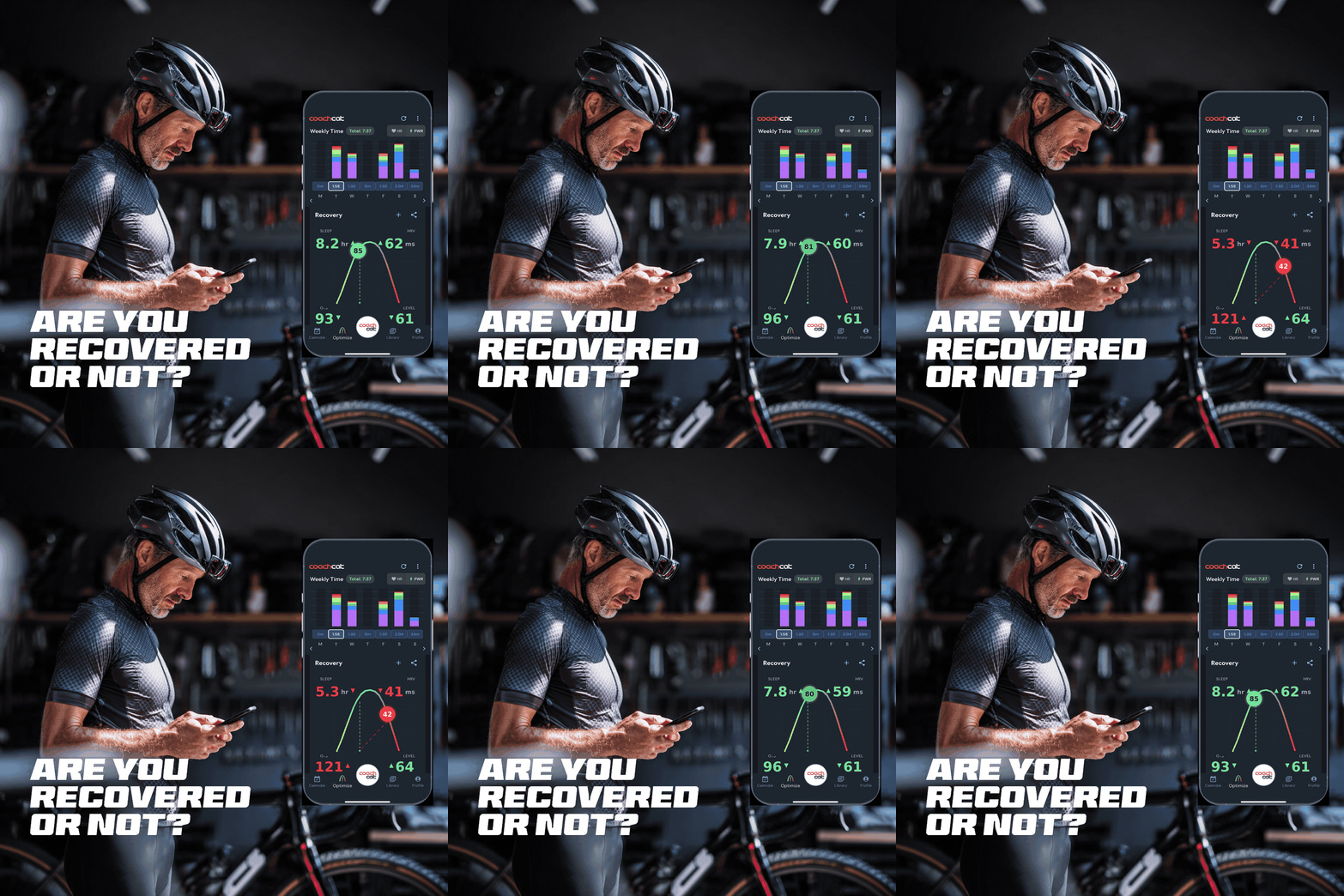
Are you recovered or not? CoachCat's Optimize screen turns your sleep, HRV, and training stress into a single readiness score, so you know whether to push or back off before you dig a hole.
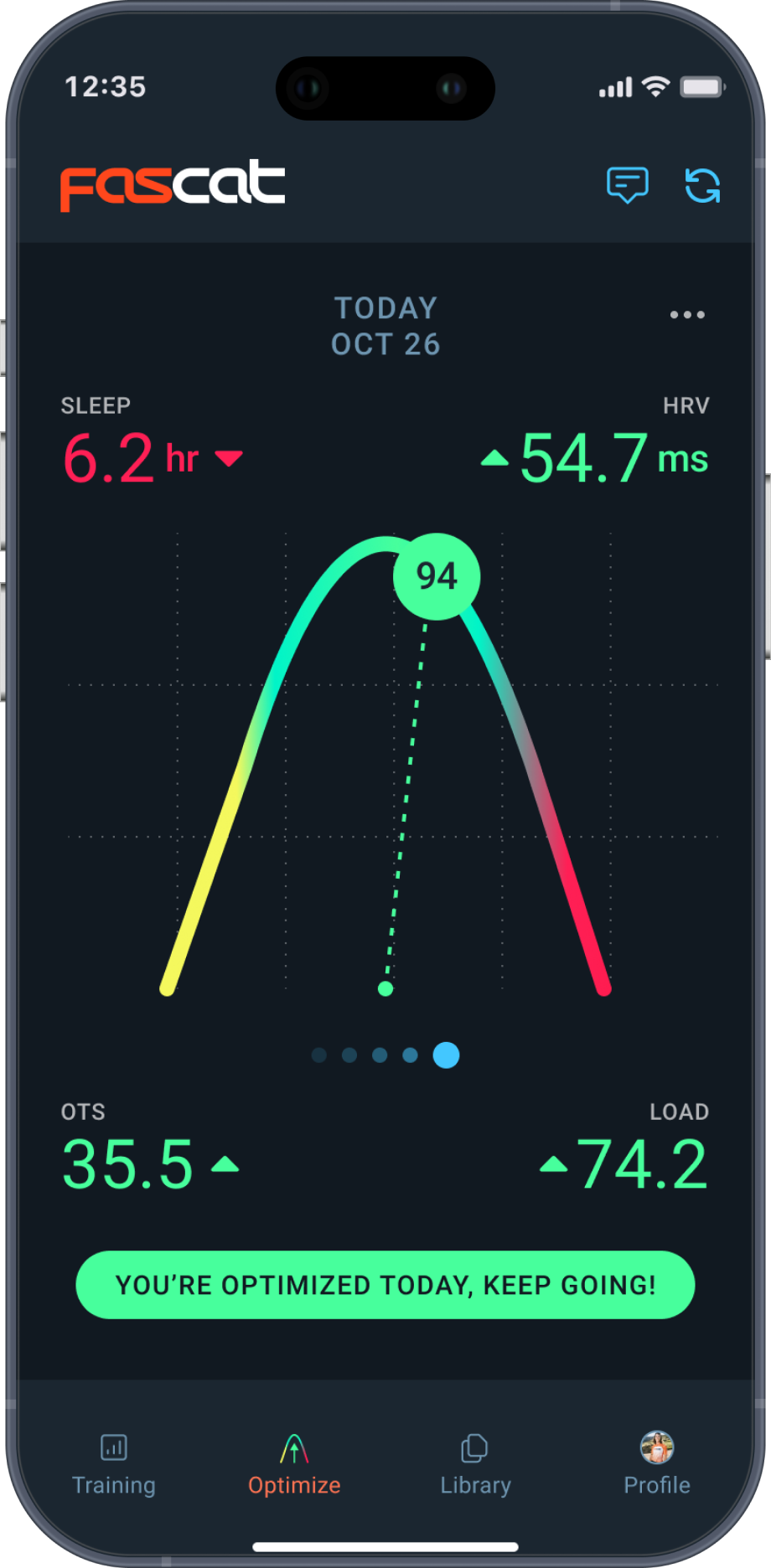
This is where the FasCat App shines for masters athletes. If you're on an Intermediate plan, use the Optimize Recovery Analysis every morning. It combines your training stress with your sleep and HRV data to give you a readiness score, so you can adjust before you dig a hole.
Because at the end of the day, the masters mantra is simple: fresher is faster. 😉
Why CoachCat Knows This and ChatGPT Doesn't
Here's something worth understanding. Everything in this article, the age-adjusted intervals, the recovery trifecta, the 5 rules, the strength periodization, is part of CoachCat's knowledge base. CoachCat is built on more than 20 years of FasCat coaching real masters athletes to national championships and world titles. This masters playbook isn't a blog post CoachCat happened to read. It's the coaching brain it runs on.
That's the difference between CoachCat and a general AI. Ask ChatGPT, Claude, or Gemini how a 55-year-old should train and you'll get a confident answer averaged from the entire internet, the good advice, the bad advice, and the generic middle. It has no coaching methodology of its own, and critically, it knows nothing about you. It has never seen your power file, your sleep, or your HRV.
CoachCat has both halves. It's grounded in this coaching philosophy, and it's connected to your data. So instead of "masters should generally recover more," you get "your Optimize readiness is low this morning, move today's VO2 workout to tomorrow." That combination, a proven coaching knowledge base plus your actual training data, is the difference between a search result and a coach in your pocket. A chatbot can describe masters training. CoachCat coaches you through it.
Masters Training FAQ
Can you still get faster as a cyclist after 50 or 60?
How many hours a week should a masters cyclist train?
Should masters cyclists do easier intervals?
Why do masters cyclists need more recovery?
What is the most important recovery tool for masters cyclists?
Do masters cyclists need to lift weights?
How much does VO2 max decline with age?
Do masters cyclists need more protein?
Is it too late to start cycling at 50 or 60?
References
- Tanaka H, Seals DR. "Endurance exercise performance in Masters athletes: age-associated changes and underlying physiological mechanisms." The Journal of Physiology, 2008.
- Lexell J. "Human aging, muscle mass, and fiber type composition." The Journals of Gerontology: Series A, 1995.
- Nichols JF, Rauh MJ. "Longitudinal changes in bone mineral density in male master cyclists and nonathletes." Journal of Strength and Conditioning Research, 2011.
- Pollock ML, et al. "Twenty-year follow-up of aerobic power and body composition of older track athletes." Journal of Applied Physiology, 1997.
Keep Learning
Want to go deeper? Here are four resources built specifically for masters athletes:
- The Seven Habits of Highly Successful Masters Cyclists
- The Three Vital Components of Masters Recovery
- Riding Faster After 50
- Age-Adjust Your Intervals
Getting older doesn't mean getting slower, it means getting smarter. Train less when you need to, recover like it's your job, stay consistent all year, and let the data guide you.
Work hard, ride fast, have fun, and as always, FtFP! 💪🚀
Ready to train smarter? Start a free trial of CoachCat and let your AI coach build a masters-friendly plan, age-adjust your intervals, and watch your recovery so you show up fresh. Learn more about CoachCat.
Riding a smart trainer app that plays workouts but never coaches you? See our TrainerRoad alternative comparison: why cyclists switch to CoachCat for age-adjusted plans, real periodization, and every ride analyzed.
