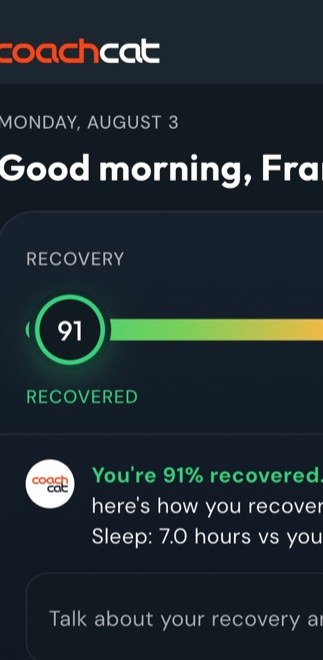



"For 12 of those years I followed structured training plans within TrainerRoad. Last summer I listened to the FasCat podcast, and after my off-season break decided to give CoachCat a try. I followed the weight training, sweet-spot base and finally gravel racing plans in preparation for a UCI gravel world series event last weekend, where I produced my best ever 3-hour normalized power, finished 3rd in my age group, and qualified for the World Championships. The CoachCat AI agent takes self-guided structured training to the next level."
If TrainerRoad has messed up your FTP, you're not alone. And an FTP problem is never just an FTP problem. Every interval, every training zone, every workout is built on that one number. Get it wrong and your whole plan is wrong. Too hard, and you dig yourself into a hole. Too easy, and you're leaving fitness on the table.
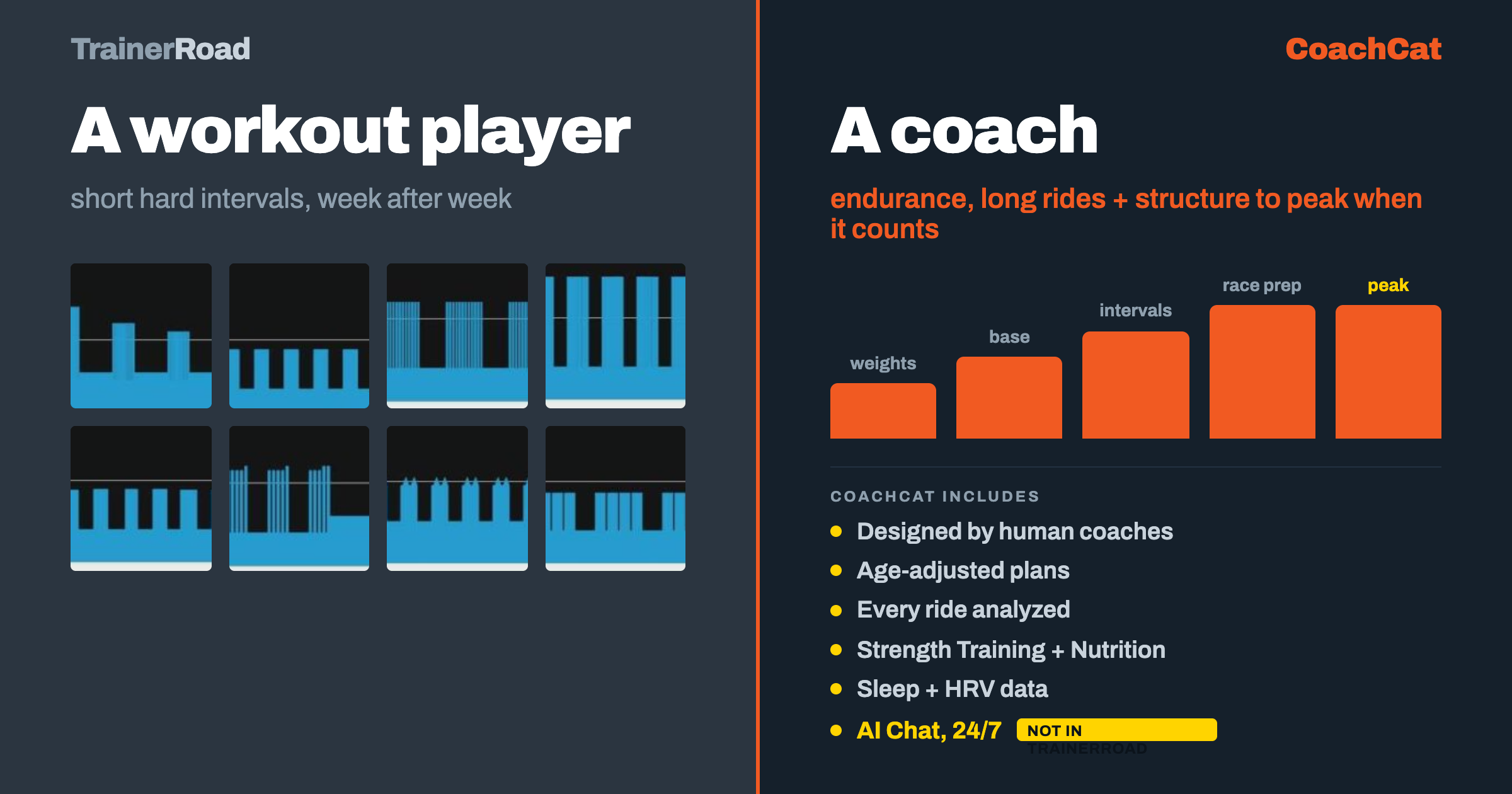
To be fair, TrainerRoad is a good indoor workout player. The intervals are precise, they land on your smart trainer, and they run flawlessly. But if you're searching for a TrainerRoad alternative, you've probably run into what a workout player doesn't do. It won't look at your rides, adjust your plan when life happens, or tell you the "why" behind any of it, and it does nothing for your nutrition, your lifting, or your recovery data.
The 7 reasons cyclists switch
- A coach that knows your age, not just your FTP
- Volume and training load, not the same intervals week after week
- Off-season strength and outdoor volume, which TrainerRoad doesn't offer
- A plan that bends when life throws a curveball
- Every ride analyzed, like having a coach on retainer
- The whole athlete, with strength, nutrition, and recovery included
- TrainerRoad users who switched are telling the story for us
There's a harder question worth asking, and it's about the methodology. If your year is built around indoor intervals, where is the off-season strength work, and where is the long outdoor volume that builds durability? Sweet spot base done right raises your FTP, but only as one block inside a full season. I'll show you what that looks like below.
That's the job CoachCat was built to do. TrainerRoad plays the workout. CoachCat coaches the athlete. Here's the difference, point by point.
One thing first, because it stops a lot of people from switching. Leaving TrainerRoad doesn't mean leaving what works. You keep your smart trainer, you keep ERG mode precision, and you keep structured intervals. Your CoachCat workouts export straight to Zwift, Rouvy, and your bike computer. The only thing that changes is who decides what goes into them, and why.
CoachCat vs. TrainerRoad at a glance
| CoachCat | TrainerRoad | |
|---|---|---|
| Strength training | Full strength plans integrated with your riding | Not offered |
| Nutrition | Meal plans and Winning in the Kitchen guidance | Not offered |
| Age-adjusted plans | Tuned for under 35 and masters 40, 50, and 60+ | One-size-fits-all progression levels |
| Every-ride analysis | Every ride reviewed automatically for power, HR, sleep, and HRV | Post-ride difficulty survey |
| Training philosophy | Structured midweek, long outdoor endurance on weekends, built around training load | Indoor-first structured intervals |
| Ask your coach anything | Coach chat trained on 25 years of real coaching | Forum and help docs |
| Coaching consultation | 1:1 consultation with an expert FasCat Coach included, a $100 value | Not offered |
| Human coaching support | Real coaches on hand Monday to Friday, 8am to 5pm, backing the instant AI chat | Not offered |
| Indoor workout control | Exports to your bike computer, Zwift, and Rouvy | Excellent native workout player |
| Plan changes | Full plan revision when life throws a curveball | Workout-level adaptations |
Reason 1: A coach that knows your age, not just your FTP
A 55-year-old athlete doesn't recover, adapt, or absorb training load the way a 28-year-old does. Every experienced coach knows it, and I build my plans around it. My plans are age-adjusted for athletes under 35 and for masters at 40, 50, and 60+, with intervals and weekly training hours calibrated to what your body can productively absorb at your age.
A workout player that only learns from whether you completed your last session can't reason about why a 60-year-old needs different recovery spacing than a 30-year-old. A coach who has trained thousands of masters athletes over 25 years can, and I built that judgment into every plan.
Reason 2: Volume and training load, not soul-sucking intervals week after week
Here's the structural flaw in the workout-player model. TrainerRoad is built around indoor structured training, so its plans lean on interval sessions you can knock out on the trainer, week after week. Hard intervals have their place, but they aren't the fastest way to get faster, and they definitely aren't the most fun.
My plans train you the way racing cyclists have always trained, with short, structured workouts during the work week, indoors or out, and long endurance rides on the weekend. I designed every one of those plans on 25 years of coaching, and they have earned over 1,000 five-star reviews from the athletes who have used them. I concentrate on volume and raising your training load, because raising your level is one of the easiest, most enjoyable, and fastest ways to get faster. And I prescribe regular rest weeks, because adaptation happens when you recover, not when you bury yourself. Volume and variety build durable fitness in a way repetitive indoor sessions never will.
Reason 3: The off-season strength block and outdoor volume TrainerRoad doesn't offer
Give TrainerRoad its due here. Their plans are periodized. The architecture runs Base, then Build, then Specialty, and their flagship base plan is literally called Sweet Spot Base. If you have trained on TR, you have followed a real progression, and I am not going to pretend otherwise.
Here is what that progression leaves out. It starts on the bike and stays on the bike. There is no off-season strength block, no barbell in November to build the force you turn into watts come spring. And because it is built around the trainer, it never builds a season around the long outdoor endurance volume that makes you durable for a 3-hour race. Those two pieces, off-season strength and outdoor volume, are the backbone of how I have coached athletes to peak for 25 years, and a bike-first workout library cannot give them to you. Sweet spot base is stronger when it sits on top of a winter of lifting and leads into real outdoor miles.
Don't take it from me. Take it from Gordon, a 12-year TrainerRoad veteran whose story opens this article. He followed the weights, sweet spot base, and race prep progression, and delivered his best ever 3-hour normalized power at a UCI gravel world series event. That is the progression over 1,000 five-star reviewers keep describing.
Reason 4: A plan that bends when life throws a curveball
A static plan breaks the first time real life shows up. With CoachCat, you get a full training plan revision when work, family, or illness derails your week, not just a swapped workout but a rethought plan. And when you want something specific, you can build any workout from a simple prompt. Ask for a Tour de France stage simulation, a climbing day, or whatever your season needs, and CoachCat builds it for you. Prefer to browse? There is a library of 300+ workouts, searchable across 45 filters.
Reason 5: Every ride analyzed, like having a coach on retainer
CoachCat reviews every single workout automatically (power, heart rate, sleep, and HRV) and gives you feedback the way a coach would: as a conversation, not a compliance score. Gary Robinson at Avid Cyclist put it this way after his review: "CoachCat truly feels like you have a dedicated team working for you," concluding that "for riders who prefer a more human-like interaction and a platform that actively talks to them about their recovery, CoachCat offers a superior, more engaging user experience."
And it's trained on something no one else has. I have personally taught CoachCat my 25 years of coaching, the physiological relationships between your data streams and the judgment calls a coach makes with them. When should low HRV change today's workout? When is the right answer "rest," even though the plan says intervals? That is the difference between software that retrieves information and a coach that coaches you.
Reason 6: The whole athlete, with strength, nutrition, and recovery included
Getting faster isn't only about intervals. CoachCat includes strength training plans, meal plans, and recovery guidance alongside your riding. One plan, one place. As one athlete on TrainerRoad's own forum noted, "FasCat has a big leg up on TR when it comes to nutrition and strength training." Another put it more simply: "I have been using the optimize app for about 6 months and am now using CoachCat. Honestly, it's awesome."
Reason 7: TrainerRoad users who switched are telling the story for us
Gordon isn't alone. The most interesting conversation about CoachCat is happening on TrainerRoad's own forum, where users have been comparing notes for over a year. One athlete guessed how I built it, unprompted. "The idea was ingenious, because I assume they trained Coach Cat on the conversations with FasCat athletes." (He assumed right.)
The most telling story belongs to a self-described time-crunched dad who trialed CoachCat early, left frustrated with some rough edges, then came back a year later and bought a full season: "The support has been phenomenal and the app and AI have taken huge strides forward in recent months and weeks." His verdict after switching from TrainerRoad: "my durability already feels to me much better than when I was on TR," and "after years of ERG monotony, I'm loving it honestly."
Frequently asked questions
How is CoachCat different from TrainerRoad's Adaptive Training?
Adaptive Training adjusts workout difficulty based on completion data. FasCat plans build progression in from the start, with longer rides each week, harder intervals, VO2 max efforts stepping from 3 to 4 to 5 minutes, and Sweet Spot Base parts 1 through 4. That progression has 20 years of coaching experience baked into it, in what we call Fatigue Dependent Training Plan Design: we know how tired you will be at every point in the plan, so we prescribe workouts that match that fatigue, and that sets you up to actually follow the plan. On top of that, CoachCat coaches. It analyzes every ride against your sleep, HRV, and season plan, adjusts your training the way a human coach would, and explains why, in a chat where you can ask anything.
Do I have to ride indoors all week?
No, and that's the point. FasCat plans use short structured workouts during the work week, indoors or outdoors, and long endurance rides on the weekend. You build fitness with volume and training load, not a full week of indoor interval sessions.
Is CoachCat just ChatGPT for cycling?
No. A general-purpose chatbot pulls from the open internet, Reddit threads and blog posts of unknown quality. CoachCat is built on FasCat's proprietary dataset, 25 years of coaching real athletes, from first-time century riders to national champions, taught to CoachCat by me, the coach who lived it.
What if I'm a masters athlete?
This is where CoachCat shines. Plans are age-adjusted at 40, 50, and 60+, with intervals and weekly hours tuned to how your body actually recovers and adapts at your age.
Does it cost more than TrainerRoad?
No. Annually it is the same price. TrainerRoad is $17.45/mo billed annually ($209.99/yr), or $21.99/mo month to month. CoachCat is $17.50/mo billed annually. For that same money you also get strength plans, nutrition, every ride analyzed, and a coach chat you can ask anything, none of which TrainerRoad offers. And you can try CoachCat before you pay. Our 7-day trial is free and takes no credit card, while TrainerRoad charges you upfront and refunds within 30 days if you cancel. You also get a coaching consultation with an expert FasCat Coach, the same consultation we give our 1:1 athletes and a $100 value. And behind the instant AI chat there is real coaching support from the FasCat team, Monday to Friday, 8am to 5pm, whenever you want a second opinion.
The bottom line
Keep the trainer. Keep the structure. Add a coach. TrainerRoad optimizes the workout. CoachCat coaches the athlete, with your data, your calendar, your age, and 25 years of coaching knowledge behind every recommendation.
Don't take my word for it, read what over 1,000 athletes have to say about training with CoachCat!
Ready to train with a coach that actually knows you?
Your data, your calendar, your age, and 25 years of coaching knowledge behind every recommendation. Keep the trainer. Add a coach.
Start Your Free 7-Day Trial of CoachCat