

The hardest workout of the year is the one where you do not follow a plan at all. Every fall we have this conversation with athletes: the season is over, and the best thing you can do for next season is to stop training. A proper post season break is 100% individual and works best as a collaboration between coach and athlete. Done right, you will draw on it all next season.
Here's the short version: take 2 weeks off structured training, re-establish your life balance, and ride only when your soul wants to. That's it. The rest of this article is why those three rules work and how to follow them without losing your mind, your fitness, or your motivation.
 Replay
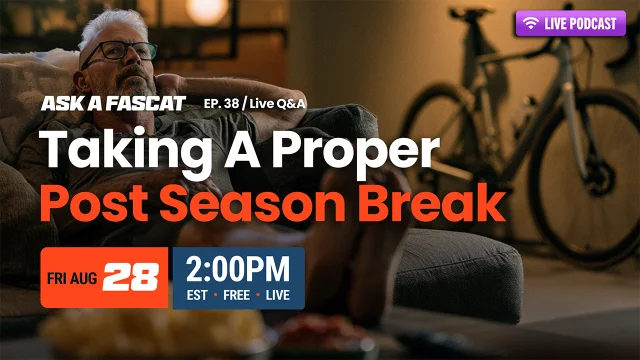
Watch the replay: taking a proper post season break
Ask a FasCat Ep. 38, recorded live on August 28, 2026. Frank makes the case for two weeks off the bike and answers questions about the break from the chat.
Watch the replay on YouTube
Replay
Watch the replay: taking a proper post season break
Ask a FasCat Ep. 38, recorded live on August 28, 2026. Frank makes the case for two weeks off the bike and answers questions about the break from the chat.
Watch the replay on YouTube
The Break Is Part of the Plan
Sports psychologists describe the post season break as a transition season: a stretch where the athlete and coach work on objectives outside of training and competition. In other words, your mental game. The point is not to stop all physical activity. The point is to stop the strict regime of training, diet, travel, and racing, add balance back into your life, and slowly start sketching out goals for the upcoming season. Think of it as hitting the reset button on life.
"Not following a training plan" is a better description than "no bike." Getting out of your daily training routine is the best training you can do after a long season, because following a plan is stressful and full of sacrifice. A proper break removes that stress and brings you back into balance with everything else: family, work, kids, relationships, friends, and other hobbies. Most importantly, it brings your motivation back for next season.
Above all, a proper post season break is a total mental and physiological break from the pressure and stress that a training plan and racing create. It returns you to a better place for training and racing than you were in before the break.
The Three Rules of a Proper Post Season Break
- Take 2 weeks off. Professional athletes may need 3 to 4 weeks of not following a training plan. The length of your break depends on how long you have been in the sport and how much time you have to train when it is time to train. For the vast majority of athletes we coach, 2 weeks is ideal. And do not take 6 weeks: that is too long. Six weeks off means roughly 6 more weeks of rebuilding, a 12 week swing just to get back to where you were.
- Re-establish life balance. Be a normal person who does not get up at the crack of dawn to train, rush to work, and get cranky. Focus on the parts of your life that matter more than sport. Be present in your relationships at home and at work.
- Soul rides. A soul ride is whatever ride makes you happy: your favorite route with your favorite training partner, as long or short, hard or easy as you want. You may have heard of "happiness watts." A soul ride can also be no ride at all. That is the beauty of not following a training plan.
For Athletes: How to 'Do' Your Break
- Relax. There is no pressure to complete 3 x 10 minutes at x, y, and z watts. Seriously, relax.
- Fix the nagging injury. The break is the time to address the injuries that need time off to heal. Back and knee pain are common for endurance athletes, and now is your window to work on them.
- Reconnect with the bike and with life. Soul rides for the former. For the latter: sleep in, stay out late, take the kids to a ball game, or plan a getaway with your significant other as a way of saying "thanks for putting up with me this season." Now is also a good time to impress the boss and make up for all those Monday mornings you were wrecked from a weekend of racing.
- Meditate. Yoga counts and comes with bonus mobility benefits. Racing burns an enormous amount of mental energy, and this is how you recharge it.
- Ask CoachCat to analyze your season. While the legs rest, review the season you just finished: your weekly hours, Level, power PRs, and FTP over the year. Follow our season in review training tip for the exact CoachCat prompts, and bring what you learn to your goal setting talk.
And take a break from being a geeky, regimented cyclist. If you were following a strict performance diet, stop. Eat the cookies, order the steak. If you were protecting 8 to 9 hours of sleep a night, stay up late and do not worry about it. Forget your resting heart rate and your power to weight ratio. All good things come to an end, and that is the point: indulge now so you can hold all the components of being a performance cyclist together when training resumes.
The Type A Caveat
One caveat on soul rides: some type A athletes will overdo 'it'. A good coach recognizes this and prescribes complete time off instead of optional riding. We all love the bike, some more than others, and the athletes who skip a real break are the ones who get 8 to 12 weeks into their off season plan and suddenly need one.
For Coaches: Read, Plan, Talk Goals
- Read the athlete's motivation before and after the break. If there is no improvement, the break was not long enough. Wait for cues from the athlete.
- Start the Annual Training Plan. You will not finish it, not even close, but when the athlete comes back refreshed and ready to charge, the coach needs the 10,000 foot view: a blueprint for how the athlete will achieve their goals.
- Have the goal setting talk. You cannot have this talk at the start of the break because the athlete is not ready. You will know they are ready when they start talking about next season on their own. That is your cue to shape those goals into a plan.
I used to be a black and white "no bike for 2 whole weeks" coach. Nowadays I find that toeing a gray line in collaboration with the athlete works better. As a coach, I enjoy this time of year as much as race season: watching an athlete go from worn out and unmotivated to talking about a podium at next summer's goal race, all in 2 to 4 weeks, never gets old.
Let CoachCat Plan Your Break and Your Comeback
Everything in this article is part of CoachCat's coaching knowledge base, built on more than 20 years of FasCat coaching. Ask a generic chatbot about the off season and you will get advice averaged from the entire internet, from a bot that has never seen your training. CoachCat knows this philosophy and your data: your season, your Level, your OTS. So when your last race is done, tell it:
When your motivation comes back, your off season training plan will be waiting.
Prefer to listen? We dedicated a full podcast episode to the post season break:
Post Season Break FAQ
How long should a post season break be?
Should I stop riding completely?
Will I lose fitness during a 2 week break?
Can I eat whatever I want on my break?
When should I start training again?
Keep Learning
Ready to think about what comes after the break?
- Weight Lifting for Cycling: The Complete 10 Week Guide
- Post Season Break and Figuring Out Goals for Next Season
- What to Do During Your 2 Week Post Season Break
- Off Season Training for Cyclists
- How to Lift Weights to Get Faster on the Bike
For the 2 weeks after your season ends the plan is no plan, so FtFP! 💪🚀
The Break Is Step One. CoachCat Builds Step Two.
When your motivation comes back, your AI coach is ready with the weights, the sweet spot base, and an Annual Training Plan pointed at next season's goal. First week free.
Start My Off Season →