

Weight lifting for cycling works: you can increase your Functional Threshold Power (FTP) by lifting weights, when the lifting is done in a cycling specific manner. We know because we've been coaching cyclists through the following 10 week, 4 phase, cycling specific weight lifting program for more than 20 years. Athletes who follow it typically gain 10 watts or more from the lifting alone, and 15 to 50 watts by spring once the base training that follows is complete.
Watch Coach Frank Overton walk through the entire program in the video above, then read on for the phase by phase details: the exercises, the sets, the reps, the percentages, and how to turn gym strength into watts on the bike.
What you'll learn in this guide
- Why lifting raises your FTP and what makes this program cycling specific
- The 4 phases: Adaptation, Hypertrophy, Strength, and Power, with sets, reps, and percentages for each
- The best weight lifting exercises for cyclists: the squat, the leg press, and the hamstring curl
- When to start lifting in your season and how the 10 weeks fit into your off season
- How to transfer gym strength to the bike with neuromuscular sprints and standing starts
- How many watts you can realistically gain, and how to keep them
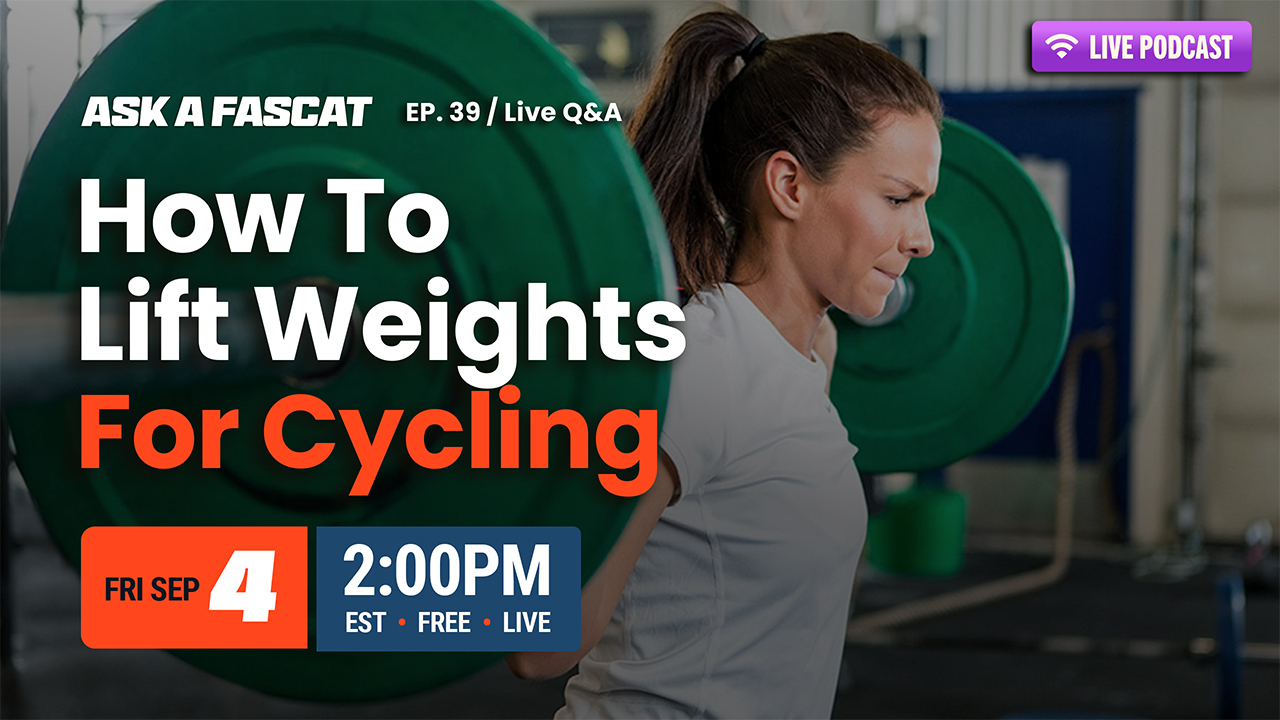 Replay
Watch the replay: how to lift weights for cycling
Ask a FasCat Ep. 39, recorded live on September 4, 2026. Coach Frank walks through the 4 phases, the exercises, the sets and reps, and when to start lifting, then answers questions from the chat.
Watch the replay on YouTube
Replay
Watch the replay: how to lift weights for cycling
Ask a FasCat Ep. 39, recorded live on September 4, 2026. Coach Frank walks through the 4 phases, the exercises, the sets and reps, and when to start lifting, then answers questions from the chat.
Watch the replay on YouTube
Why Lift Weights for Cycling?
Your power on the bike comes from the force you put into the pedals, stroke after stroke. Weight lifting raises the ceiling on that force, and when you then train the new strength at cycling speeds, it shows up where it counts: a higher FTP, a harder attack, and legs that hold up deep into a long race or ride.
The research backs this up. In their review of strength training for endurance athletes, Ronnestad and Mujika concluded that "combining endurance training with explosive and heavy strength training will improve endurance performance due to the delayed activation of less efficient type II fibers, improved neuromuscular efficiency, [and] conversion of fast-twitch type IIX fibers into more fatigue-resistant type IIA fibers."
In coaching terms, that means:
- More watts at threshold. Improved neuromuscular efficiency and cycling economy raise your FTP.
- A bigger punch. Greater short term power to attack, counterattack, respond to surges, and carry momentum over technical terrain.
- Durability. Fatigue resistant muscle fibers keep you strong in the final hour when everyone else is fading.
- Healthy aging. Resistance training counteracts age related muscle loss, and because cycling is not a weight bearing sport, the gym is one of the few places a cyclist loads their bones.
Our Philosophy on Resistance Training for Cyclists
- Sprinters should follow a weight program for at least 2 years to develop the muscle adaptations necessary for sprint power.
- Time Trialists, Mountain Bikers, Cyclocrossers, Triathletes, and Road Racers will increase their Functional Threshold Power with this strength training. They will also increase the amplitude of their short term power output to attack, counterattack, respond to surges in the peloton and carry momentum over technical terrain.
- Masters athletes benefit from resistance training to prevent age related declines in performance.
- Resistance training needs to be speed specific and has accompanying neuromuscular work coupled to the gym workouts.
During the 4 phases of weight lifting, cyclists first build new muscle (hypertrophy phase) and then train that new muscle to produce great force (strength phase). Then, most importantly, in the 4th and final phase cyclists train that new muscle capable of producing great force to contract at speeds specific to cycling (power phase).
"Speeds specific to cycling" is the secret sauce of this program. The weight lifting is made cycling specific by the velocity of the lifts plus the neuromuscular sprint workouts that are coupled to the Strength and Power phases.
The 4 Phases of Cycling Specific Weight Lifting
Successful resistance training involves more than just a lot of squats, which is why you need a plan. You'll want to break down your time in the weight room into four phases, each with a physiological purpose, and couple those phases with on the bike training to take the strength gains from the gym out onto the bike. Here's the whole program at a glance:
| Phase | Duration | Sets x Reps | Weight (% of 1 rep max)* | Frequency |
|---|---|---|---|---|
| 1. Adaptation | About 3 weeks | 4 x 8 | Light, technique focus | 3 days per week |
| 2. Hypertrophy | 2 weeks | 6 x 8 to 12 | 65% to 75% | 3 to 4 days per week |
| 3. Strength | 2 weeks (4 to 5 workouts) | 4 x 6 or fewer | 70% to 100% | 2 to 3 rest days between workouts |
| 4. Power | 2 weeks (4 to 5 workouts) | 4 x 6, max velocity | 45% to 60%, as fast as possible | 2 to 3 rest days between workouts |
* You don't have to do the math on your loads: we give you a resistance training calculator that computes the exact weight to lift for every set and phase from your 1 rep max. It's included with the Weight Lifting for Cycling plan and in CoachCat.
Neuromuscular sprint work on the bike is coupled to the lifting in phases 3 and 4, and recovery weeks round out the 10 weeks. Here's what each phase looks like in practice.
Phase 1: Adaptation
Start gradually. The first three weeks are about developing proper and safe squat technique and letting your muscles and joints adapt to forces much different than they encounter on the bike.
- The lifts: the squat, the leg press, and the hamstring (leg) curl. Add the hip thrust if you have prior weight lifting experience.
- Sets and reps: 4 sets of 8 repetitions (reps), with 2 minutes of rest between sets.
- Weight: light to start, increasing gradually over the three weeks.
- Frequency: 3 days per week.
Choose weight that is challenging but never so heavy that you cannot finish a set or find yourself sore in the days that follow.
Phase 2: Hypertrophy
After three weeks you are ready for the big time: building muscle. Muscle size is closely correlated with muscle strength, so the goal of this phase is to build the legs that fill out your bib shorts. It's OK to gain some weight during this phase! In power to weight terms you are gaining far more power than the 1 to 4 pounds of muscle you may add.
- Sets and reps: 6 sets of 8 to 12 reps, with 2 minutes of rest between sets.
- Weight: 65% to 75% of your 1 rep max (1RM, the most weight you can lift once with good form), increasing roughly 5% from one set to the next.
- Frequency: up to 4 days per week, for 2 weeks.
Select weight that is hard but allows you to just finish all six sets. As the workouts start to feel easier, resist the urge to keep piling on weight. Recover better from the workouts instead.
Phase 3: Strength
Once you've put on a few pounds of power producing leg muscle, it's time to train this muscle to produce more forceful contractions. Without going into a physiology lecture, the goal is to teach your brain to innervate (contract) the musculature you built in the hypertrophy phase. Fewer reps and heavier weight is the name of the game.
- Sets and reps: 4 sets of 6 reps or fewer. For an even greater training effect, add weight with each set and drop the reps.
- Weight: 70% and up to 100% of your 1RM, increased in a safety conscious way.
- Frequency: 4 to 5 workouts over 2 weeks, with 2 to 3 recovery days between lifting days.
- On the bike: neuromuscular sprint intervals coupled with the gym work, to transfer the gains made in the weight room out onto the bike.
Lifting this heavy produces great stress, and progress only comes with adequate recovery. Honor the rest days.
Phase 4: Power
The final phase is the fun part. Muscle strength is speed specific, and up until now we haven't been lifting at speeds specific to cycling. Now you drop the weight to almost ridiculously easy levels and perform each lift as fast as possible. The squat becomes the "jump squat" as you accelerate out of the squatting position so fast that you actually leave the ground.
- Sets and reps: 4 sets of 6 reps, every rep as fast as possible.
- Weight: 45% to 60% of your 1RM.
- Frequency: 4 to 5 workouts over 2 weeks, with 2 to 3 rest days in between.
- On the bike: standing start sprints coupled to the gym workouts, to transfer the speed specific gains from the gym to the bike.
Please exercise extreme caution and safety in the weight room during this phase. A Smith machine has built in safety features that make it a reasonable place to perform jump squats, and an even better recommendation is to work with a personal trainer to learn proper jump squat form and technique.
The Best Weight Lifting Exercises for Cycling
You may notice this program is built on just three primary lifts, plus one optional one:
- The squat, the king of cycling strength work. Nail your squat form in the adaptation phase before the weight gets heavy.
- The leg press, which lets you load the same musculature safely, especially useful in the strength phase when the percentages climb. Here's how to use the leg press for cycling.
- The hamstring (leg) curl, to balance all that quad work and protect your knees.
- The hip thrust (optional), for athletes with prior weight lifting experience.
That's on purpose. Cyclists don't need a 12 exercise circuit; they need heavy, targeted work on the muscles that drive the pedals, with enough left in the tank to recover and ride. If you don't have access to a gym, see our guides to at home weight lifting for cyclists and alternative weightlifting movements.
When Should Cyclists Start Lifting Weights?
In the off season, after your post season break. There is no single month to start. Your start date comes from counting backward from your first goal event, not off a calendar, because a cyclocross racer, a spring stage racer, and a summer gravel racer all reach that week at different times.
When given enough time in the off season, our coaches split it into two parts: the first half includes these 10 weeks of resistance training, followed by 8 to 12 weeks of sweet spot and aerobic endurance training. That sequence, weights then base then intervals, is the backbone of the Annual Training Plan. If your season ends late or your goals come early, shift that whole sequence earlier to land on the date you counted back to.
You keep riding while you lift, mostly easy endurance between gym days. The hard work during these 10 weeks happens in the gym, plus the short neuromuscular workouts that are part of the program.
How Many Watts Can You Gain?
Ten weeks for 10 watts or more. That's the typical FTP return our athletes see from the lifting itself, and it's why we named the video that way. The full payoff arrives in the spring: the strength you build in the gym multiplies the base training that follows it, and athletes routinely arrive at their first races 15 to 50 watts stronger than the year before.
The biggest gains go to athletes who have never lifted in a structured, cycling specific way, and to masters athletes, who have the most muscle to reclaim. Prefer to listen? Coach Frank breaks down the entire program on the podcast:
From the Gym to the Bike
Strength that stays in the weight room doesn't win bike races. The transfer happens through the on the bike work coupled to the program:
- Neuromuscular sprint intervals during the Strength phase teach your newly stronger muscles to fire at pedaling speeds.
- Standing starts during the Power phase turn maximum force into maximum power from a near standstill.
- Muscle tension intervals afterward lock the strength in: low cadence, high force climbing efforts that bridge the gym and your base training.
There you have it: more power for you to put into the pedals.
Get the 10 Week Plan in CoachCat
You could write all of this down and program it yourself, or you can have it scheduled for you. Your CoachCat free trial includes the complete 10 week weight lifting plan: daily gym workouts with your sets, reps, and weights computed for you by the resistance training calculator, the neuromuscular and muscle tension workouts timed to the right phases, and unlimited plan adjustments when life happens. Prefer a standalone plan? The Weight Lifting for Cycling training plan has you covered.
Copy that into CoachCat and your gym days, sets, reps, and percentages land on your calendar.
Why CoachCat Knows This and ChatGPT Doesn't
Everything in this guide, the 4 phases, the percentages, the sprint coupling, the timing within your season, is part of CoachCat's knowledge base. CoachCat is built on more than 20 years of FasCat coaching real athletes through this exact program. This isn't a blog post CoachCat happened to read. It's the coaching brain it runs on.
Ask ChatGPT, Claude, or Gemini for a cycling weight lifting plan and you'll get something that looks good: squats, sets and reps arranged in tidy weeks. Follow it and you may get stronger in the gym, but don't expect your power output to change. A generic plan doesn't piece together all 4 phases with the right sets, reps, and loads in the right sequence, and it leaves out the neuromuscular on the bike work that transfers the strength from the weight room out onto the bike. Strength that never makes it to the pedals is just gym strength.
That's what an answer averaged from the entire internet gets you: powerlifting advice, bodybuilding advice, and the generic middle. A general AI has no coaching methodology of its own, and critically, it knows nothing about you. It has never seen your power files, your sleep, or your training plan.
CoachCat has both halves. It's grounded in this program, and it's connected to your data. So instead of "cyclists should do squats," you get your Adaptation phase scheduled around your rides, today's weights and reps, and a heads up to move a gym day when your Optimize score says you haven't recovered. A chatbot can describe weight lifting for cycling. CoachCat coaches you through it.
Weight Lifting for Cycling FAQ
Does weight lifting increase FTP?
When should cyclists start lifting weights?
How many days a week should a cyclist lift weights?
Should cyclists lift heavy or light weights?
Will weight lifting make me too heavy for climbing?
Can I lift weights and ride on the same day?
Should cyclists lift weights year round?
Keep Learning
Ready to go deeper on strength work and the off season?
- Proper Squat Form for Cycling
- At Home Weight Lifting for Cyclists
- Alternative Weightlifting Movements for Cyclists
- How to Lift Weights to Get Faster on the Bike
- The Annual Training Plan: All 7 Phases Explained
- Sweet Spot Training: The Complete Guide
References:
- Ronnestad BR, Mujika I. "Optimizing strength training for running and cycling endurance performance: A review." Scand J Med Sci Sports. 2014;24(4):603-612.
- Ronnestad BR, Hansen EA, Raastad T. "In-season strength maintenance training increases well-trained cyclists' performance." Eur J Appl Physiol. 2010;110(6):1269-1282.
- Aagaard P, et al. "Effects of resistance training on endurance capacity and muscle fiber composition in young top-level cyclists." Scand J Med Sci Sports. 2011;21(6):e298-e307.
- Vikmoen O, et al. "Strength training improves cycling performance, fractional utilization of VO2max and cycling economy in female cyclists." Scand J Med Sci Sports. 2016;26(4):384-396.
10 Weeks for 10 Watts or More
Start your free trial of CoachCat and the 10 week weight lifting for cycling plan is included: daily gym workouts with your sets, reps, and weights, the on the bike workouts that go with them, and unlimited plan adjustments.
Start Lifting Right →