

Muscle Tension Intervals are big gear, low cadence efforts that work like lifting weights on the bike. Pair them with weight training for cycling and you get an even better adaptation: MTIs prepare your legs for the forces they will meet in the gym, then help you turn that gym strength into power on the pedals. That is why they are a big part of our Fall Foundation Training and our 30 Week Off Season Plan.
What you'll learn
- What Muscle Tension Intervals are and why they build strength you can use on the bike
- How to do them: gear, cadence, terrain, and form
- A 5 week MTI progression you can start this week
- The sport science: why seated efforts on a 2 to 4% grade target your glutes
- How to pair MTIs with weight training in your off season
What are Muscle Tension Intervals?
As athletes move from summer to fall and review their seasons, many tell me their biggest weakness was not having enough strength. A lot of them think, "I need to spend more time in the gym." That is not always the answer, because you can target strength on and off the bike.
The key is applying the strength you build directly to the pedals. The solution is to pair a gym program with an exercise on the bike that builds sustainable strength while keeping the movement specific to cycling. That exercise is Muscle Tension work.
MTIs, or Muscle Tension Intervals, are high torque intervals done at a low cadence. We like to call them "big gear mashers." They are best done up a steady 2 to 4% grade or on an indoor trainer, so the effort stays controlled and uninterrupted.
How to do Muscle Tension Intervals
- Pick your terrain. A steady 2 to 4% climb or your indoor trainer. No steady climb nearby? Watch the video above to see how to do MTIs on Zwift.
- Shift into a big gear. Choose a gear that takes real work to turn over and puts your cadence at 40 to 60 rpm.
- Stay seated. Seated efforts let you control how your glutes fire.
- Pedal all the way around. Push with your quads, pull with your hamstrings, and engage your glutes, applying torque through all 360 degrees of the pedal stroke. The slow cadence will make any dead spots in your stroke obvious.
- Hold a steady Sweet Spot effort. CoachCat prescribes MTIs at Zone 3 to Sweet Spot, 84 to 97% of threshold. The big gear supplies the torque, so don't turn them into a threshold effort. This is about targeted muscular work.
- Start short. Begin with 2 x 5 minutes, then build the duration week by week.
A 5 week Muscle Tension Interval progression
Once you have mastered a couple of 5 minute efforts, slowly bump up the duration. A good multi week progression looks like this:
| Week | Intervals | Recovery between | Total MTI time |
|---|---|---|---|
| Week 1 | 3 x 7 minutes | 3.5 minutes | 21 minutes |
| Week 2 | 3 x 10 minutes | 5 minutes | 30 minutes |
| Week 3 | 4 x 8 minutes | 4 minutes | 32 minutes |
| Week 4 | 5 x 9 minutes | 4.5 minutes | 45 minutes |
| Week 5 | 4 x 10 minutes | 5 minutes | 40 minutes |
Keep building until you can hold 20 minutes steady and strong. During the off season you should be able to do MTIs twice a week without putting too much stress on your body or needing a lot of recovery.
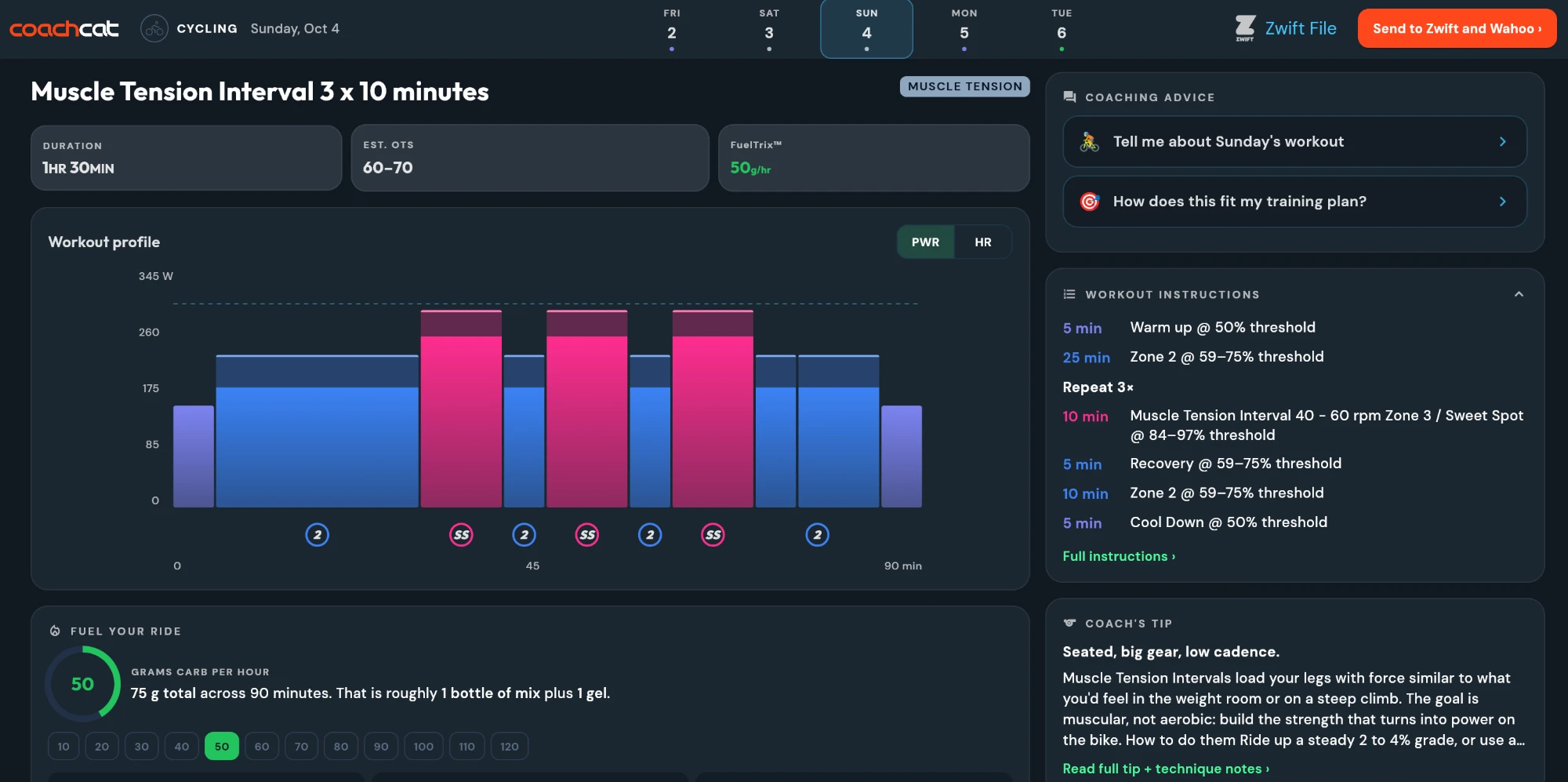
Find it in the CoachCat workout library
CoachCat's workout library has 18 Muscle Tension workouts ready to go. Open CoachCat in the app or on the web, tap Library, search for Muscle Tension, and add any of them to your calendar. Every interval is already scaled to your FTP, and they send straight to Zwift and Wahoo. Want something different? Ask CoachCat to build it. Longer intervals, a different cadence, MTIs on your local climb, or a session that fits around your gym days: its AI can customize a Muscle Tension workout any way you want. Open the workout libraryThe sport science behind MTIs
MTIs help you target your glutes, which matters because cyclists tend to be quad and hamstring dominant. With EMG (electromyography), researchers can track how well efforts like MTIs activate particular muscles. In the study "Muscular activity during ergometer cycling," Ericson (1986) found that the hip extensors provided 27% of the total work. That is a sizable share, and the glutes are a large part of the hip extensors, so focusing on them is well worth it.
Another EMG study, "Muscular activity during uphill cycling: effect of slope, posture, hand grip position and constrained bicycle lateral sways" (Duc, Bertucci and colleagues, 2008), compared seated and standing climbing. A wide range of muscles, upper and lower body, were much more active when standing. That is why we recommend doing MTIs seated: you can better control how your gluteus maximus fires.
Finally, grade matters. Research by Sarabon and colleagues (2012) showed a drop in glute activation on grades that are too steep. To best recruit your glutes, do your MTIs up a steady 2 to 4% grade.
Pair MTIs with weight training
Paired with weight training, Muscle Tension Intervals help turn strength into pure power transfer on the bike, so you get the most from the gains you make in the gym. Use them carefully, especially if you have a history of knee injuries.
Why CoachCat knows this and ChatGPT doesn't
Ask a general chatbot about strength work for cycling and you will get an average of everything on the internet. CoachCat is built on how FasCat actually coaches: MTIs are written into our Fall Foundation and 30 Week Off Season plans, timed around the 10 week weight lifting plan, and progressed the way you see above. And CoachCat sees your own data, so it can fit MTIs around your rides, your recovery, and your gym days.
To do Muscle Tension Intervals as described in this training tip, start a free month of CoachCat. The Fall Foundation plan, the 10 week weight lifting plan, and the 30 Week Off Season Plan are all included, along with a custom plan builder, unlimited revisions, and custom workouts.
Frequently asked questions
What are Muscle Tension Intervals?
What cadence should I use for MTIs?
How hard should Muscle Tension Intervals be?
How long and how often should I do MTIs?
Can I do Muscle Tension Intervals indoors or on Zwift?
Do MTIs replace weight training?
Are Muscle Tension Intervals safe for my knees?
References
Ericson, M.O., Bratt, A., Nisell, R. et al. Europ. J. Appl. Physiol. (1986) 55: 229.
Duc S, Bertucci W, Pernin JN, Grappe F. "Muscular activity during uphill cycling: effect of slope, posture, hand grip position and constrained bicycle lateral sways." J Electromyogr Kinesiol. 2008 Feb;18(1):116-27.
Sarabon N, Fonda B, Markovic G. "Change of muscle activation patterns in uphill cycling of varying slope." Eur J Appl Physiol. 2012 Jul;112(7):2615-23.
