

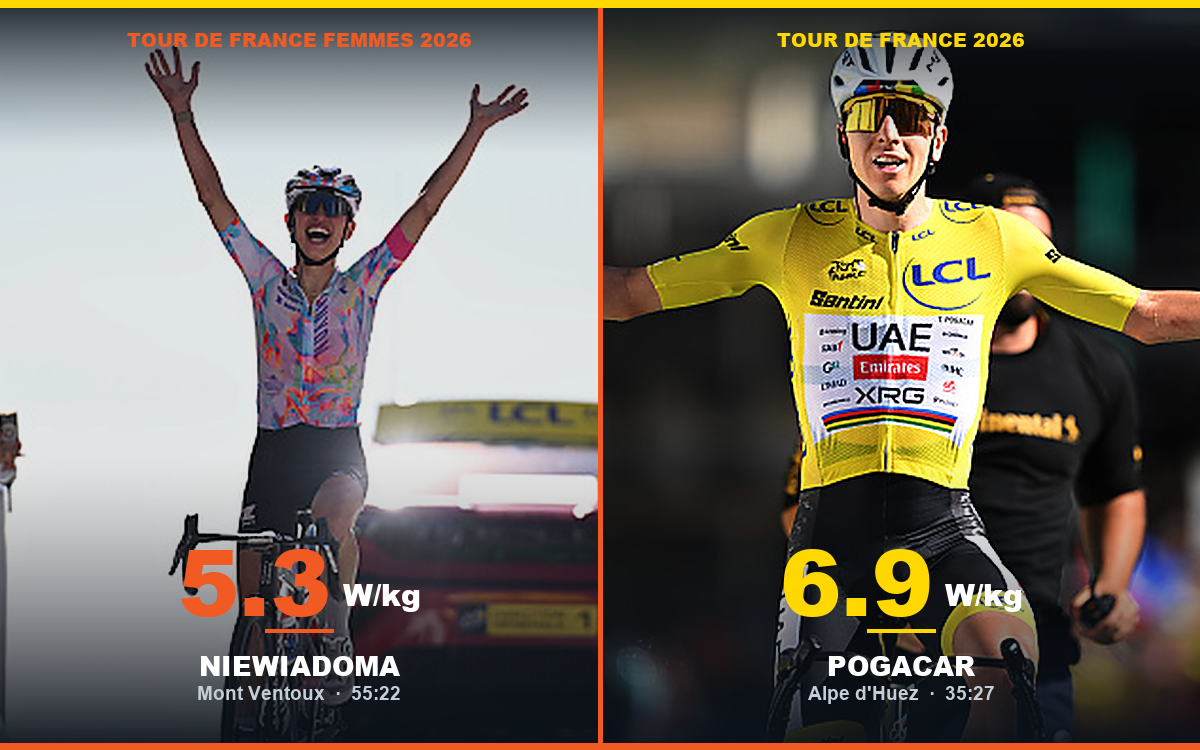
This summer we put physics-based power estimates on every stage of the men's Tour de France and every stage of the Tour de France Femmes. Now that both races are in the books, we can line the numbers up side by side. Not to score men against women, but because the best of the best defines what is physiologically possible, and that helps us coach amateur men and amateur women better. The headline finding: women sprint at the same watts per kilogram as men. On the climbs there is a gap, and it is the same gap at every duration. As Dr. Stacy Sims puts it: women are not small men. The numbers below show exactly what she means.
The Numbers, Side by Side
Lorena Wiebes
the field sprinters
W/CdA is watts divided by drag area in square metres, the number that sets your speed on flat ground. Physics-based estimates unless marked measured, and the two time trial courses were not identical, so treat that pair as a ballpark.
Here's what we found: Women sprint at the same watts per kilogram as men. Not close to, not almost: the same. On the climbs they hold about three quarters of the men's power, and that ratio barely moves whether the climb lasts 8 minutes or the better part of an hour. Against the clock, the number that decides is not watts per kilogram at all, it is watts divided by how much air you push.
Women Sprint at the Same Watts per Kilogram as Men
Lorena Wiebes' Garmin measured a 1,272 watt peak at 68 km/h to win a bunch sprint into Geneva. At her size that is 21.2 W/kg, right there with the roughly 20.5 W/kg we estimate for the men's field sprints. That is the whole point: per kilogram of body weight, the fastest woman in the world sprints as hard as the fastest men, and on this day slightly harder. Sprinting is neuromuscular: it scales with muscle, and muscle comes with the kilograms. The raw wattage difference is mostly a body-size difference, not an engine-quality one.
What the per-kilogram number does not tell you is speed. The men still cross the line faster: Wiebes won at 68 km/h, while the men's sprints launch around 60 km/h and peak north of 70. That gap is the leadout as much as the sprinter. A men's train delivers its rider to the last 200 metres at a higher speed, and speed comes from total watts pushed against the air, not watts per kilogram. Same engine per kilo, faster delivery.
On the Climbs, the Gap Never Changes
Sustained climbing is a different story, and the interesting part is how consistent it is. Kasia Niewiadoma's 6.2 W/kg for a punchy 8 minute climb, Demi Vollering's 5.73 W/kg for the 18 minute climb that won the Tour, Niewiadoma again at 5.3 W/kg for nearly an hour up Mont Ventoux: every one of those lands at roughly 78 percent of the best men's number for the same kind of effort. The gap does not widen as the climb gets longer, and it does not shrink. It just sits there.
That is because long climbs are aerobic. They reflect VO2max, hemoglobin, and body composition, and those differ physiologically between elite men and elite women. That is biology, not effort or ability. Vollering's ride to win the Tour is every bit the athletic equal of Pogacar's Alpe d'Huez record. It is simply happening in a different body, and that is exactly the point.
Women Are Not Small Men: What This Means for Your Training
Dr. Stacy Sims coined the mantra because the sports science that built most training plans was done on men. The 2026 numbers make the case in watts: you cannot coach a woman by shrinking a man's plan by 20 percent, because the differences are not uniform. Sprint power per kilo: essentially equal. Sustained climbing power: a steady physiological offset. What we take from this as coaches:
- Benchmark against the right ceiling. If you are a woman holding 3.5 W/kg for 20 minutes, compare yourself to Vollering's 5.73, not Pogacar's 7.5. The percentage tells you where you really stand, and it is usually better than you think.
- Set your zones to your FTP. Every number in this post is a percentage of what that rider could hold, and your training works the same way. A sweet spot interval at 90 percent of FTP is the same stimulus for Vollering as it is for you, only the watts differ. Test, set your zones off your own FTP, and train to those, not to a pro's raw watts.
- Train your strengths at full value. Women sprint at the same watts per kilogram as men, so there is nothing to hold back in neuromuscular and short anaerobic work. Sprints, over unders, and hard starts belong in women's training at full intensity, not scaled down.
- Fuel the work. Sims' research is emphatic that under-fueling costs women more than men, especially around high-intensity sessions. Eat before, during, and after the hard days.
- Recovery drives adaptation. The stimulus only becomes fitness if you absorb it. That is why CoachCat watches your Needle Score and OTS and adjusts the plan, whoever you are.
Same sport, same tactics, same suffering. Different physiology, therefore different coaching. That understanding makes both the men's and the women's numbers more impressive, not less.
Train Like Demi Raced: Col d'Eze Over Unders
Vollering won the Tour with an 18:37 climb at 5.73 W/kg, riding Niewiadoma's wheel and then punching over the top of a long sweet spot effort. That shape (steady sub-threshold power with short violent surges) is exactly what amateur racing demands too, and it is trainable. Here is the workout we built from her ride:
Demi's Col d'Eze Over Unders, 75 minutes: after a warm-up, ride 3 x 15 minute blocks. Open each block with a 10 second Zone 6 surge, settle into 14:20 of Sweet Spot (88 to 94% FTP), then close the block with a 30 second Zone 6 surge. Recover 5 minutes between blocks and cool down.
Copy this into CoachCat and it will scale the workout to your FTP, current Level, and OTS:
Want the full story behind every number in this post? Every stage of both Tours is broken down, with the watts and the workout to match: men's Tour de France watts/kg and Tour de France Femmes watts/kg.
