

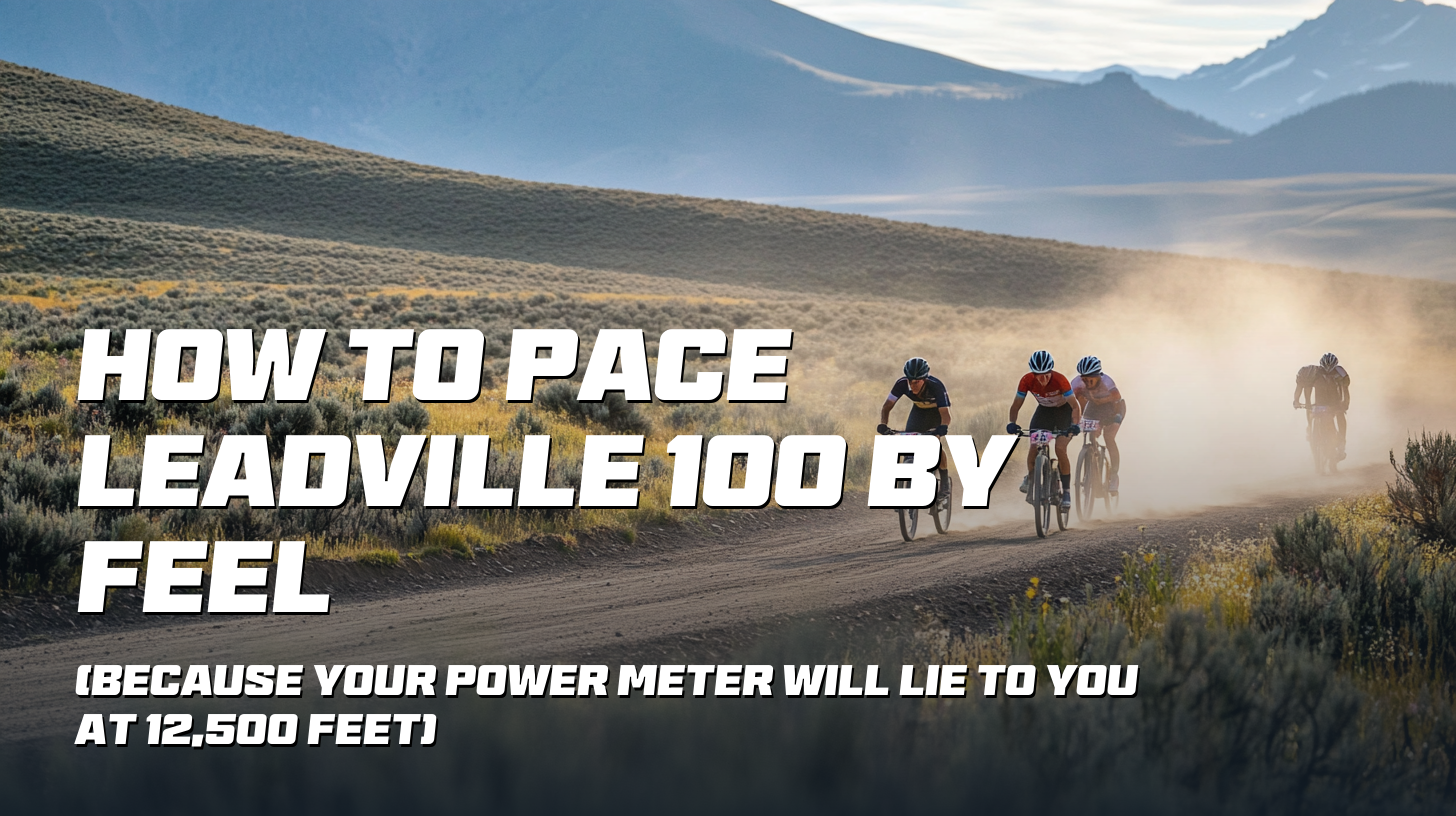
A lot of data-driven cyclists are surprised to hear this, but the Leadville Trail 100 MTB is one race where staring at your power meter will get you in trouble. At 10,000-plus feet, the altitude rocks people so hard that the numbers you trained with all season stop meaning what they used to. Your FTP isn't your FTP up here. Your zones were calibrated in a world with more oxygen in it. Chase your normal watts on the Columbine climb and you'll blow to pieces long before the turnaround, then spend the back half walking your bike home.
The athletes who have great days at Leadville almost all pace the same way: they pace by feel. That's the coaching advice we give, and after years of sending athletes to that start line, it's what works. Your power meter becomes a backup instrument, a guardrail to keep you from doing something stupid, not the thing you ride to. Here's how to do it.
What you'll learn in this tip
- Why your power meter and heart rate lie to you above 10,000 feet
- How to pace Leadville by feel, segment by segment, using RPE and the talk test
- The negative-split strategy that lets you pass riders on the long road home from Columbine
- How to fuel a 7-to-12-hour day so your stomach, not your fitness, decides your finish
- How to train your "feel" before race day and taper the final two weeks
- Why these pacing lessons carry over to any long, hard event
Respect the course profile
You can't pace what you don't understand. The essentials:
- Date: August 15, 2026
- Distance: 105.3 miles with about 12,300 feet of climbing
- Start: roughly 10,152 ft in downtown Leadville
- Lowest point: 9,180 ft, so you never drop below 9,000
- Highest point: 12,500 ft at the Columbine Mine turnaround
- The big climbs: St. Kevin's and Sugarloaf early, the infamous Powerline, Columbine to the turnaround, then Powerline again and Carter Summit on the way home
- The buckles: sub-9 hours for the Big Buckle, sub-12 hours to be an official finisher
The most important thing that profile tells you is that it's an out-and-back, and the hardest climbing comes in the second half. Powerline going out is a grind. Powerline coming back, at mile 80, after Columbine, is where Leadville dreams go to die. Ride the first half with the back half in mind.
Why your power meter betrays you up high
Every number in your training file was earned with more oxygen than Leadville gives you, and the mountain doesn't care what your flatland FTP says.
Our long-standing rule of thumb, and the research behind it, is roughly a 1% drop in power for every 1,000 feet of elevation, and it gets steeper if you haven't acclimatized. In our own altitude testing, an athlete with a 380-watt sea-level FTP dropped to about 335 watts in a high-altitude time trial. That's a 16% haircut.
The part that makes power a bad master at Leadville is that the penalty isn't a fixed number you can just program in. It shifts with the day, your acclimatization, your hydration, the heat, and how deep you already are. There's no single "altitude FTP" to pace off of.
Heart rate is just as slippery. Up high your HR ceiling drops, it runs elevated for the same effort, and it lags behind what your legs are actually doing. Pace off stale watts or a heart-rate number and you'll either ride scared and slow or, far more often, chase a number you think you should be able to hit, bury yourself, and detonate.
The one instrument that never goes out of calibration is the one between your ears. At altitude, feel matters as much as watts, and usually more.
Pace by feel: the method we coach
Pacing by feel sounds vague, but it's a real, repeatable method. You read the signals your body gives you in real time and ride to those, using your breathing as a tachometer and perceived effort (RPE on a 1 to 10 scale) as your gauge.
The golden rule for the first 60 miles: if you can't speak a short sentence, you're going too hard. Ease up.
Here's the race by feel, segment by segment:
| Segment | How it should feel | Breathing check |
|---|---|---|
| Start to St. Kevin's (first hour) | RPE 5 to 6. Almost too easy. You'll be swarmed by people going too hard, so let them go. This is where the race is lost. | Full sentences, easy. |
| Rolling sections and flats | RPE 4 to 5. Spin, draft, recover, eat and drink. This is free speed, so don't waste matches here. | Totally conversational. |
| Powerline (outbound) and rollers | RPE 6 to 7, or comfortably hard. Firm and steady, never a stab. Stay seated where you can. | Short phrases only, rhythmic, not ragged. |
| Columbine to the turnaround | RPE 7 building to survival. Settle into a breathing rhythm you could hold for an hour. When it turns into a hike-a-bike, walk it efficiently. That beats gasping to stay clipped in. | If you're panting and can't get a word out, back off now. |
| The return (miles 60 to 105) | RPE 6 to 7, then whatever's left. This is your negative-split payoff. Paced right, you'll pass people the whole way home. Watch for cramps and ease before they lock up. | Steady, controlled, back under command. |
| Powerline (return) and Carter | Empty the tank, by feel. The crux of the day. Pace the front half honestly and you ride it. If you didn't, you walk it. | All-in is finally allowed. |
A few rules that matter more than any single number:
- Ride the first third like you're being timed on the finish. The adrenaline and the crowd will beg you to surge, and discipline in the opening hour is the whole ballgame.
- Keep it smooth, not spiky. Every time you punch hard over the top of a climb at altitude, you dig a hole that takes far longer to climb out of than it would at sea level. Smooth, rhythmic efforts win.
- Negative-split the out-and-back. Your second 50 miles should feel stronger than your first, even as the fatigue builds. If you're going backwards by Twin Lakes, you started too hard.
Where the power meter still helps
Don't tape over the screen. Just change its job. Use power and heart rate as a ceiling alarm instead of a target. Set a do-not-exceed cap for the early climbs, and if you glance down and see a number above it, that's your cue to back off. Never chase a floor. Never bury yourself trying to hit a watt number your body is telling you it doesn't have today. When the meter and your feel disagree at Leadville, trust the feel.
Train your feel before race day
Pacing by feel is a skill, and like any skill you have to practice it before you're at 12,500 feet with your heart in your throat.
On some of your interval days, run the efforts without looking at the number. Learn what threshold, Sweet Spot, and endurance actually feel like in your breathing and your legs, then check the file afterward to see how close you were. Practice the talk test on climbs so you know exactly where comfortably hard tips over into too hard. Do your big training days at effort rather than at a wattage target, so race-day pacing is a rehearsed habit instead of a hopeful guess. Build this now and you'll be able to execute your plan blind, which is exactly when it matters most.
Don't let your stomach end your race
Fitness rarely ends a Leadville day. Fueling does. You're burning through a 7-to-12-hour effort, and your gut has to keep up.
Aim for 60 to 90 grams of carbohydrate per hour, and if you're experienced and gut-trained, push toward 100 or more. Practice it in training, because your gut is trainable and your long rides are as much about rehearsing fueling as building fitness. Go in with a hands-off plan for the aid stations at Twin Lakes, in both directions, so you're not losing minutes standing around or, worse, arriving empty.
The last two weeks: sharpen, don't cram
You can't add fitness in the final two weeks. You can only add fatigue or shed it. This is the highest-leverage window of your whole build, and most amateurs waste it panic training.
Taper the volume but keep a little intensity, with a few short race-effort efforts to keep your legs sharp so they don't go flat. Do your openers the day before, an easy spin with a handful of short, punchy efforts to wake the legs up. Then show up rested and calm. Freshness beats one more confidence long ride every single time.
The bottom line
Leadville rewards the disciplined, not the strong, and at altitude discipline means riding by feel. Recalibrate your expectations for the thin air. Ride the first half two gears easier than your ego wants. Let your breathing be your governor, fuel like it's a job, and show up rested. Do that and you'll pass a parade of fitter, better-funded riders on the long road home from Columbine, the ones still staring at a power number the mountain won't let them hit.
Not racing Leadville? Steal these anyway
Leadville is the extreme case, but the lessons travel to any hard, long day, whether it's a gran fondo, a gravel race, your first century, a hot road race, or a spicy group ride. Learn to pace by feel and you're never at the mercy of a device. A dead battery, a hot day, a course at altitude, or an FTP you haven't tested in months can all make your numbers lie. Riders who know what their zones feel like can pace any event, anywhere, on any day.
- Breathing is the most honest gauge you own. The talk test works at every elevation. If you can't speak a short sentence, you're over your sustainable effort, so use it on every long climb.
- The first third decides the last third. Going out one RPE point too hot always gets paid back with interest later, so ride the opening like you're being timed on the finish.
- Keep it smooth and negative-split everything. Fewer matches burned early means a stronger back half, and your best-paced ride should feel stronger at the end than at the start.
- Fuel like it's a job. Shoot for 60 to 90 grams of carbs per hour on anything over about three hours, and rehearse it, because more days end from an empty tank than from a lack of fitness.
- Freshness beats one more long ride. For any goal event, taper the volume, keep a little intensity, and show up rested.
- Your body is the one instrument that's always calibrated. Learn to read it and you'll ride smarter everywhere, whether the finish line is in Leadville or your own backyard.
Want to show up to Leadville, or your goal event, knowing exactly how to pace it? FasCat's training plans and CoachCat build the Sweet Spot fitness the day demands and teach you to know your efforts by feel, so you can execute when the numbers get weird at altitude. We'll adjust your training for elevation and taper you to peak on the right day. Start a free trial of CoachCat and train with FasCat.
Riding a smart trainer app that plays workouts but never coaches you? See our TrainerRoad alternative comparison: why cyclists switch to CoachCat for age-adjusted plans, real periodization, and every ride analyzed.
