

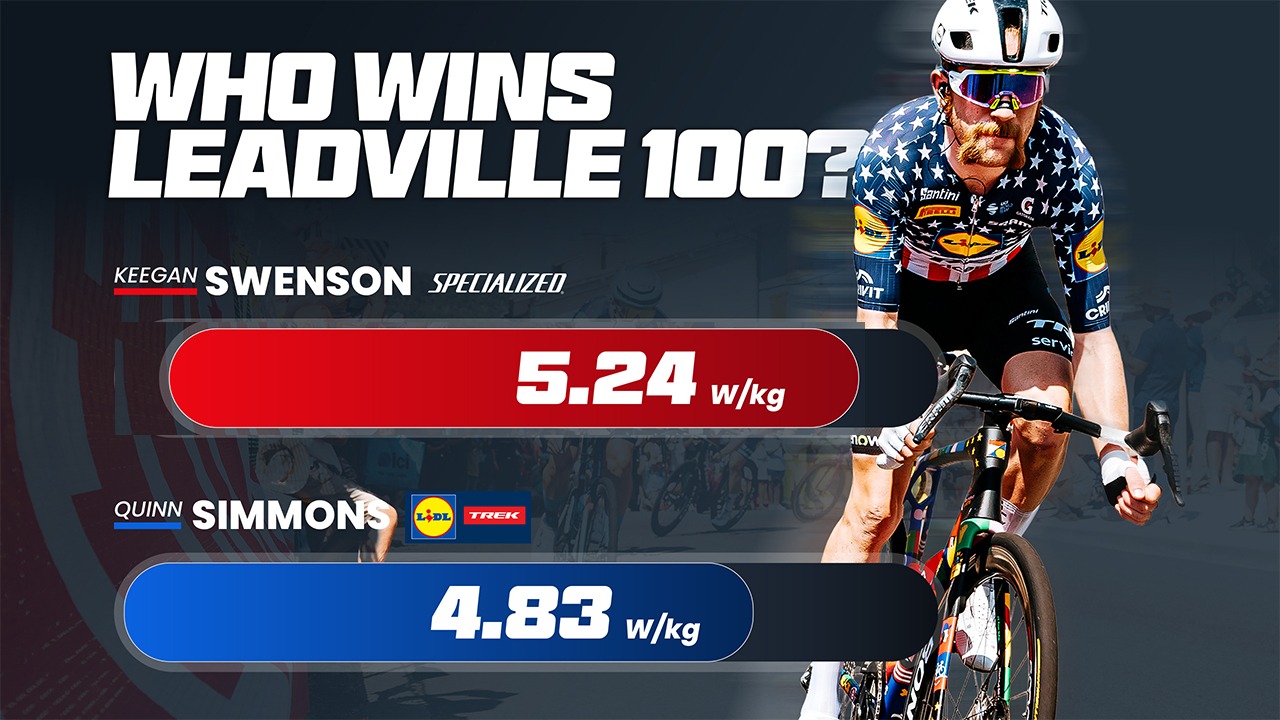
Keegan Swenson has won the Leadville Trail 100 MTB five years running. On Saturday he lines up against Quinn Simmons, who finished the Tour de France three weeks ago and last raced Leadville in 2019 as an 18 year old, when he finished second. Everybody has an opinion about that matchup. We wanted a better answer than an opinion.
So we pulled every published power number on both riders and ran them at Leadville altitude, because a sea level watt does not show up at 12,424 feet. But power files have never decided a bike race on their own. Alongside them we weighed what a coach weighs: a course that just lost 2,043 feet of climbing and the Powerline climb, who can actually descend a mountain bike and who has not raced one since June, who lives at altitude and who flew in, who has teammates and whether those teammates want him to win, and who is peaking on Saturday against who is building toward the World Championships in September. Fourteen factors in all. Here is what we found, and it is not what we expected.
This Is the Flattest Leadville Ever Raced
The Willow Fire forced a reroute. Hagerman Pass, Sugarloaf and the iconic Powerline climb are all out. Columbine survives.
| Traditional course | 2026 course | |
|---|---|---|
| Distance | 104 mi | 102.1 mi |
| Climbing | 12,000+ ft | 9,916 ft |
That is 2,043 fewer feet of climbing.
Everything Here Is at 10,000 Feet
This matters more than anything else in the analysis. Swenson's files were recorded between 10,100 and 12,424 feet, so they are already race realistic. Every number Quinn Simmons has published was recorded in Europe at sea level.
The reference for this is Bassett et al. (1999), the model built from cycling hour records, which returns the proportion of your sea level power you keep at a given altitude. The important thing about it is that it is a curve, not a straight line, and that is exactly what trips people up at Leadville.
You have probably heard the shorthand that you lose about 1% per 1,000 feet. It is a fine rule in Boulder. It falls apart in Leadville, because Bassett's curve steepens the higher you go:
| Elevation | 1% per 1,000 ft | Bassett, acclimatised |
|---|---|---|
| 5,000 ft | 95.0% | 94.5% |
| 7,500 ft | 92.5% | 89.8% |
| 10,152 ft, Leadville start line | 89.8% | 83.4% |
| 12,424 ft, top of Columbine | 87.6% | 76.7% |
At 5,000 feet the shorthand is half a point out. At the top of Columbine it is nearly eleven points out, and eleven points of power is the entire race.
One number does not cover the whole climb, and we factored that in. Air keeps thinning as you go up, so the higher you climb the less of your engine you keep. Columbine runs from Twin Lakes at about 9,200 feet to the turnaround at 12,424:
So it is not 82% the whole way up. That 82% is the average across the climb, and at the summit it is 76.7%. A rider starts Columbine keeping about 86% of his sea level power and crests it keeping about 77%. Because the effort is a single 43 minute push across that entire range, the honest figure to use is the average, which Bassett puts at 81.6% and we rounded to 82%*. Anchoring on the 76.7% summit figure instead would have overstated the penalty and made his projection look worse than the ride actually is. So we altitude adjusted Simmons' published number which is the only honest way to ask the question that actually matters: what will he make up there?
| Point on Columbine | Elevation | Bassett, acclimatised |
|---|---|---|
| Twin Lakes, bottom of the climb | 9,200 ft | 85.9% |
| Climb average | 10,812 ft | 81.6% |
| Turnaround, the top | 12,424 ft | 76.7% |
Columbine, Side by Side
Swenson's 2023 course record file is the most complete Leadville MTB power data in the sport. Here is his Columbine climb against our projection for Simmons.
Swenson | Simmons | |
|---|---|---|
| Weight | 66 kg | 73 kg |
| Power at altitude | 346 W | ~353 W |
| W/kg at altitude | 5.24 | 4.83 |
| Columbine time | 43:15 | ~46:55 |
Read that table twice, because it says something that sounds backwards. Simmons makes more watts up Columbine than Swenson does. He still loses almost four minutes.
That is the single most useful coaching lesson in this whole race. On a climb that steep it is not watts that move you up the hill, it is watts per kilogram, and Simmons is carrying seven more kilograms. Raw power is not the currency. Power to weight is.
Swenson climbed it in 45:54 at about 5.2 W/kg in 2025, so this is a repeatable number, not a one off.
And Simmons says the same thing about himself. On taking third at GP Montreal last fall, behind only Brandon McNulty and Tadej Pogacar, he put it this way:
Being there in the final of a race with 4,000 meters of elevation gain and my weight really gave me a confidence boost.
He knows exactly what his limiter is. This is not a rider who thinks he climbs with the light guys. He is a rider who is proud of hanging on despite the weight, which is the Columbine problem in one sentence, from the man himself.
The Five Hour Engine
Here is what we know for certain. Swenson can do 274 watts for five hours and forty three minutes, because that is exactly what he did winning Leadville at 10,100 feet. At 66 kg that is 4.15 W/kg. He backed it up by winning the Marathon MTB world title at roughly 5 W/kg for six hours at lower elevation. Two different races, one very consistent engine.
We know Simmons can do 300 watts for four hours, because that is his Tour de Suisse breakaway.
But that was at much lower altitude, and it was draft assisted in a rotating breakaway. He had wheels to sit on, and he was only ever doing what the break required, not what he had.
So what would Simmons do for four hours, solo, at 10,000 feet? Nobody knows. That is the honest answer, and it is the most interesting unanswered question of the matchup. He won the US Pro Road Race title in 4:43:16 with a solo attack over the last 29 kilometers, which is exactly the file we would want to see. It has never been published.
The Scorecard
Fourteen factors, sorted by how much they matter.
| # | Factor | Favors |
|---|---|---|
| DECISIVE | ||
| 1 | If it is a time trial | SWENSON |
| 2 | If it is a bike race, a lead group of 3 to 5 off Columbine | SIMMONS |
| STRONG | ||
| 3 | Columbine W/kg | SWENSON |
| 4 | The five hour engine | SWENSON |
| 5 | Descending and handling | SWENSON |
| MODERATE | ||
| 6 | 2,043 ft less climbing | SIMMONS |
| 7 | Powerline removed | SIMMONS |
| 8 | Grand Prix points dynamics | SIMMONS |
| 9 | Altitude residence | Even |
| SLIGHT | ||
| 10 | Teammates | SWENSON |
| 11 | Frontal area on the flats | SWENSON |
| EVEN / WILDCARD | ||
| 12 | Absolute watts at altitude | Even |
| 13 | Motivation | Even |
| 14 | Form timing, 20 days post Tour | Wildcard |
Can Simmons Ride Back Up to Swenson After Columbine?
This is the question everyone asks, and the answer is no. He goes backwards.
Swenson's file gives us his actual return leg number. Simmons' is projected.
| Swenson (measured) | Simmons (projected) | |
|---|---|---|
| Return leg power | 309 W | ~315 W |
| W/kg at altitude | 4.68 | 4.32 |
| Frontal area | baseline | ~6% larger |
Simmons makes about six more watts on the flats. That sounds like a chase. It is not. On flat ground speed tracks watts divided by aerodynamic drag, and Simmons is 1.83 m and 73 kg pushing a bigger hole in the air. Net his watts against his frontal area and he comes out about 1.3% slower than Swenson even with more raw power. Over the two and a half hours of rolling road home, that is not closing a four minute gap. It is losing another two minutes.
To actually close it he would need roughly 352 watts at altitude for two and a half hours, or 4.82 W/kg. His projected forty minute power is 353 watts. He would have to hold his forty minute power for two and a half hours, after five hours of racing, having just been dropped. That is not a hard ask. It is a physiological impossibility.
Solo, Simmons does not close it, and Swenson wins by five to six minutes. Which means the only way this becomes a race is tactical.
Why Simmons Is Really Here: Montreal
Here is the context that reframes everything about his form. The World Championships in Montreal, September 20 to 27, are his number one target of the season, rated above both the Tour de France and Amstel Gold. He finished third at GP Montreal last fall on the same Mount Royal circuit, behind only McNulty and Pogacar, and he has been open about what he wants:
It's been since Lance Armstrong. Hopefully, I'll be the one it's all about at the end of September.
The Worlds course is 273.7 km with 3,803 m of climbing over twelve laps. Long, attritional and punchy. That is his course.
So what is he doing at Leadville? He has raced nothing since the Tour ended around July 26. He went straight home to Colorado, where he lives at 2,000 m, and long altitude blocks are a core part of his program rather than an occasional thing. Leadville is his first race back.
That matters two ways. Leadville is not his peak, it is a stimulus, six weeks out from the goal, so he is in a build and not a taper. A seven hour effort at 10,000 feet is close to ideal Worlds preparation if he recovers from it well. But it is also a serious load to take on that close to your season's biggest day, and that cuts both directions.
The practical read: his post Grand Tour form is being deliberately managed toward late September rather than gambled on. That makes him more dangerous on Saturday than a rider simply showing up tired. It also means he is not going to throw his season away to win a mountain bike race.
Motivation: Even
Worth saying out loud, because it is the factor people assume is lopsided and it is not.
Swenson has plenty on the line. A five year streak, the Grand Prix lead he is tied for. Specialized signed him to a super team partly for days like this. He is not sleepwalking into Saturday.
But Simmons is just as motivated, only pointed at two things at once. He was second here in 2019 as an 18 year old and never came back, so there is real unfinished business. And Montreal being six weeks out cuts both ways. It raises his motivation, because a hard seven hour day at altitude is exactly the stimulus he wants before Worlds. It also caps it, because he is not going to bury himself deep enough to win a mountain bike race that he compromises the biggest target of his season.
That is why it nets out even. Swenson wants this particular win more in isolation. Simmons arrives with more total motivation in his season, just spread across two goals instead of one. Swenson is racing for the streak. Simmons is racing for September. Both of those get you a rider who turns up ready.
The Scenario: Does Matt Beers Sit On, or Does He Work?
Picture it. The pack stays together to Twin Lakes. Columbine splits it. Swenson tops out three and a half to four minutes clear with 52 miles of rolling road left. Simmons starts chasing.
If Beers sits on, it gets worse for Simmons, not better. The chase group moves at Simmons' solo speed, because he is the only one pulling. Beers rides the wheel at around 230 watts and saves 25 to 30%. Simmons gets no benefit from the company at all, and when they hit St. Kevin's and the Boulevard, Beers is fresh and Simmons is cooked. He could get dropped by the rider he towed for two hours.
If Beers works, it closes. A committed rotation is worth roughly 2 to 3% in speed. The threshold to erase three and a half minutes over 150 minutes is 2.3%. It lands right on the number. Barely, but it closes.
So will he?
Here is the thing. Matt Beers and Keegan Swenson are teammates on Specialized Off-Road, and they are tied for first in Life Time Grand Prix points. Quinn Simmons is not in the series at all.
If Swenson solos away, Beers' championship rival takes the biggest points haul of the season. If Simmons wins, it costs Beers nothing and buries Swenson. The team jersey says protect Keegan. The standings say chase him.
And Swenson has nobody else. Mads Wurtz Schmidt, the one teammate carrying a real debt after Swenson sacrificed his own Unbound to deliver him that win, is not on the start list.
Our Pick: Swenson by 2 to 4 Minutes
Five straight wins, one loss at altitude since 2022, and thirteen minutes of free time on the Columbine descent at 30 mph. The math backs the streak.
But Simmons has a real path now, and it is specific rather than hopeful: survive Columbine inside four minutes, use the flatter second half and the fact that nobody in the Grand Prix wants to chase him, and detonate one move in the last hour. Leadville has been a time trial for five straight years because Columbine and Powerline let Swenson ride away. Take Powerline out and it might finally be a bike race, and that phrase means something specific: a lead group of three to five riders cresting Columbine together and racing the return leg as a pack. Pack dynamics change everything. Nobody has to ride alone into the wind, the pace goes elastic instead of steady, and the race stops being decided by who holds the highest five hour power and starts being decided by who reads the moves and has something left for the last one. That is Simmons' world, not Swenson's.
One genuine unknown remains, and it is not his form. It is mountain bike specificity. He has had almost no time on a mountain bike since June, and Leadville punishes that on the Columbine descent, where Swenson takes thirteen minutes of free time at 30 mph.
The Women's Race Is Wider Open
Kate Courtney set the course record last year and signed with FDJ United-SUEZ in July to focus on the road. She is not starting, which leaves the top step genuinely open.
| Sofia Gomez Villafane | Melisa Rollins | |
|---|---|---|
| Grand Prix standing | Leads | Last of 25 |
| Leadville history | Won 2023, 4th in 2025 | Won 2024, 2nd in 2025 |
| Races since March | Full season | Two |
Rollins is the sentimental favorite and she moved to Leadville in early August to acclimate. Her season has been wrecked though: an elbow break and surgery before Cape Epic, then a partially torn triceps, then getting sideswiped by a car. Do not read her last place series standing as form. She is last because she did not start, not because she got beaten, and she won the US cross country marathon title in July.
But a marathon title is a three to four hour race and Leadville is seven. Durability comes from accumulated volume, not from a peak. Her risk is not hours one through four. It is hours five through seven, which is exactly where a season with two race starts shows up, and exactly where Leadville is decided.
Gomez Villafane is a three time series champion who leads the standings and will be racing to win, because that is what she is paid to do. What makes her especially dangerous here is that she pairs that intent with the highest floor in the field. On a start line where the other favorites carry real downside risk, the rider who simply does not have a bad day is very hard to beat over seven hours.
The Altitude Lesson Hiding in All of This
Two of Saturday's contenders got their altitude timing right. The science says most amateurs do not.
Ventilatory adaptation starts within days, but meaningful blood adaptations take two to four weeks. And critically, days three through seven at altitude are actually worse than day one: disrupted sleep, elevated resting heart rate, suppressed power. The guidance that follows is to arrive either under 48 hours out, before the acute effects peak, or three plus weeks out, fully adapted. The window in between is the worst place to be.
| Rider | Arrival | Where that lands |
|---|---|---|
| Rollins | Early August, about 2 weeks | Approaching adapted |
| Simmons | About 2.5 weeks post Tour | Approaching adapted |
Both of them land in the good window, which is not an accident. If you have an altitude race on your calendar, that timing is worth more to you than any of the watts above it. Get the timing right, and altitude adjust your expectations with Bassett before you pin a number on the day. At Leadville that is roughly 82% of your sea level power, not the 90% the usual shorthand suggests.
One last caveat on the records. With 2,000 fewer feet of climbing, times should come down across the board this year. If somebody breaks the course record on Saturday, it will not mean what a course record normally means.
Want to get your own pacing right? Start with how to pace Leadville by feel and our Leadville 100 MTB training guide.
Good Luck Out There
However Saturday shakes out, it is going to be a great one to follow. Good luck to Keegan and Quinn, to Melisa and Sofia, and to everybody else rolling down Sixth Street at six in the morning.
A special good luck to every FasCat athlete on that start line. When the gun goes, remember that the work is already done. The confidence to toe that line was earned months ago, in the intervals nobody watched and the mornings nobody clapped for. You do not have to find it on Saturday. You just have to go collect it.
Race founder Ken Chlouber was a shift boss at the Climax mine before he was a race director, and he left this town the only two words that matter above 10,000 feet. Dig deep.
And a thank you to CoachCat athlete Jered Gruber for the photo at the top of this piece. Good luck with the FtFP’ing, Jered.
* Altitude adjustment from Bassett DR Jr, Kyle CR, Passfield L, Broker JP, Burke ER. "Comparing cycling world hour records, 1967 to 1996: modeling with empirical data." Medicine & Science in Sports & Exercise, 1999;31(11):1665 to 1676. We used the altitude acclimatised curve, which returns the proportion of sea level power retained at a given elevation, evaluated at the mean elevation of the Columbine climb.
