

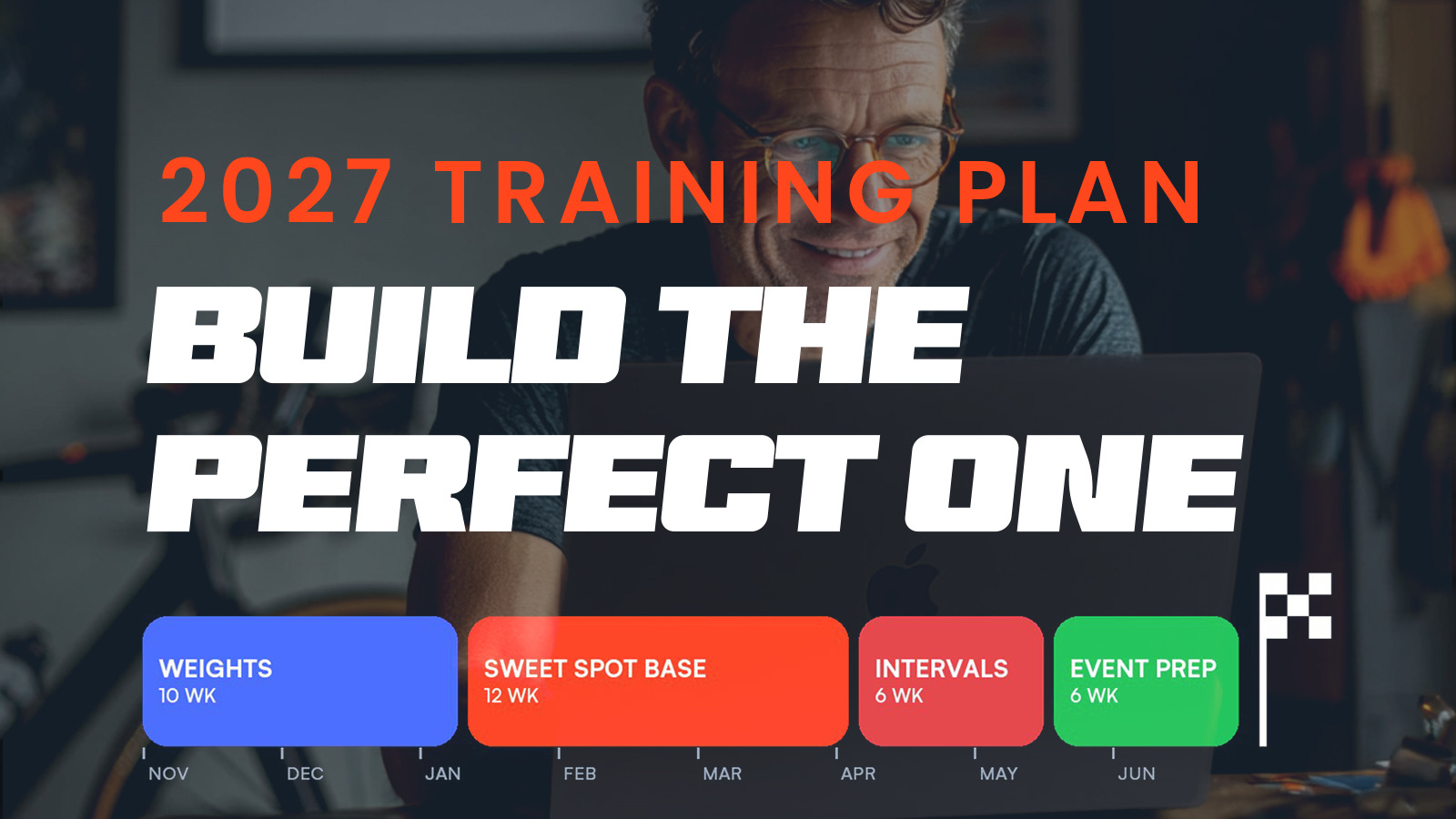
Most cyclists plan their season in the wrong direction. They sign up for a race, then start riding hard and hope the fitness shows up on the right weekend. The FasCat way is the opposite: pick the race first, then work backward from race day through the phases that get you there, in order, with enough weeks in each one. That is the whole secret of a training calendar, and it is exactly what the CoachCat custom plan builder does for you in five questions.
Pick Your Event, See Your Plan
Pick your 2027 A race from the table (or add your own) and we will show you the custom training plan CoachCat would build for it: the phases, the FasCat plans behind each one, and the dates, using the same rules as the plan builder in the CoachCat app. The result shows the plan with weights and with climbing intervals where the course calls for them. Flip the strength and climbing options in the result to see what replaces them. The weeks away column counts from the Monday CoachCat would start your plan, so the result is built for the day you are reading this.
| Event | Type | 2027 date | Weeks away | Your plan |
|---|---|---|---|---|
| FasCat Girona Gravel Camp | Trip | Tue Feb 16, 2027 | 20 | |
| The Mid South | Gravel | Sat Mar 13, 2027 | 23 | |
| Levi's GranFondo | Fondo | Sat Apr 24, 2027 | 29 | |
| Belgian Waffle Ride California | Gravel | Sun Apr 25, 2027 expected | 29 | |
| The Traka 200 | Gravel | Sat May 1, 2027 | 30 | |
| GFNY New York City | Fondo | Sun May 16, 2027 expected | 32 | |
| Unbound Gravel 200 | Gravel | Sat Jun 5, 2027 | 35 | |
| SBT GRVL | Gravel | Sun Jun 27, 2027 | 38 | |
| Crusher in the Tushar | MTB | Sat Jul 10, 2027 expected | 40 | |
| Triple Bypass | Fondo | Sat Jul 10, 2027 expected | 40 | |
| Dust Bowl 100 | Gravel | Sat Jul 24, 2027 expected | 42 | |
| Leadville Trail 100 MTB | MTB | Sat Aug 14, 2027 | 45 | |
| Breck Epic | MTB | Sun Aug 15, 2027 | 45 | |
| Gravel Worlds (Nebraska) | Gravel | Sat Aug 21, 2027 | 46 | |
| Mammoth Gran Fondo | Fondo | Sat Sep 11, 2027 expected | 49 | |
| Big Sugar Gravel | Gravel | Sat Oct 16, 2027 expected | 54 | |
| Iceman Cometh Challenge | MTB | Sat Nov 6, 2027 expected | 57 | |
Dates marked "expected" have not been announced by the organizer yet and are projected from the usual weekend. Weeks away are counted from the Monday CoachCat would start your plan: this week if today is Monday or Tuesday, otherwise next Monday.
This is a model of what the plan builder does. The real thing in the CoachCat app also asks your fitness level, your weekly hours and the days you cannot train, then schedules every workout and keeps coaching you through the plan in chat.
 Live this Friday
Join us live: how to build your perfect training plan
Friday, October 16 at 2:00 PM EST. Pick your 2027 event and work backward from the big day.
Watch live on YouTube →
Live this Friday
Join us live: how to build your perfect training plan
Friday, October 16 at 2:00 PM EST. Pick your 2027 event and work backward from the big day.
Watch live on YouTube →
This tip walks through how we set up a 2027 calendar for the athletes we coach: how many A races to pick, how to fill in B and C races, how to set goals, and how to lay the four FasCat training phases (weights, sweet spot base, intervals and event-specific training) onto the weeks you actually have. The tool above shows you the result. The rest of this post explains the thinking behind it so you can set up the whole season, B and C races included.
What you'll learn
- How many A races to target in 2027, how far apart to space them, and where the mid-season break goes
- The 2027 dates for the most popular gravel, gran fondo and mountain bike events, plus a cycling trip, and when each plan needs to start
- The four phases we use to build every FasCat athlete's year, how long each one is, and why the order matters
- How the CoachCat custom plan builder turns five answers into a periodized plan timed to your event
- How the Pick Your Event, See Your Plan tool decides which phases and FasCat plans you get, and when to turn climbing intervals or lifting on or off
- The calendar mistakes we see every year and how to avoid them
Step 1: Pick your A races first
An A race is the event you want to be at your absolute best for. Everything on the calendar is arranged around it. Our rule of thumb for 2027:
- Two or three A races per season. One is fine. Four is a stretch unless they are close together, like a block of races on back to back weekends.
- Eight or more weeks apart if you want to peak for each one separately. Closer than that and you are really peaking once and holding it, which works for a 2 to 3 week block but not for a June race and a July race.
- Take a mid-season break if your A races span spring and fall. One to two easy weeks after your first peak, then a short base block, then build again. The athletes who skip the break are the ones who are flat in September.
How to choose the right A race
Before you commit to an A race, run it through the same checklist our coaches use in a first consultation. Start with the gut check: does the event look fun and inspiring? You are going to spend six months thinking about it, so pick a race you will be excited to train for in February. Then the practical questions:
- Is the cost feasible? Add up the entry fee, travel, lodging, food and the time off work. Unbound with a lottery entry, four nights in Emporia and a flight is a very different commitment than a gravel race two hours up the road.
- How will you get there, and does that work for you? A race you can drive to means you can bring your own bike, your own food and your own schedule. A race that needs a plane means a bike box, a rental car and a day of travel on each end. Both are fine. Just make sure the logistics are something you will actually follow through on.
- Does the course suit your strengths? If it has a lot of climbing, be honest about whether you are a climber or are willing to become one. Leadville, SBT GRVL and Levi's GranFondo reward power to weight. Mid South, Unbound and Gravel Worlds are relatively flat and reward a big diesel engine and durability. Pick the course that plays to what you have, or pick the one that motivates you to build what you do not have, but know which one you are doing.
- What time of year is it? An early season race like Mid South in March or Levi's in April means your build happens over the winter, which for most athletes means a lot of hours indoors on the trainer. A late season race like Gravel Worlds, Big Sugar or Iceman lets you do most of the hard training outdoors in warm weather, and it gives you a cushion over the winter to ski, cross train and keep the off-season fun. Neither is wrong. Match the race to how you want your winter to look.
The 2027 dates for the events our athletes ask about most are in the Pick Your Event, See Your Plan tool at the top of this post, with the weeks you have left for each one.
Notice that the spring gravel races and the Girona camp are already inside a full build. If Mid South or Levi's GranFondo is your A race, your off-season is now. If it is Leadville or Gravel Worlds, you have the luxury of the full 30 week weights and sweet spot base before the intervals start in the spring.
Step 2: Fill in your B and C races
B races are events you take seriously but do not taper for. Ride them hard, learn something, and go right back to training on Monday. C races are training days with a number on: group rides, local crits, a gravel grinder you do with friends. The point of a C race is the training stimulus and the practice, not the result.
- Put one or two B races 3 to 6 weeks before each A race. That is when your event-specific phase is running, and a race effort is the best simulation ride there is.
- Use C races to practice the things you cannot practice alone: pacing in a group, fueling at race intensity, starts, descending, cornering, equipment.
- Keep B and C races similar to your A race. A criterium is a poor rehearsal for Unbound. A 3 hour gravel race or a hard 5 hour group ride is a great one.
Step 3: Set a goal for every race on the calendar
A race without a goal is just a hard ride. The goals that work are the ones you control:
- Process goals beat outcome goals. "Eat 90 grams of carbs an hour and never surge over threshold in the first 3 hours" is a goal you can execute. "Top 10" depends on who shows up.
- Power goals beat time goals. Your average power for 5 hours is yours. Your finishing time belongs to the wind, the heat, the altitude and the course changes. We have seen too many athletes ride a personal best wattage and feel bad about a slower time.
- A race goals should account for the specifics: altitude for Leadville and SBT GRVL, heat for Unbound, the climbing for Levi's or Mammoth. Write them down in CoachCat and it will hold you to them.
- B and C race goals are the skills you are rehearsing. Nail the start. Stay in the front group through the first selection. Hit your fueling numbers.
- Season goals sit above all of it: an upgrade, a finisher's buckle, a personal best at a race you have done before, keeping up with your group on the Saturday ride. Every race goal should point at the season goal.
Step 4: Work backward from race day through the four phases
This is the part that turns a race calendar into a training calendar. Behind the CoachCat plan builder are more than 100 FasCat training plans that act as phases of your year. For almost every athlete and every event, the phases line up in the same order, and only the lengths change:
 Phase 1 · 10 weeks
Weights
Off-season strength: hypertrophy, strength and power blocks that raise your sprint, your muscle tension work and your durability for the whole year. Ride in Zone 2 and sweet spot around the lifting. Can't lift? Sweet spot base takes its place and muscle tension intervals become your strength work.
Weight lifting for cycling Phase 2 · 12 to 18 weeks
Sweet Spot Base
The aerobic engine. Sweet Spot Parts 1, 2 and 3 progress from 2x15 minute efforts to 2 hours of sweet spot in a 4 hour ride. This is where your FTP goes up.
The complete guide to sweet spot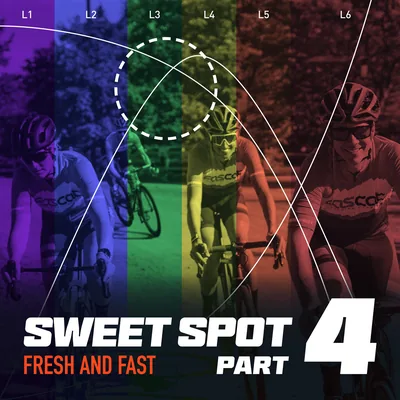 Phase 3 · 6 weeks
Intervals
Threshold, VO2 max and climbing intervals that sharpen the base into race power. Which intervals depends on your event: climbing intervals for the mountains, anaerobic work for XC and cyclocross.
Interval training plans Phase 4 · 6 weeks
Event-Specific
Simulation rides, race-specific power, fueling practice and a taper built for the demands of your course: Unbound, Leadville, SBT GRVL, a gran fondo, a stage race or your trip.
Event-specific plansAdd it up and the full build is about 34 weeks: 10 weeks of weights, 12 to 16 weeks of base, 6 weeks of intervals and a 6 week event plan. With 26 or more weeks before your intervals, the weights and the base are one plan, the 30 Week Weights + Sweet Spot Base. Most athletes do not have 34 weeks, and that is fine. The phases compress in a predictable order:
- Protect the event-specific phase. Six weeks of training for the actual demands of the course is non-negotiable. The taper lives inside it.
- Then the intervals. Six weeks is ideal. Three is the minimum to get a response.
- Base takes whatever is left, and more base is never wasted. If you have 20 weeks to Unbound, that is 8 weeks of sweet spot, not 8 weeks of intervals.
- Weights need 16 weeks of lead-up. The 10 week weight lifting plan plus at least 6 weeks of sweet spot before your intervals and event plan. With less than that, CoachCat skips the lifting block and adds strength maintenance workouts to each week.
- Phase lengths flex to your date. Race dates rarely land on a multiple of 6 weeks. Each sweet spot part is 6 weeks at most, so the plan picker fills the gap with a week or two of the next part (Part 2, then a week of Part 3) rather than leaving a hole in the calendar.
- Climbing intervals are a choice, and the course decides it. If your event has climbs longer than 8 minutes, a 6 week Climbing Intervals block goes in right before the event plan. If it does not, like GFNY New York City or Unbound, the intervals come from the discipline's own plan: road intervals for a flat fondo, the gravel plan's intervals for flat gravel, XC intervals for mountain bike. The tool presets this per event and lets you flip it.
- Can't lift because of a knee, a back or an injury? Pick that option and CoachCat puts 16 Weeks of Sweet Spot base in place of the weights block and moves your strength work onto the bike with muscle tension intervals.
Example: Unbound Gravel 200, June 5, 2027
Counting back from the first Saturday in June, a full build starts in early October. The 30 Week Weights + Sweet Spot Base carries you from October through the holidays and into late April, then the Unbound plan takes over with simulation rides, 5 hour power and the taper. B races: Mid South in March as a long simulation, and a local gravel race in early May.
Example: a cycling trip, the Girona Gravel Camp, February 16 to 21, 2027
A trip is an A event with a different shape. You are not peaking for one 6 hour effort. You need to ride five days in a row, so CoachCat coaches it like a group ride goal: base and durability first, then climbing intervals because Girona has climbing, and no single event plan. From early October to mid February is 20 weeks, inside the 22 week window where the app skips the lifting block: 14 weeks of 16 Weeks of Sweet Spot, then 6 weeks of Climbing Intervals for Rocacorba and the Traka sectors. Then you fly to Girona ready to ride, and you fly home with the rest of your 2027 plan built with Frank during camp week.
Step 5: Pick your event and see your plan
Everything above is what a FasCat coach does with a new athlete in the first consultation, and it is exactly what the Pick Your Event, See Your Plan tool at the top of this post does for you. Scroll back up, pick your 2027 A race from the table or add your own, and it lays out the four phases, the FasCat plans behind each one, and the dates, working backward from race day with the same rules as the plan builder in the app.
Pick Your Event, See Your Plan ↑
Like what you see? The custom plan builder in CoachCat asks the same five questions, your hours, your event, your race date, strength training, and your week, then stitches the right FasCat plans together as the phases of your year, dated to the day, with your rest days where you need them. Change your race, your hours or your schedule later and it rebuilds. The full walkthrough is in Build a custom cycling training plan in 5 questions.
The calendar mistakes we see every year
- Too many races. Racing every weekend from March to October means you are never training, only recovering and racing. Pick your A races and let some weekends be training weekends.
- Too few races. One A race with nothing before it means your first race effort of the year is the one that counts. Put a B race 3 to 6 weeks out.
- Races that are too different. A crit series and a 200 mile gravel race in the same month pull your training in two directions. Pick a lane for each block of the season.
- Poor spacing. Two A races 4 weeks apart is one peak, not two. Either race the second one as a B, or space them 8 or more weeks apart with a short base block in between.
- Crushing yourself over the winter. Intervals in December for a June race means you peak in March and fade in May. Winter is for weights and base.
- Obsessing over watts per kilo. Power to weight matters on the climbs, but a diet in base season costs you the training that raises the numerator. Fuel the work. Eat for the ride you are doing.
- Buying speed instead of building it. Upgrade the training before the equipment. The engine is the cheapest upgrade there is.
Why CoachCat knows this and ChatGPT doesn't
Ask a general chatbot to plan your season and you get an average of every training article on the internet: a tidy base, build, peak outline with made up week counts and nothing behind it. Nobody who has done your race wrote it.
Every phase in a CoachCat plan is a FasCat training plan, written by a coach who has raced the event or coached athletes to the podium there. That is not just a schedule of weeks. It is coaching advice built into the plans and the workouts you do. The Unbound plan has course-specific simulation rides: long, hot, flat, and fueled the way Unbound demands. The Leadville plan trains the sustained climbing power that Columbine and Powerline require, at the durations those climbs take. The SBT GRVL plan builds the repeated climbs at altitude. Each one rehearses the power demands of that course, not generic "hard efforts."
Here is what that looks like in practice. If your A race has an 8 minute hill that decides the selection, your CoachCat plan includes workouts to raise your 8 minute power: climbing intervals at the right intensity and duration, scheduled after rest days so you can actually hit the numbers. If it is a 200 mile gravel race, the plan trains 5 hour power and fueling at race intensity. If it is a stage race, it trains back to back hard days. The workouts match the event because a coach who knows the event designed them.
Then CoachCat adds what no plan on a shelf can: it knows you. Your power data, your hours, your days off, your age, your goals, and how your body responded to the last block. That is why it can tell you that your Unbound build starts in October, that your Girona prep should trade intervals for base, and that your FTP is up 12 watts so the next phase gets harder. A chatbot can write a calendar. CoachCat coaches one, with the race-specific workouts to back it up.
The bottom line
Pick your 2027 A races now. Fill in B and C races that look like them. Write a goal for every one. Then count back from race day: six weeks of event-specific training, six weeks of intervals, as much sweet spot base as you have left, and weights before all of it if you have the time. Or answer five questions in CoachCat and let it do the counting.
Copy this into CoachCat
Build me a custom training plan for my A race, [event name] on [date]. I can train [hours] hours a week, I want the 10 week lifting plan this off-season, and my long ride day is [Saturday or Sunday]. Then help me pick two B races 3 to 6 weeks before it.Build your 2027 plan in CoachCat
