

VO2 max intervals are the single fastest way to raise your FTP and power output in cycling. Do them in Zone 5, above your FTP, in efforts of 3 to 5 minutes, holding a steady, repeatable power and recovering fully between reps. Our two go-to sessions are the 4-minute VO2's (2 sets of 4 x 4 min at 106 to 130% FTP) and the classic 5 x 5 Hickson/Holloszy (5 x 5 min at 105 to 125% FTP). Paste either CoachCat prompt below and the app builds the workout to your exact FTP and tells you how to pace it.
Key Takeaways
- VO2 max intervals raise your FTP and power output faster than any other session in cycling.
- Work in Zone 5, above FTP, in 3 to 5 minute efforts. Consistency and pacing matter more than going all out.
- Pace it: go as hard as you can hold for every rep, not as hard as you can for the first one.
- Use a power meter. Heart rate lags your effort and makes most riders start too hard and blow up.
- How many intervals? It depends on your age. Masters riders scale the reps and sets per decade. See our Masters Intervals video below.
- Copy our CoachCat prompts below to get the exact watts, scaled to your FTP, LEVEL and OTS.
When I bought my first power meter in 2001, I quickly discovered that intervals are more effectively executed using power rather than heart rate. In this training tip, I will explain how to perform VO2 Max intervals with a power meter, "The Right Way". Utilizing a power meter for intervals provides significantly greater benefits compared to relying on heart rate or perceived effort.
Listen to our podcast about performing VO2 Max Intervals "The Right Way" with your Powermeter 👇
But first, if there is one single thing you can do to become faster, it's VO2 max intervals. With power data, it is possible to evaluate an athlete's interval 'technique' and show them visually how to perform intervals with a power meter. Even if you don't have a power meter the graphical analysis below will help you conduct your intervals the "RIGHT WAY" by “feel”.
What VO2 Max Intervals Are and Why They Work
VO2 max is the ceiling on how much oxygen your body can take in and use to make power. Intervals in Zone 5, just above your FTP, are the most efficient way to push that ceiling higher. The effort forces your heart, lungs, and muscles to move and use more oxygen than they are used to, and over a block of weeks that ceiling rises. A higher ceiling means more power at every duration below it, which is why VO2 work pays off across the board.
The science here is old and settled. The classic reference is the Hickson and Holloszy endurance research out of Washington University, where repeated 5-minute efforts near VO2 max drove a steady, almost linear rise in aerobic power. Dr. Andy Coggan, who co-developed the power-based training model most of us use today, went deep on the why with us on our podcast: Sweet Spot Training with Dr. Andy Coggan. The takeaway is simple: short, hard, repeatable efforts at the right intensity drive the adaptation, not heroics.
The Workouts: Copy These Into CoachCat
Here are the two VO2 max sessions we prescribe most. Paste either prompt into CoachCat and it builds the workout to your FTP, current LEVEL, and OTS, then tells you how to pace it. No math, no guessing at watts.
1. The 4-Minute VO2's
What that workout looks like (4 x 4 min Zone 5 at 106-130% FTP, in 2 sets):
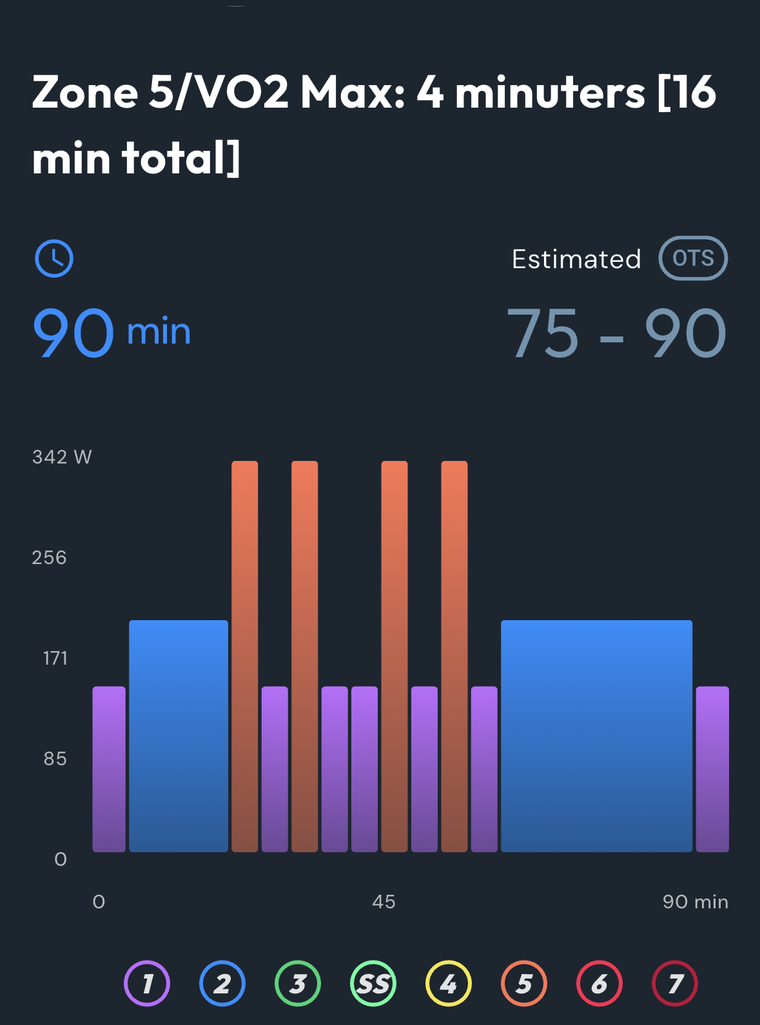
Workout steps
- 5 min warm-up
- 15 min Zone 2 at 65 to 75% FTP
- Set 1: 4 min VO2 at 106 to 130% / 4 min easy / 4 min VO2 at 106 to 130% / 4 min easy
- 4 min set break easy (8 min total easy between sets)
- Set 2: 4 min VO2 at 106 to 130% / 4 min easy / 4 min VO2 at 106 to 130% / 4 min easy
- 29 min Zone 2 at 65 to 75% FTP
- 5 min cool-down
2. The 5 x 5 Hickson/Holloszy Classic
What that workout looks like (5 x 5 min Zone 5 at 105-125% FTP):
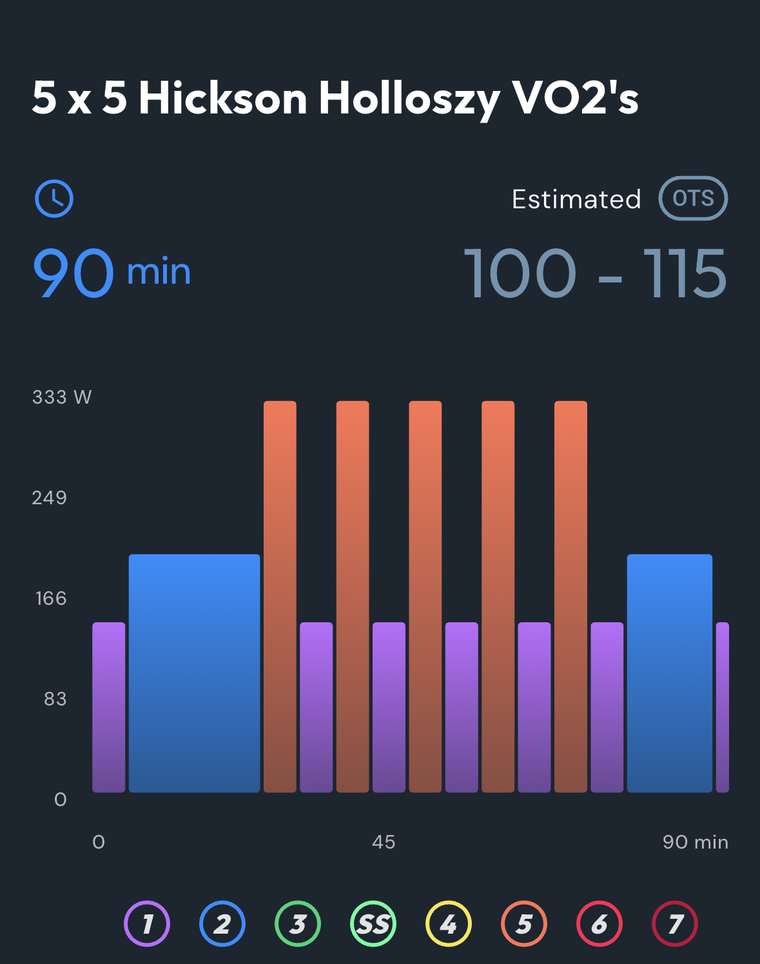
Workout steps
- 5 min warm-up
- 20 min Zone 2 at 65 to 75% FTP
- 5 x (5 min VO2 at 105 to 125% + 5 min easy at 45 to 55%)
- 13 min Zone 2 at 65 to 75% FTP
- 2 min cool-down
How many intervals should you do? It depends on your age.
Your decade of life changes how many VO2 efforts and sets you can absorb and recover from. We made an age-appropriate guide so masters riders pick the right dose instead of copying what a 25-year-old pro does. Watch it before you set your interval count.
Watch: Masters VO2 Intervals by AgeThe Right Way:
In the graph below, one can see power, heart rate and elevation data. This is the "RIGHT WAY" to perform intervals with a power meter: consistent steady power output. Notice how the last interval (av 414 watts) is close to the first interval (av 445 watts). We call that proper interval pacing not only during the one interval but for all 4 intervals in the set.
During the interval, use the real time power data to adjust your effort based on your power readout and the prescribed wattage ranges. We like to say, "Not too hard, not too easy, just right like Goldilocks. A steady effort produces a nice consistent power output over the course of the interval as shown above. The bottom line is to go as hard as you can but gauge your effort so that you can finish the interval with as much effort or power as you started the interval. If you can do this your power output will look like the graph above and you are well on your way to improving and maybe winning some races.
The Wrong Way:
Starting off too hard at the beginning of an interval is a common mistake especially for cyclists going off of heart rate alone. Notice how these intervals below start with a huge surge above the prescribed ranges followed by a drop in power below the prescribed range for the remainder of the interval. In other words the athlete “blew up” chasing a heart rate zone and exceeding the prescribed wattage range. Don’t make the mistake of going as hard as you can in order to get your HR up as soon as possible. Heart rate lags behind your power output and in the case of these intervals is not a true indicator of what’s going on.

Use the upper end of your wattage zones to not go too hard and use the lower end to stay above and not go too easy. The Zone 5 VO2 Max range shown here is 306 - 362 watts.
Therefore, when doing VO2 Max intervals, use the real time power readout to not exceed 362 watts (too hard) and to hold the effort above 306 watts.
There are two reasons why you want a consistent power output for your intervals: First, there will be less pain and suffering! Second, by pacing yourself you'll actually be able to perform more intervals at the prescribed wattage.
In the "WRONG WAY" graph above the athlete's average power for the first interval is too high/above his prescribed zone and then because it was too hard, the athlete really starts to suffer and limps thru the next 3 intervals with the last one below the prescribed wattage. Thus the physiological adaptation is not achieved. From a sports psych perspective this 'performance' is discouraging for athletes. So the athlete went out too hard, underperformed, and limped home discouraged. Not optimal.
In the "RIGHT WAY" graph, the athlete paced himself properly and all four intervals were between the prescribed wattage zone. Plus there was less suffering and a feeling of accomplishment. By RPE the first interval wasn't 'that bad', the second wasn't either, the 3rd interval really 'hurt' (but the wattage was there) and the fourth interval was not only extremely hard but the athlete's power dropped off ~ 30 watts. That's a well paced and executed interval workout in my opinion and experience.
Here’s our motto of interval training:
Go as hard as you can BUT only as hard as you can maintain for the duration of your entire interval workout.
You’ll be able to do more intervals, recover in-between each, and start to see a big difference in your training, racing, and cycling performance.
For a step-by-step guide to performing intervals please read our training tip here.
When Not to Do VO2 Max Intervals
VO2 work is potent, which means it is easy to overdo. Skip or postpone these sessions when:
- You have not built an aerobic base yet. VO2 intervals sit on top of base fitness, not in place of it. Build it first with sweet spot training.
- You are under-recovered, sick, or sleep-deprived. A flat VO2 session just digs a hole you have to climb out of.
- It is deep in your off-season. Save the bulk of your VO2 work for the 4 to 8 weeks before your event.
VO2 max intervals are not a year round workout. We like to prescribe them as key workouts, once a week for 3 weeks in a row, starting with 3 minuters the first week, 4 minuters the next, and 5 minuters the 3rd and final week. We call it the 3 → 4 → 5 minute VO2 Max Progression. They work best as part of a well thought out training plan like the ones in the CoachCat app, which sequences your base, build, and peak and tells you when you are recovered enough to do them and when to back off.
Copy the 3 → 4 → 5 Progression Into CoachCat
How the progression builds (one key VO2 session per week, intervals growing 3 → 4 → 5 min):
VO2 Max Intervals FAQ
What power should I target for VO2 max intervals?
How hard should I go on a VO2 max interval?
Should I use power or heart rate for VO2 max intervals?
What is the most common mistake with VO2 max intervals?
How many VO2 max intervals should I do?
Can I do VO2 max intervals without a power meter?
How long should each VO2 max interval be?
What is the Hickson/Holloszy 5 x 5 VO2 workout?
Try the FasCat App for Free for 1 week and perform your VO2 max intervals "The Right Way". We'll build you a custom training plan and CoachCat will guide you along with unlimited, instant training plan revisions and data analysis.
